Dipodomys venustus venustus
Santa Cruz Kangaroo Rat
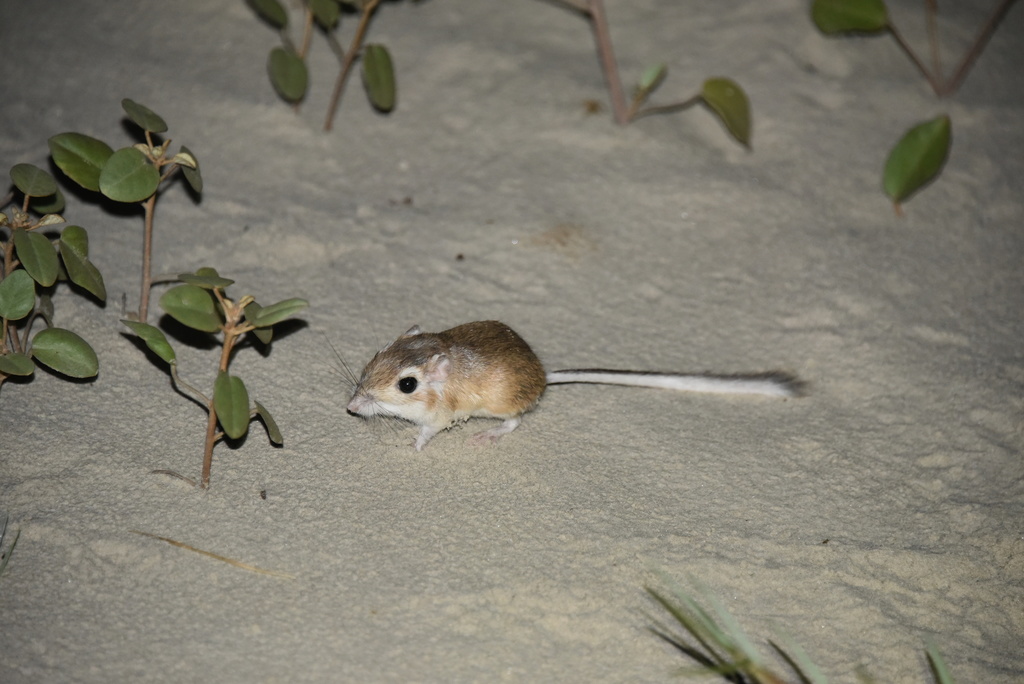
(c) Cody Stricker, some rights reserved (CC BY) · licence
Family: Heteromyidae · Class: Mammalia · Order: Rodentia
Conservation status: G4T1 S1
Dipodomys venustus venustus (Santa Cruz Kangaroo Rat) is a California animal in the Heteromyidae family.
The Santa Cruz kangaroo rat (Dipodomys venustus venustus) is a medium-sized heteromyid rodent endemic to a small portion of the central California coast. Adults typically measure 240-320 mm (9.4-12.6 inches) in total length, with the tail comprising approximately 60% of total body length. The species exhibits the characteristic kangaroo rat morphology with enlarged hind limbs adapted for saltatory locomotion, a long tufted tail, and large eyes. The dorsal pelage is buff to pale cinnamon with darker guard hairs, while the ventral surface is white to pale buff. A distinct white hip stripe extends from the base of the hind leg toward the flank. Historically, the Santa Cruz kangaroo rat occurred in coastal scrub and chaparral habitats from the San Francisco Bay area south to Monterey County. The subspecies is now restricted to a few scattered populations in Santa Cruz and Monterey counties, representing a dramatic range reduction from its historical distribution. Current populations are concentrated in the Santa Cruz Mountains and adjacent coastal terraces, with the largest remaining populations occurring in areas near Santa Cruz and Scotts Valley. The species inhabits coastal scrub, maritime chaparral, and oak woodland edge habitats typically below 400 meters (1,312 feet) elevation. Preferred microhabitats include sandy soils with sparse to moderate shrub cover, particularly areas dominated by coast live oak (Quercus agrifolia), manzanita (Arctostaphylos species), and ceanothus (Ceanothus species). The kangaroo rats construct extensive burrow systems in well-drained sandy soils, with multiple entrances and specialized chambers for food storage and nesting. Santa Cruz kangaroo rats are primarily granivorous, feeding on seeds of shrubs, forbs, and grasses. Their diet varies seasonally, with green vegetation consumed during periods of fresh growth and seeds cached during autumn months. The species exhibits typical heteromyid adaptations for arid conditions, including highly efficient kidneys and the ability to metabolize water from dry seeds. Breeding occurs primarily from February through July, with females producing 1-3 litters annually. Litter size ranges from 1-4 young, with an average of 2-3 offspring per litter. The Santa Cruz kangaroo rat has experienced severe population decline and range reduction due to habitat loss from urban development, agriculture, and recreational activities. The Global/State Rank of G4T1 S1 indicates the subspecies is critically imperiled in California, with fewer than five occurrences and very few individuals remaining. Primary threats include continued habitat fragmentation, invasive plant species, and increased fire frequency that alters natural vegetation structure. The species' small population size and restricted range make it particularly vulnerable to local extinction from stochastic events. Conservation efforts focus on habitat protection and restoration, population monitoring, and research into breeding biology and habitat requirements to inform management strategies.
Classification
Class: Mammalia · Order: Rodentia · Family: Heteromyidae
Conservation status
G4T1 S1
Frequently asked questions
How is Dipodomys venustus venustus classified?
Dipodomys venustus venustus belongs to class Mammalia, order Rodentia, family Heteromyidae.
What family does Dipodomys venustus venustus belong to?
Dipodomys venustus venustus is in the Heteromyidae family.
Is Dipodomys venustus venustus protected or of conservation concern?
Dipodomys venustus venustus carries the following status: G4T1 S1.
What is Dipodomys venustus venustus?
The Santa Cruz kangaroo rat (Dipodomys venustus venustus) is a medium-sized heteromyid rodent endemic to a small portion of the central California coast.
Is Dipodomys venustus venustus found in California?
Yes. Dipodomys venustus venustus is recorded in California in The California Species Project's catalogue.
Related species
Other California species in the same genus, family, or bioregion.
Data from The California Species Project — 14,000+ California species with verified data from CNPS, CDFW, USFWS, and more.