Dipsosaurus dorsalis
Desert Iguana
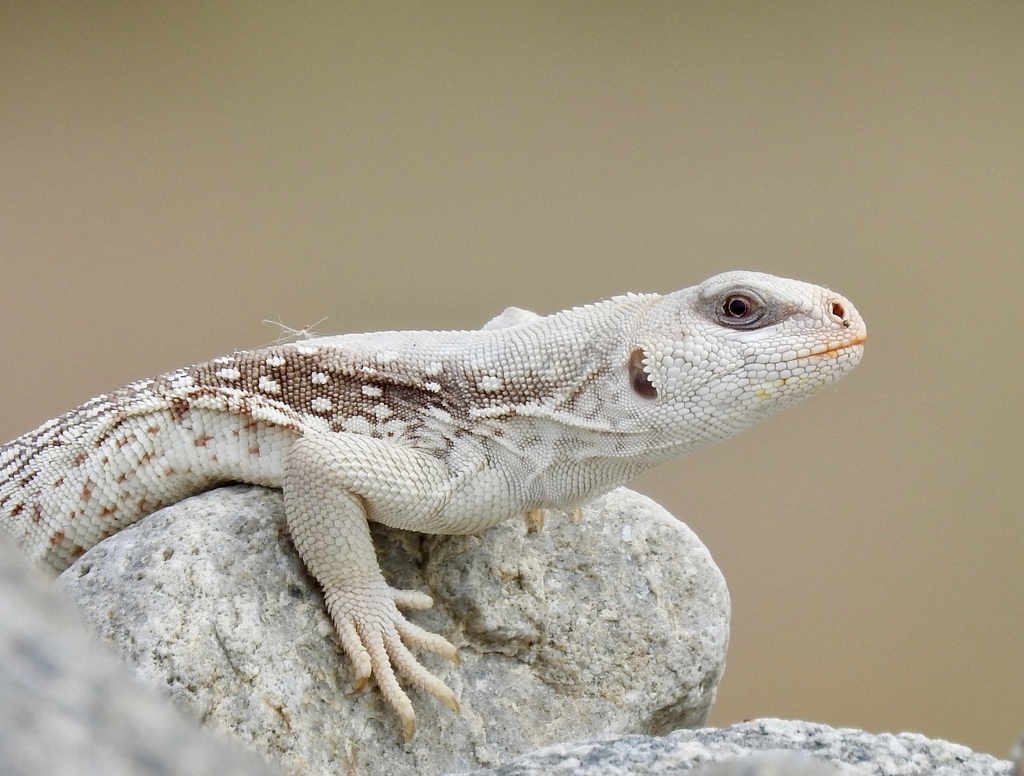
(c) Diana, some rights reserved (CC BY) · licence
Family: Iguanidae · Class: Reptilia · Order: Squamata
Dipsosaurus dorsalis (Desert Iguana) is a California animal in the Iguanidae family.
The desert iguana is a large, robust lizard native to the southwestern United States and northwestern Mexico. Adults typically measure 24 to 61 centimeters (9.4 to 24 inches) in total length, with the tail comprising approximately 1.5 times the body length. The species exhibits a distinctive appearance with a pale gray to tan dorsal coloration marked by irregular brown or reddish-brown bands across the back and tail. A prominent row of enlarged, keeled scales runs along the dorsal midline from the neck to the tail base, forming a low crest. The head is relatively small with a blunt snout, and the body appears laterally compressed. Juveniles display more pronounced banding patterns that tend to fade with age. In California, desert iguanas occur primarily in the Colorado and Mojave deserts of southeastern counties, including Imperial, Riverside, San Bernardino, and Inyo counties. Their range extends from sea level to approximately 300 meters (1,000 feet) elevation, with isolated populations documented at higher elevations. The species reaches its northern distributional limit in the Coachella Valley and Death Valley regions of California. Desert iguanas inhabit arid scrublands dominated by creosote bush, desert washes, rocky hillsides, and sandy flats. They show a strong association with desert ironwood trees and palo verde, often utilizing these plants for thermoregulation and foraging. The species constructs burrows in sandy or gravelly substrates, typically beneath shrubs or along wash edges. These burrows can extend 0.6 to 2 meters (2 to 6.5 feet) in length and provide essential thermal refugia. Primarily herbivorous, desert iguanas feed on flowers, fruits, and leaves of desert plants, with creosote bush comprising a significant portion of their diet. They also consume cactus flowers and fruits, particularly those of cholla and barrel cacti. Breeding occurs from April through June, with females depositing 2 to 8 eggs in sandy burrows during late spring. Incubation lasts approximately 10 to 12 weeks, with hatchlings emerging in late summer. The species exhibits pronounced seasonal activity patterns, remaining active during hot summer months when most other reptiles seek shelter. Desert iguanas can tolerate body temperatures exceeding 46°C (115°F), among the highest recorded for any lizard species. Desert iguanas are not federally or state-listed as threatened or endangered, and current populations appear stable across most of their California range. However, localized threats include habitat loss from urban development, particularly in the Coachella Valley, off-road vehicle activity, and collection for the pet trade. Climate change may pose future challenges by altering precipitation patterns and vegetation communities upon which the species depends. The species benefits from protection within several national parks and preserves, including Joshua Tree National Park and Mojave National Preserve, where significant portions of suitable habitat remain undisturbed.
Classification
Class: Reptilia · Order: Squamata · Family: Iguanidae
Frequently asked questions
How is Dipsosaurus dorsalis classified?
Dipsosaurus dorsalis belongs to class Reptilia, order Squamata, family Iguanidae.
What family does Dipsosaurus dorsalis belong to?
Dipsosaurus dorsalis is in the Iguanidae family.
What is Dipsosaurus dorsalis?
The desert iguana is a large, robust lizard native to the southwestern United States and northwestern Mexico.
Is Dipsosaurus dorsalis found in California?
Yes. Dipsosaurus dorsalis is recorded in California in The California Species Project's catalogue.
Related species
Other California species in the same genus, family, or bioregion.
Data from The California Species Project — 14,000+ California species with verified data from CNPS, CDFW, USFWS, and more.