Dirona picta
Colorful Dirona
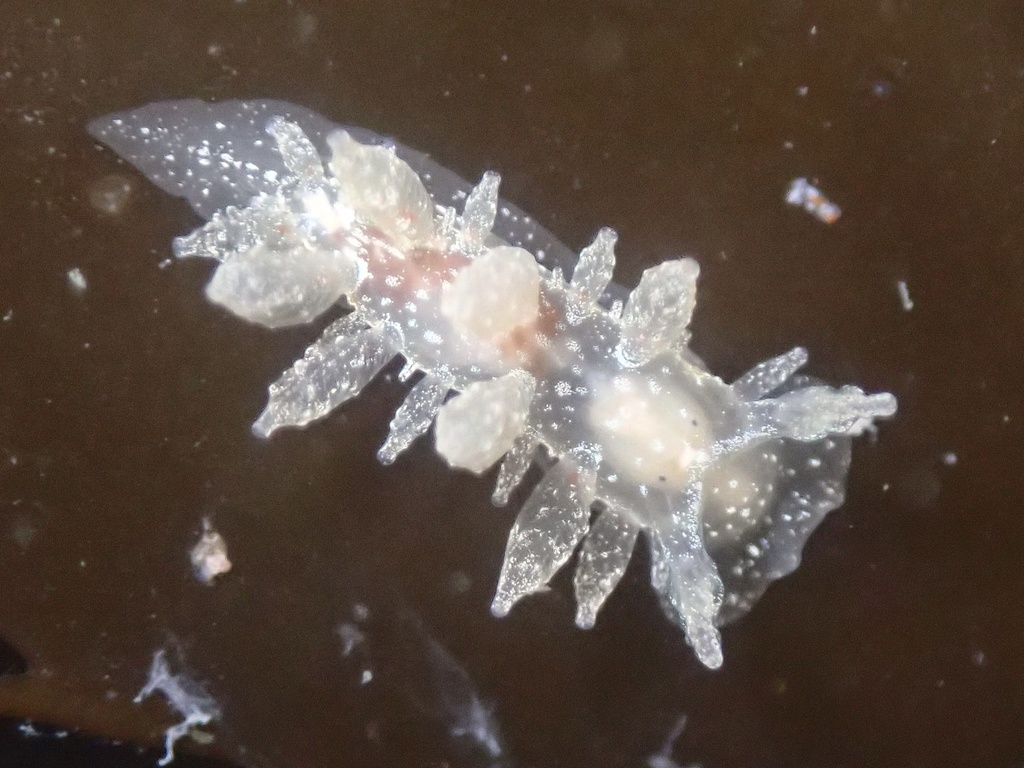
(c) Cricket Raspet, some rights reserved (CC BY) · licence
Family: Dironidae · Class: Gastropoda · Order: Nudibranchia
Dirona picta (Colorful Dirona) is a California animal in the Dironidae family.
Dirona picta is a species of nudibranch sea slug found in the Eastern Pacific Ocean. This marine gastropod mollusk belongs to the family Dironidae within the order Nudibranchia. The species exhibits considerable color variation, ranging from translucent cream through red to bright green forms, with specimens displaying a characteristic wide frontal veil and distinctive white stripe running up each rhinophore (The Slug Site). The cerata (finger-like projections) are typically smooth, distinguishing this species from some related nudibranchs. The colorful dirona occurs along the Pacific coast from California to Baja California, Mexico. Documented locations include Santa Barbara Island in the California Channel Islands, where translucent cream-colored specimens are commonly observed, and waters near San Diego where large aggregations have been encountered on shipwrecks (The Slug Site). The species extends southward to Bahia de los Angeles in Baja California, where it has been regularly documented during diving surveys. This nudibranch inhabits marine environments at various depths, from shallow coastal waters to areas around offshore islands. Specimens have been observed crawling over algae including Padina species, suggesting an association with algae-rich substrates (The Slug Site). The species appears to utilize both natural rocky reef habitats and artificial structures such as shipwrecks, where it can form substantial local populations. Like other members of the order Nudibranchia, Dirona picta exhibits simultaneous hermaphroditism, with both individuals in a mating pair possessing functional male and female reproductive organs (SeaLifeBase). During mating behavior, both individuals extend their penis toward each other in a reciprocal process. The species likely feeds on hydroids, bryozoans, or other small invertebrates typical of nudibranch diets, though specific prey preferences have not been extensively documented. Seasonal activity patterns may influence abundance, with some observations noting greater algal growth and associated nudibranch activity during certain times of the year. Currently, no formal conservation status has been assigned to Dirona picta by major conservation organizations. The species appears to maintain stable populations throughout its known range, with documented occurrences spanning several decades without apparent decline. However, like many marine invertebrates, the colorful dirona may face potential threats from ocean acidification, warming sea temperatures, and coastal development that could affect its algae-associated habitats. The species' ability to colonize artificial structures such as shipwrecks suggests some adaptability to human-modified marine environments. Continued monitoring through citizen science platforms and research diving surveys provides ongoing documentation of population status and distribution patterns across the Eastern Pacific range.
Classification
Class: Gastropoda · Order: Nudibranchia · Family: Dironidae
Frequently asked questions
How is Dirona picta classified?
Dirona picta belongs to class Gastropoda, order Nudibranchia, family Dironidae.
What family does Dirona picta belong to?
Dirona picta is in the Dironidae family.
What is Dirona picta?
Dirona picta is a species of nudibranch sea slug found in the Eastern Pacific Ocean.
Is Dirona picta found in California?
Yes. Dirona picta is recorded in California in The California Species Project's catalogue.
More California species
This species has no close relatives in our California data — here are other species to explore.
Data from The California Species Project — 14,000+ California species with verified data from CNPS, CDFW, USFWS, and more.