Dissosteira pictipennis
California Rose-winged Grasshopper
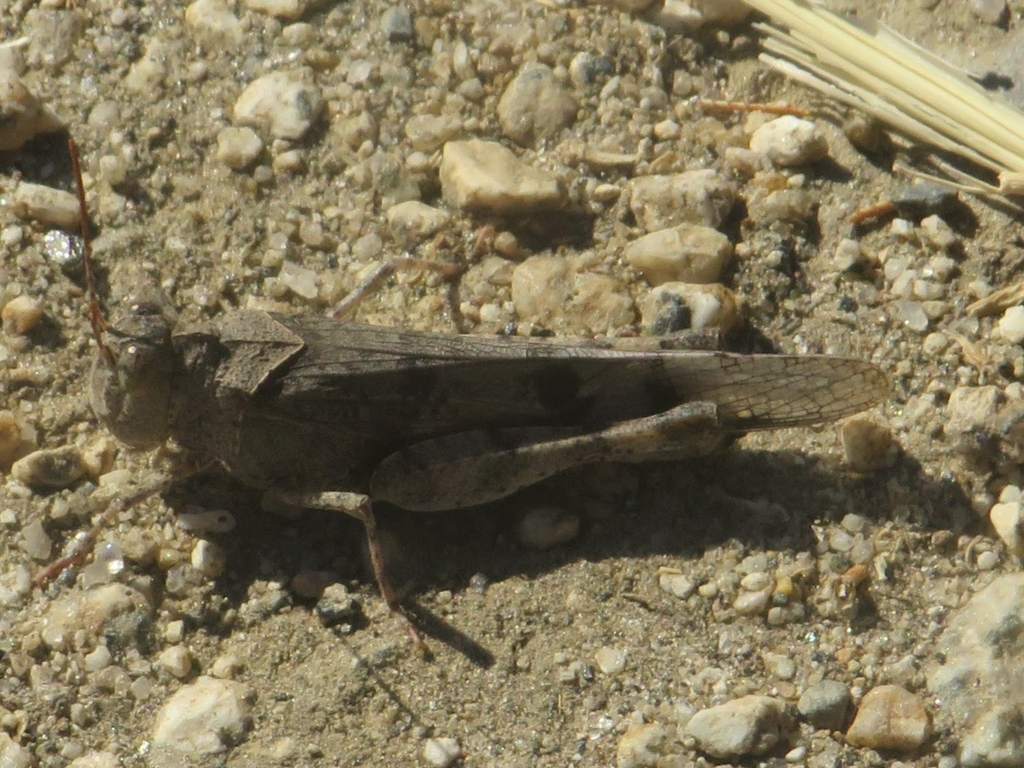
(c) Justin, some rights reserved (CC BY) · licence
Family: Acrididae · Class: Insecta · Order: Orthoptera
Dissosteira pictipennis (California Rose-winged Grasshopper) is a California animal in the Acrididae family.
The California Rose-winged Grasshopper is a medium-sized orthopteran belonging to the band-winged grasshopper subfamily Oedipodinae. Adults measure approximately 20-30 mm (0.8-1.2 inches) in length, with females being notably larger than males. The species displays the characteristic cryptic coloration typical of band-winged grasshoppers, with mottled brown and gray forewings that provide camouflage against rocky and sandy substrates. The hindwings feature distinctive rose or pinkish coloration that becomes visible during flight, giving the species its common name. Males are generally more slender and angular in appearance compared to the broader females (BugGuide). Dissosteira pictipennis is endemic to California, where it occurs primarily in coastal and near-coastal regions. The species has been documented from Santa Barbara County and other coastal areas, with observations extending into interior valleys and foothills. Historical records suggest a broader distribution, though current range limits remain incompletely documented. The species appears to maintain localized colonies in suitable habitat areas rather than displaying wide dispersal patterns (BugGuide). This grasshopper inhabits coastal sandy backdune environments, hardpacked gravel trails, oak woodlands, and chaparral communities. The species shows a preference for areas with exposed soil or gravel substrates that match its cryptic coloration. Coastal populations utilize sandy coastal scrub and dune systems, while inland populations occur in oak-chaparral habitats and similar dry, open areas with suitable substrate conditions (BugGuide). As with other band-winged grasshoppers, the California Rose-winged Grasshopper exhibits crepitant flight behavior, producing clicking or crackling sounds during flight through wing-beating. This acoustic display, combined with the flash of rose-colored hindwings, likely serves both in predator deterrence and intraspecific communication. The species tends to form localized colonies in favorable habitat patches and shows limited dispersal behavior unless disturbed. Adults are most active during warmer months, with peak activity typically occurring from late spring through early fall. Specific dietary preferences have not been well documented, though the species likely feeds on various grasses and forbs typical of its habitat. The conservation status of Dissosteira pictipennis has not been formally evaluated by state or federal agencies. The species is not currently listed under the Endangered Species Act or designated as a Species of Special Concern by the California Department of Fish and Wildlife. However, as a California endemic with apparently limited distribution, the species may face threats from coastal development, habitat fragmentation, and changes in land use practices. Coastal dune systems, which provide critical habitat for some populations, are particularly vulnerable to development pressures and recreational impacts. The tendency of this species to form localized colonies rather than disperse widely may make populations vulnerable to habitat loss at specific sites. Detailed ecological studies of this species remain limited. Scientific documentation of population trends, specific host plant relationships, and detailed habitat requirements would enhance understanding of conservation needs. Community contributions of verified field observations and ecological data would improve knowledge of this endemic California grasshopper's distribution and biology.
Classification
Class: Insecta · Order: Orthoptera · Family: Acrididae
Frequently asked questions
How is Dissosteira pictipennis classified?
Dissosteira pictipennis belongs to class Insecta, order Orthoptera, family Acrididae.
What family does Dissosteira pictipennis belong to?
Dissosteira pictipennis is in the Acrididae family.
What is Dissosteira pictipennis?
The California Rose-winged Grasshopper is a medium-sized orthopteran belonging to the band-winged grasshopper subfamily Oedipodinae.
Is Dissosteira pictipennis found in California?
Yes. Dissosteira pictipennis is recorded in California in The California Species Project's catalogue.
Related species
Other California species in the same genus, family, or bioregion.
Data from The California Species Project — 14,000+ California species with verified data from CNPS, CDFW, USFWS, and more.