Dolichovespula arenaria
Common Aerial Yellowjacket
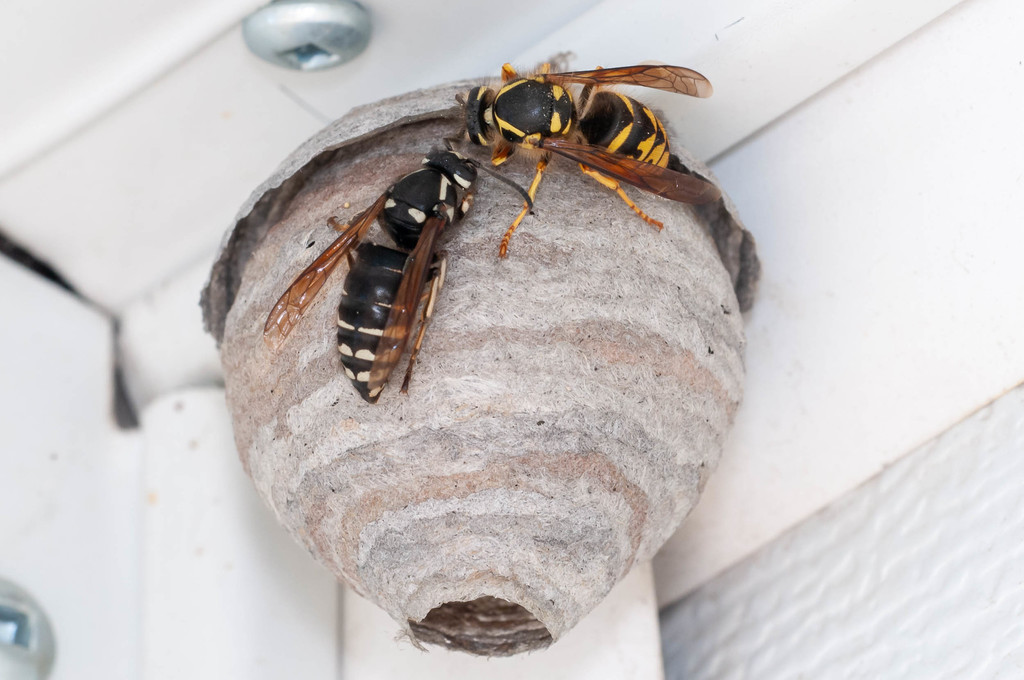
(c) Chris O'Donoghue, some rights reserved (CC BY) · licence
Family: Vespidae · Class: Insecta · Order: Hymenoptera
Dolichovespula arenaria (Common Aerial Yellowjacket) is a California animal in the Vespidae family.
The Common Aerial Yellowjacket is a social wasp species in the family Vespidae, subfamily Vespinae. Workers measure approximately 10-15 mm in length, while queens are larger at 15-20 mm. The species displays the characteristic yellowjacket coloration with bright yellow and black markings, though it can be distinguished from other yellowjackets by its relatively hairy face and specific facial markings (BugGuide). Males, which appear later in the season, are typically smaller than workers and have longer antennae. This species has an extensive North American range, occurring from north-central Alaska south to New Mexico and Arizona, and is abundant throughout boreal North America (BugGuide). The range extends across most of Canada and the northern United States, with populations documented in California's mountainous regions. In California, the species is present in various counties, particularly in forested and mountainous areas at elevations ranging from foothill zones to montane forests. Common Aerial Yellowjackets construct their distinctive paper nests in aerial locations, typically 3-15 feet above ground in shrubs, trees, or under building eaves. The nests are constructed from chewed wood pulp mixed with saliva, creating a gray, papery material. Unlike ground-nesting yellowjackets, this species prefers exposed locations for nest building. The spherical to oval nests can reach basketball size by late season and contain multiple tiers of hexagonal cells. Habitat preferences include mixed forests, woodland edges, parks, and suburban areas with adequate tree cover. The colony cycle begins in spring when overwintered queens emerge and establish new nests. Queens initially work alone, constructing small starter nests and raising the first brood of workers. Worker populations peak in late summer, with colonies containing several hundred to over 1,000 individuals. Workers are opportunistic predators and scavengers, capturing insects including flies, caterpillars, and other soft-bodied arthropods to feed developing larvae. Adults also feed on nectar, tree sap, and sugary substances. They have been observed feeding on insect remains at moth bait stations, demonstrating their scavenging behavior (Preisser 2001). The species exhibits typical yellowjacket defensive behavior when colonies are disturbed, with workers capable of multiple stings. New queens and males are produced in late summer, with mating occurring before winter. Only mated queens survive winter, hibernating in protected locations such as under bark, in logs, or building crevices. The Common Aerial Yellowjacket has no special conservation status and is considered a common species throughout its range. Populations appear stable, and the species has adapted well to human-modified landscapes. While sometimes considered a nuisance due to aggressive behavior around food sources and nesting sites, the species plays beneficial ecological roles as both predator of pest insects and occasional pollinator. Climate change may affect distribution patterns, potentially allowing range expansion northward, though specific population trend data are not available. The species' adaptability to various habitats and food sources suggests resilience to environmental changes within its current range.
Classification
Class: Insecta · Order: Hymenoptera · Family: Vespidae
Frequently asked questions
How is Dolichovespula arenaria classified?
Dolichovespula arenaria belongs to class Insecta, order Hymenoptera, family Vespidae.
What family does Dolichovespula arenaria belong to?
Dolichovespula arenaria is in the Vespidae family.
What is Dolichovespula arenaria?
The Common Aerial Yellowjacket is a social wasp species in the family Vespidae, subfamily Vespinae.
Is Dolichovespula arenaria found in California?
Yes. Dolichovespula arenaria is recorded in California in The California Species Project's catalogue.
Related species
Other California species in the same genus, family, or bioregion.
Data from The California Species Project — 14,000+ California species with verified data from CNPS, CDFW, USFWS, and more.