Donax gouldii
Gould Beanclam
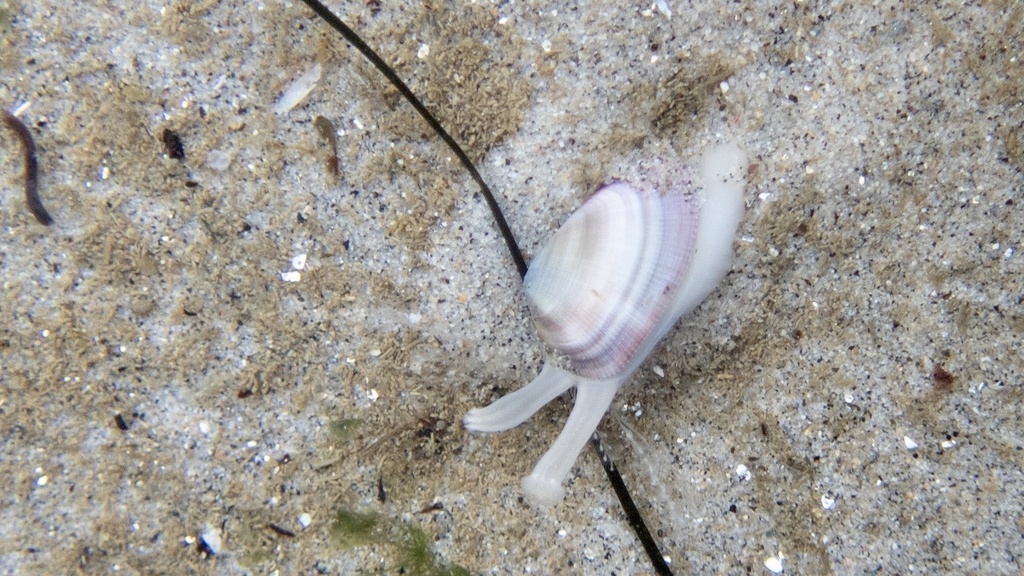
(c) Eric Klug, some rights reserved (CC BY) · licence
Family: Donacidae · Class: Bivalvia · Order: Veneroida
Donax gouldii (Gould Beanclam) is a California animal in the Donacidae family.
The Gould beanclam (Donax gouldii) is a small marine bivalve mollusk in the family Donacidae. Adults typically measure 15 to 25 mm (0.6 to 1.0 inches) in length, with a triangular, wedge-shaped shell that is higher than it is long. The shell exhibits variable coloration ranging from white to yellow, pink, purple, or brown, often with radiating color bands or zigzag patterns. The exterior surface is smooth to finely sculptured with concentric growth lines, while the interior displays a characteristic purple or white coloration. Gould beanclams occur along the Pacific coast from central California south to Baja California, Mexico. In California, the species is distributed from Monterey County southward to the Mexican border, with populations documented at Point Dume State Marine Conservation Area and Tijuana River Mouth State Marine Conservation Area. The species is listed among marine species monitored by the California Department of Fish and Wildlife under the Marine Life Management Act. This species inhabits sandy beaches in the intertidal and shallow subtidal zones, typically in areas with moderate to high wave energy. Gould beanclams prefer fine to medium-grained sand substrates on wide, gently sloping beaches with open ocean exposure. They are commonly found in the swash zone where waves repeatedly wash over the sand, creating the dynamic environment they require. The species often forms dense aggregations or beds that can span several meters across-shore, particularly in suitable habitat areas. Gould beanclams are active filter feeders, using their siphons to draw in seawater and extract phytoplankton, detritus, and small organic particles. They are highly mobile burrowers, capable of rapid vertical and horizontal movement through the sand using their muscular foot. This mobility allows them to maintain their position in the dynamic swash zone as waves and tides shift sand around them. The species exhibits synchronized spawning behavior, typically releasing gametes during warmer months when phytoplankton abundance is higher. Larvae undergo a planktonic stage before settling and metamorphosing into juvenile clams. While not currently listed under state or federal endangered species acts, Gould beanclams face ongoing pressures from coastal development, beach modification, and human recreational activities. Sandy beach habitats are particularly vulnerable to erosion, sand mining, and hardening of shorelines through seawalls and other structures. Climate change poses additional threats through sea level rise, altered wave patterns, and changing ocean chemistry. The species' occurrence in marine protected areas like Point Dume and Tijuana River Mouth provides some habitat protection. Population monitoring indicates the species maintains stable populations in suitable habitat, though localized declines may occur in areas with intensive human use or habitat modification. Conservation efforts focus on maintaining natural beach processes and minimizing disturbance to sandy intertidal communities.
Classification
Class: Bivalvia · Order: Veneroida · Family: Donacidae
Frequently asked questions
How is Donax gouldii classified?
Donax gouldii belongs to class Bivalvia, order Veneroida, family Donacidae.
What family does Donax gouldii belong to?
Donax gouldii is in the Donacidae family.
What is Donax gouldii?
The Gould beanclam (Donax gouldii) is a small marine bivalve mollusk in the family Donacidae.
Is Donax gouldii found in California?
Yes. Donax gouldii is recorded in California in The California Species Project's catalogue.
More California species
This species has no close relatives in our California data — here are other species to explore.
Data from The California Species Project — 14,000+ California species with verified data from CNPS, CDFW, USFWS, and more.