Dorosoma petenense
Threadfin shad
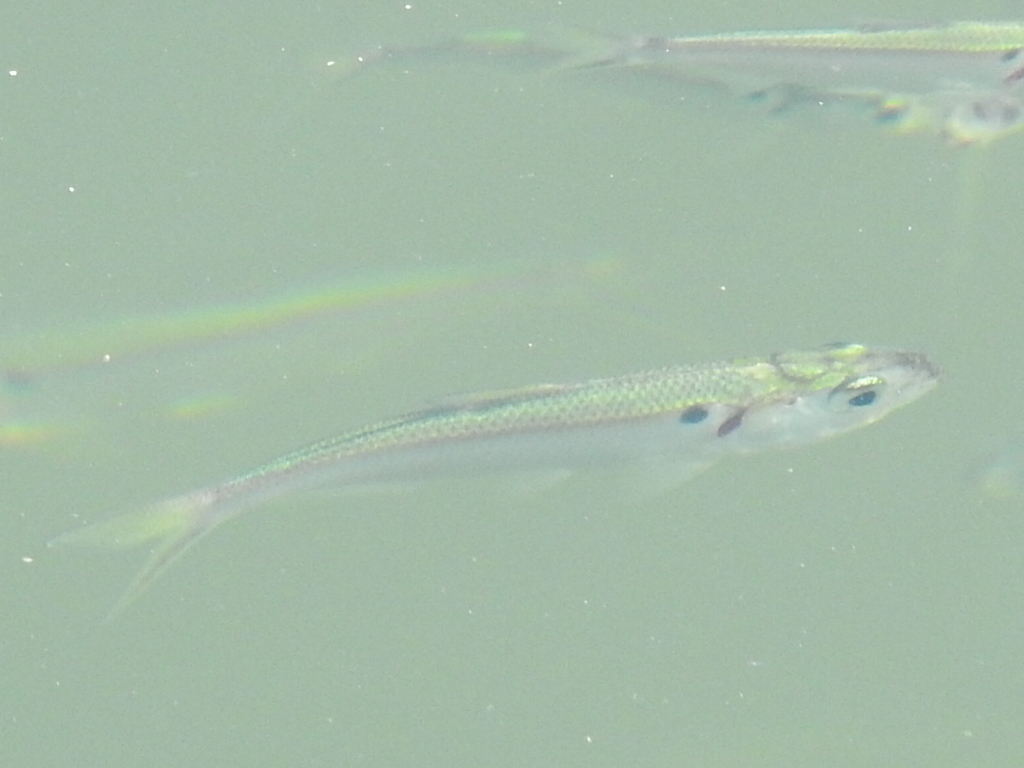
(c) Sam Kieschnick, some rights reserved (CC BY) · licence
Family: Dorosomatidae · Class: Actinopterygii · Order: Clupeiformes
Dorosoma petenense (Threadfin shad) is a California animal in the Dorosomatidae family.
The threadfin shad is a small, laterally compressed fish native to freshwater and estuarine environments. Adults typically measure 100 to 200 mm (4 to 8 inches) in total length, with a maximum recorded length of 250 mm (10 inches). The body is silvery with a distinctive blue-green sheen on the dorsal surface and bright silver sides. A prominent dark spot appears behind the gill cover, and the species is characterized by an extremely elongated last ray of the dorsal fin that extends well beyond the fin membrane, giving the species its common name. The mouth is small and terminal, adapted for filter feeding, with fine gill rakers that strain plankton from the water. Threadfin shad occur throughout much of the southeastern and south-central United States, with their native range extending from the Ohio River drainage south to Central America. In California, the species was introduced to reservoirs and the Colorado River system beginning in the 1950s as forage fish for sport fish populations. The species now occurs in numerous California water bodies including Lake Havasu, the Salton Sea, and various Central Valley reservoirs. Populations have also established in the San Francisco Bay-Delta system following introductions. The species inhabits warm, productive waters of lakes, reservoirs, rivers, and estuaries. Threadfin shad prefer temperatures above 10°C (50°F) and experience significant mortality when water temperatures drop below 7°C (45°F). They typically occupy open water areas but move to shallow, protected areas for spawning. The species tolerates a wide range of salinities, from freshwater to brackish conditions up to 17 parts per thousand, allowing populations to persist in estuarine environments. Threadfin shad are planktivorous filter feeders, consuming zooplankton, phytoplankton, detritus, and small invertebrates. They form large schools and exhibit diel vertical migration patterns, moving to surface waters at night to feed. Spawning occurs from April through October when water temperatures exceed 16°C (60°F), with peak activity during summer months. Females broadcast adhesive eggs over shallow areas with vegetation or hard substrate. A single female can produce 20,000 to 60,000 eggs per spawning event. The species is short-lived, with most individuals surviving only 2 to 3 years. Threadfin shad are not listed under federal or state endangered species legislation and are considered secure throughout their range. In California, the species is managed as an introduced fish that serves as an important forage base for sport fish species including striped bass, largemouth bass, and various catfish species. However, their introduction has raised ecological concerns, as they may compete with native fish species for planktonic food resources and can experience periodic die-offs during cold weather events, potentially affecting water quality in affected water bodies.
Classification
Class: Actinopterygii · Order: Clupeiformes · Family: Dorosomatidae
Frequently asked questions
How is Dorosoma petenense classified?
Dorosoma petenense belongs to class Actinopterygii, order Clupeiformes, family Dorosomatidae.
What family does Dorosoma petenense belong to?
Dorosoma petenense is in the Dorosomatidae family.
What is Dorosoma petenense?
The threadfin shad is a small, laterally compressed fish native to freshwater and estuarine environments.
Is Dorosoma petenense found in California?
Yes. Dorosoma petenense is recorded in California in The California Species Project's catalogue.
More California species
This species has no close relatives in our California data — here are other species to explore.
Data from The California Species Project — 14,000+ California species with verified data from CNPS, CDFW, USFWS, and more.