Dracotettix monstrosus
Gray Dragon Lubber
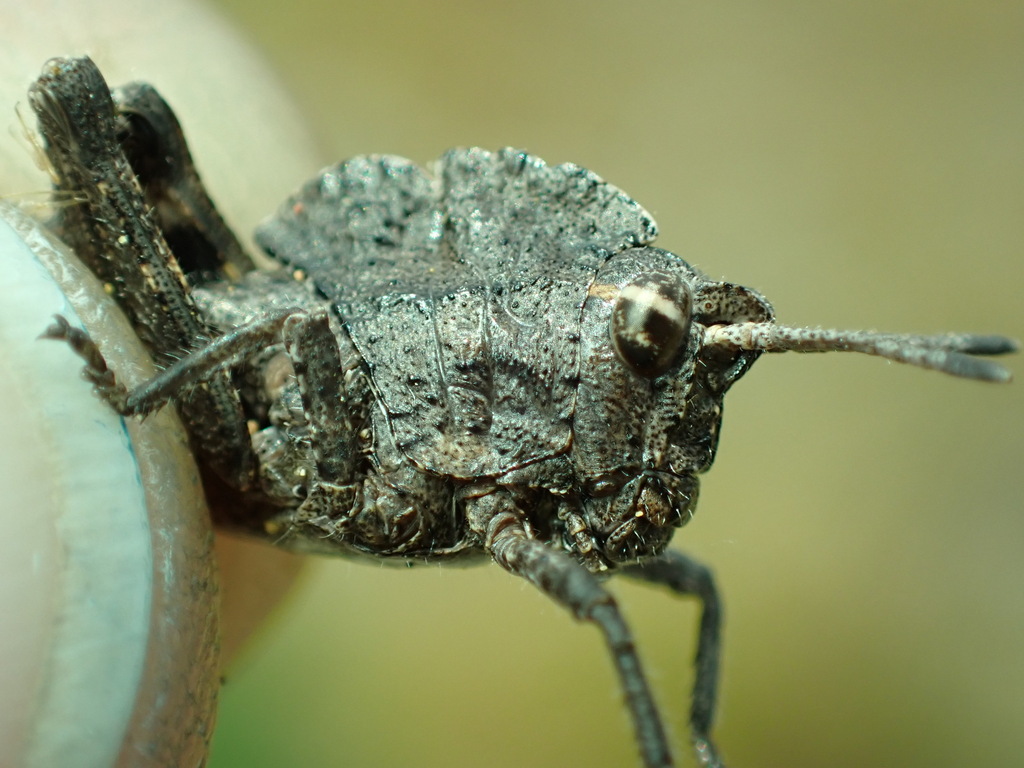
(c) Cricket Raspet, some rights reserved (CC BY) · licence
Family: Romaleidae · Class: Insecta · Order: Orthoptera
Dracotettix monstrosus (Gray Dragon Lubber) is a California animal in the Romaleidae family.
The Gray Dragon Lubber (Dracotettix monstrosus) is a large grasshopper in the family Romaleidae, distinguished by its robust build and distinctive morphology. Adult specimens typically measure 35-50 mm in body length, with females generally larger than males. The species exhibits a mottled gray-brown coloration with darker banding patterns across the thorax and abdomen. The head is proportionally large with prominent compound eyes, and the antennae are relatively short and thick. Wings are reduced in size relative to the body, with the forewings (tegmina) appearing leathery and the hindwings often brightly colored when exposed during threat displays. Dracotettix monstrosus is endemic to the southwestern United States, with its primary distribution centered in Southern California. The species occurs in scattered populations across the Sonoran and Mojave Desert regions, extending into Baja California, Mexico. In California, documented populations exist in Imperial, Riverside, and San Bernardino counties, with isolated records from the Colorado Desert and surrounding mountain foothills. The species' range appears fragmented, with populations separated by unsuitable habitat and urban development. This grasshopper inhabits arid and semi-arid environments, showing a preference for desert scrubland and chaparral communities. It occurs at elevations ranging from below sea level in the Salton Sink to approximately 1,200 meters in foothill areas. The species favors areas with sparse to moderate vegetation cover, particularly locations with a mix of shrubs, cacti, and herbaceous plants. Substrate preferences include sandy and gravelly soils with good drainage, often in association with washes and alluvial fans where moisture periodically accumulates. As a member of the Romaleidae, the Gray Dragon Lubber exhibits typical lubber grasshopper behaviors including limited flight capability and reliance on walking for locomotion. Adults are primarily active during daylight hours and feed on a variety of desert vegetation, including shrubs, forbs, and occasionally grasses. The species appears to be multivoltine in favorable conditions, with peak adult activity occurring from late spring through early fall. When threatened, individuals may display their hindwings and produce defensive secretions, behaviors characteristic of the family. Nymphs develop through five instars before reaching maturity, with development time influenced by temperature and food availability. Currently, Dracotettix monstrosus does not appear on federal or state endangered species lists as of December 2025. However, like many desert-adapted insects, the species faces potential threats from habitat loss due to urban expansion, renewable energy development, and climate change impacts on desert ecosystems. The fragmented nature of known populations suggests vulnerability to local extirpations. Comprehensive surveys and population monitoring would be valuable for assessing the species' conservation status, as detailed ecological studies of this grasshopper remain limited in the scientific literature.
Classification
Class: Insecta · Order: Orthoptera · Family: Romaleidae
Frequently asked questions
How is Dracotettix monstrosus classified?
Dracotettix monstrosus belongs to class Insecta, order Orthoptera, family Romaleidae.
What family does Dracotettix monstrosus belong to?
Dracotettix monstrosus is in the Romaleidae family.
What is Dracotettix monstrosus?
The Gray Dragon Lubber (Dracotettix monstrosus) is a large grasshopper in the family Romaleidae, distinguished by its robust build and distinctive morphology.
Is Dracotettix monstrosus found in California?
Yes. Dracotettix monstrosus is recorded in California in The California Species Project's catalogue.
More California species
This species has no close relatives in our California data — here are other species to explore.
Data from The California Species Project — 14,000+ California species with verified data from CNPS, CDFW, USFWS, and more.