Drasteria adumbrata
Shadowy Arches
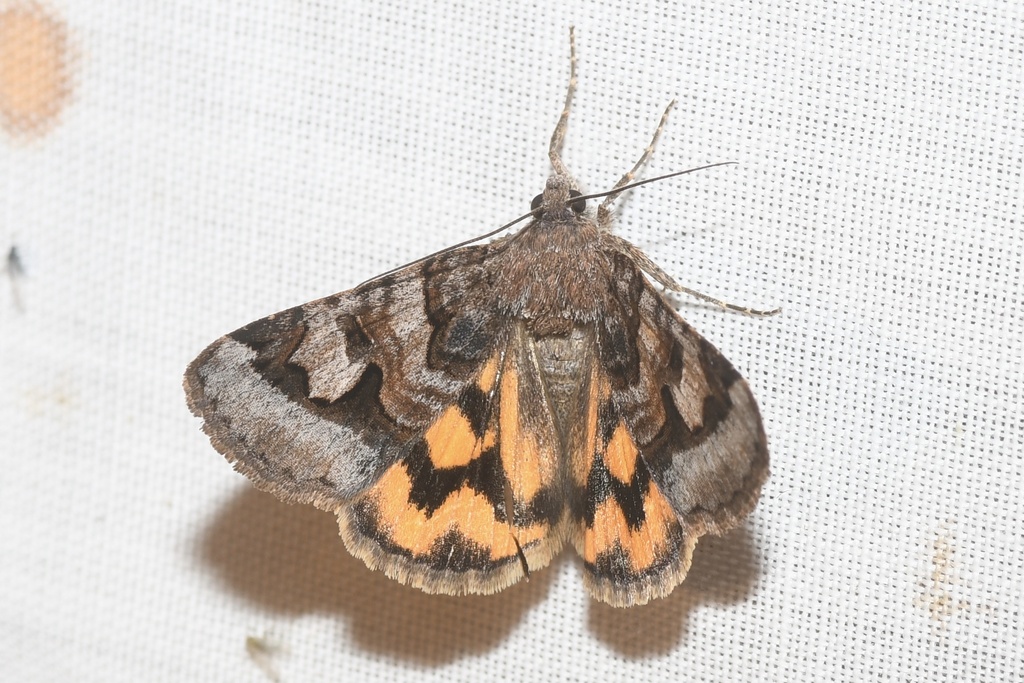
(c) Henrique Pacheco, some rights reserved (CC BY) · licence
Family: Erebidae · Class: Insecta · Order: Lepidoptera
Drasteria adumbrata (Shadowy Arches) is a California animal in the Erebidae family.
The Shadowy Arches is a medium-sized moth with a wingspan of approximately 32 mm (1.3 inches). The forewings display a distinctive mottled pattern of light and dark brown, with the basal area, median band, reniform spot, and subterminal area appearing notably paler than the surrounding regions (BugGuide 2025). The antemedial line curves characteristically toward the base near the inner margin. The hindwings are creamy yellow to orange with contrasting black marginal and postmedial bands, with the postmedial band joining to form a black discal crescent. Drasteria adumbrata exhibits a transcontinental distribution, ranging coast to coast across southern Canada and extending south in western regions to California and Colorado, and in eastern regions to New England and Michigan (BugGuide 2025). In California, the species has been documented in the Sierra Nevada, with records from Fresno County at China Peak Resort at 7,500 feet elevation (News of the Lepidopterists' Society 2013). Additional western records include collections from Idaho at multiple locations including Boise County and Custer County (News of the Lepidopterists' Society 2019). This species inhabits dry montane woodlands and sandy open woods, showing a preference for elevated forest environments. The elevation range extends from moderate to high montane zones, with documented occurrences above 7,000 feet in California's Sierra Nevada. The species demonstrates adaptation to both coniferous and mixed woodland ecosystems across its broad geographic range. Shadowy Arches exhibits distinctive behavioral characteristics that separate it from many related noctuids. The species is notably day-active and demonstrates rapid flight patterns during daylight hours (BugGuide 2025). This diurnal activity pattern is unusual among members of the Erebidae family, which are predominantly nocturnal. BugGuide notes that the response to artificial lights varies by subspecies, with subspecies saxea regularly attracted to light in southern British Columbia, while subspecies alleni is very rarely attracted to light sources. Adults fly during summer months, with peak activity occurring in July and August based on collection records. Larvae feed on Lowbush Blueberry (Vaccinium angustifolium) in Quebec, though host plant relationships across the full range require further documentation. The conservation status of Drasteria adumbrata has not been formally evaluated by federal or state agencies. The species appears to maintain stable populations across its extensive range, though comprehensive population assessments are lacking. Climate change impacts on montane forest habitats could potentially affect future distributions, particularly in the southern portions of the range where warming temperatures may force upslope habitat shifts. The species' dependence on specific woodland conditions and potential host plant relationships suggest vulnerability to habitat fragmentation and forest management practices. However, the broad geographic distribution and apparent ecological adaptability across diverse montane environments may provide some resilience against localized threats. Additional research on population trends, habitat requirements, and host plant relationships would benefit conservation planning for this distinctive day-flying moth.
Classification
Class: Insecta · Order: Lepidoptera · Family: Erebidae
Frequently asked questions
How is Drasteria adumbrata classified?
Drasteria adumbrata belongs to class Insecta, order Lepidoptera, family Erebidae.
What family does Drasteria adumbrata belong to?
Drasteria adumbrata is in the Erebidae family.
What is Drasteria adumbrata?
The Shadowy Arches is a medium-sized moth with a wingspan of approximately 32 mm (1.3 inches).
Is Drasteria adumbrata found in California?
Yes. Drasteria adumbrata is recorded in California in The California Species Project's catalogue.
Related species
Other California species in the same genus, family, or bioregion.
Data from The California Species Project — 14,000+ California species with verified data from CNPS, CDFW, USFWS, and more.