Drasteria divergens
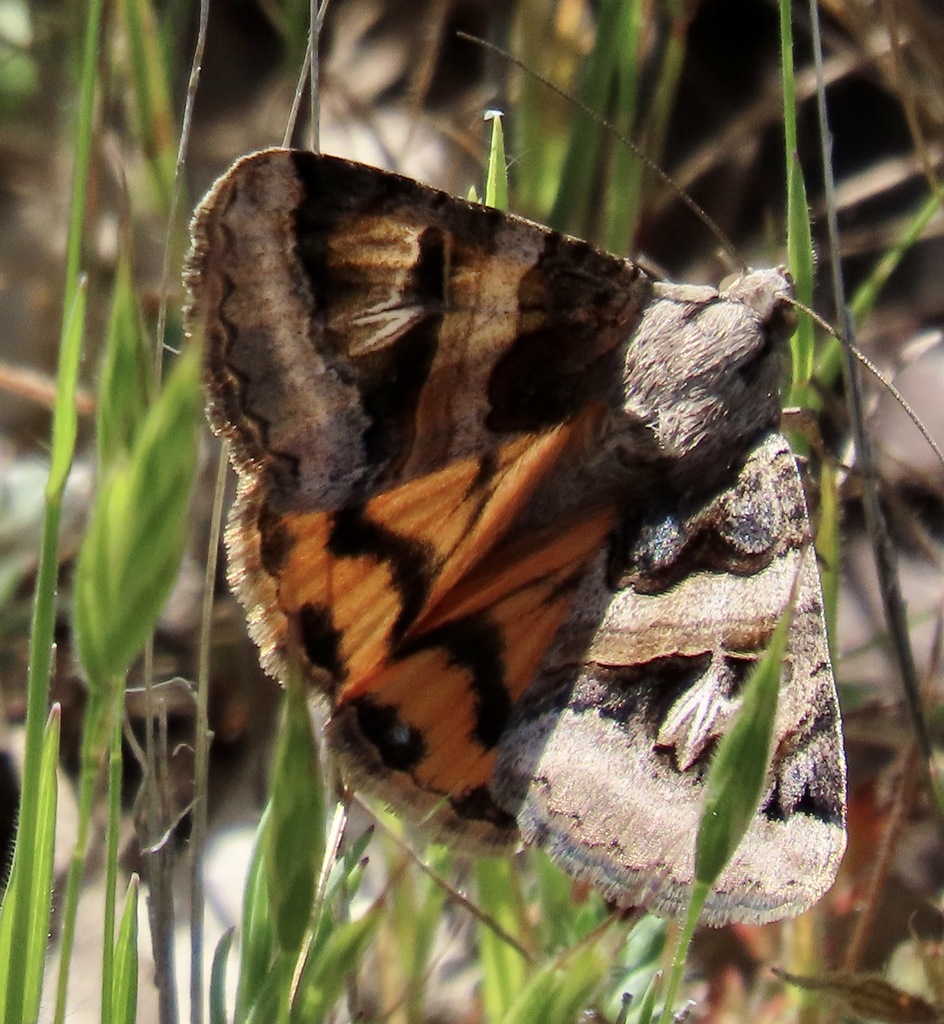
(c) John Hibbard, some rights reserved (CC BY) · licence
Family: Erebidae · Class: Insecta · Order: Lepidoptera
Drasteria divergens is a California animal in the Erebidae family.
Drasteria divergens is a moth in the family Erebidae, subfamily Erebinae, commonly known as a looper moth or owlet moth. Adult moths typically have a wingspan ranging from 28 to 35 mm (1.1 to 1.4 inches). The forewings display a mottled pattern of gray and brown coloration with darker transverse lines and pale markings. The hindwings are typically lighter in color, often whitish or pale gray with darker marginal bands. Like other Drasteria species, the forewings show distinctive reniform and orbicular spots, though these markings can be variable in prominence. The species exhibits sexual dimorphism, with males generally having more prominent feathered antennae and slightly smaller body size compared to females. Drasteria divergens occurs in western North America, with records from California, Nevada, Arizona, and Utah. In California, the species has been documented from desert and semi-arid regions, particularly in the Mojave Desert and adjacent areas. Specific county records include San Bernardino, Riverside, and Inyo counties, though the full extent of its California distribution may not be completely documented due to limited survey efforts in remote desert areas. The species inhabits arid and semi-arid environments, typically in desert scrubland and chaparral communities. Adults are found in areas with sparse vegetation dominated by drought-adapted shrubs and perennial plants. Elevation range appears to span from approximately 300 to 1,500 meters (1,000 to 5,000 feet), though specific elevation limits require further documentation. The habitat is characterized by low annual precipitation, extreme temperature fluctuations, and well-drained soils. Drasteria divergens exhibits nocturnal activity patterns typical of most erebid moths. Adults are attracted to artificial light sources during nighttime hours. Flight period appears to occur during warmer months, though specific timing may vary with elevation and local climate conditions. Like other Drasteria species, larvae are likely polyphagous, feeding on various low-growing herbaceous plants and possibly shrub foliage, though specific host plant relationships for this species remain poorly documented. Reproductive biology follows typical lepidopteran patterns, with females depositing eggs on or near host plants and larvae developing through multiple instars before pupation. The conservation status of Drasteria divergens has not been formally assessed by state or federal agencies. The species does not appear on California Department of Fish and Wildlife special concern lists or federal endangered species listings as of December 2025. However, like many desert-adapted species, it may face threats from habitat loss due to urban development, renewable energy projects, and off-road vehicle activity in desert regions. Climate change may also affect the species through altered precipitation patterns and increased temperature extremes. The extent of population trends and conservation needs remains unclear due to limited systematic surveys of desert lepidopteran communities in California.
Classification
Class: Insecta · Order: Lepidoptera · Family: Erebidae
Frequently asked questions
How is Drasteria divergens classified?
Drasteria divergens belongs to class Insecta, order Lepidoptera, family Erebidae.
What family does Drasteria divergens belong to?
Drasteria divergens is in the Erebidae family.
What is Drasteria divergens?
Drasteria divergens is a moth in the family Erebidae, subfamily Erebinae, commonly known as a looper moth or owlet moth.
Is Drasteria divergens found in California?
Yes. Drasteria divergens is recorded in California in The California Species Project's catalogue.
Related species
Other California species in the same genus, family, or bioregion.
Data from The California Species Project — 14,000+ California species with verified data from CNPS, CDFW, USFWS, and more.