Drosophila hydei
Hydei Fruit Fly
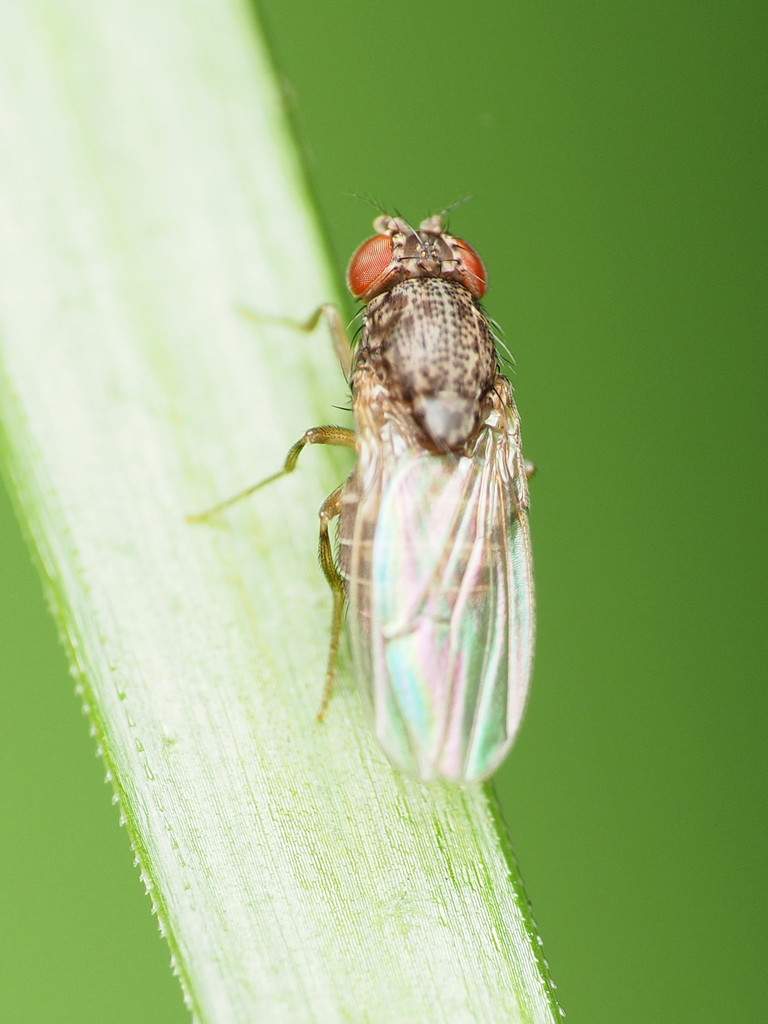
(c) Katja Schulz, some rights reserved (CC BY) · licence
Family: Drosophilidae · Class: Insecta · Order: Diptera
Drosophila hydei (Hydei Fruit Fly) is a California animal in the Drosophilidae family.
Drosophila hydei is a small dipteran fly belonging to the family Drosophilidae, commonly known as vinegar flies or fruit flies. Adults measure approximately 3-4 mm in length and display the typical drosophilid body plan with prominent red compound eyes, short antennae, and translucent to pale brown wings. The species exhibits sexual dimorphism, with males being slightly smaller than females and possessing distinctive sex combs on their forelegs used during courtship behaviors. This cosmopolitan species has a global distribution and is well-established throughout California and North America. Drosophila hydei likely arrived in California through human-mediated dispersal and has become naturalized across diverse habitats from sea level to moderate elevations. The species occurs in both urban and rural environments throughout the state, though specific county-level distribution data within California remains poorly documented. Drosophila hydei inhabits environments rich in decaying organic matter, particularly rotting fruits, vegetables, and fermenting plant materials. According to BugGuide, populations are usually associated with human settlements, thriving in areas where organic waste accumulates such as compost piles, garbage areas, and agricultural sites. The species tolerates a wide range of temperatures and humidity levels, contributing to its successful establishment across California's varied climatic zones. The species exhibits typical drosophilid reproductive and feeding behaviors. Adults are attracted to fermenting organic matter where they feed on yeasts and bacteria associated with decomposition. Females lay eggs directly on or near suitable larval food sources, with larvae developing through three instars before pupating. Development time varies with temperature, typically completing a generation in 10-14 days under optimal laboratory conditions. According to BugGuide, D. hydei serves as a food source for various organisms and is commonly bred as pet food for reptiles, amphibians, and arachnids. Laboratory studies have documented its role in the diet of various species, including the Venezuelan frog Oreophrynella nigra. Drosophila hydei has no federal or state conservation listing status and is not considered a species of conservation concern in California. As an introduced species with stable, self-sustaining populations, it faces no significant threats to its persistence. The species' association with human environments and ability to exploit anthropogenic food sources suggests populations are likely stable or potentially increasing. While not native to California, D. hydei has become an established component of the state's dipteran fauna and plays ecological roles in decomposition processes and as prey for native predators. No specific management or conservation actions are warranted for this widespread, non-native species.
Classification
Class: Insecta · Order: Diptera · Family: Drosophilidae
Frequently asked questions
How is Drosophila hydei classified?
Drosophila hydei belongs to class Insecta, order Diptera, family Drosophilidae.
What family does Drosophila hydei belong to?
Drosophila hydei is in the Drosophilidae family.
What is Drosophila hydei?
Drosophila hydei is a small dipteran fly belonging to the family Drosophilidae, commonly known as vinegar flies or fruit flies.
Is Drosophila hydei found in California?
Yes. Drosophila hydei is recorded in California in The California Species Project's catalogue.
Related species
Other California species in the same genus, family, or bioregion.
Data from The California Species Project — 14,000+ California species with verified data from CNPS, CDFW, USFWS, and more.