Dryobates albolarvatus
White-headed Woodpecker
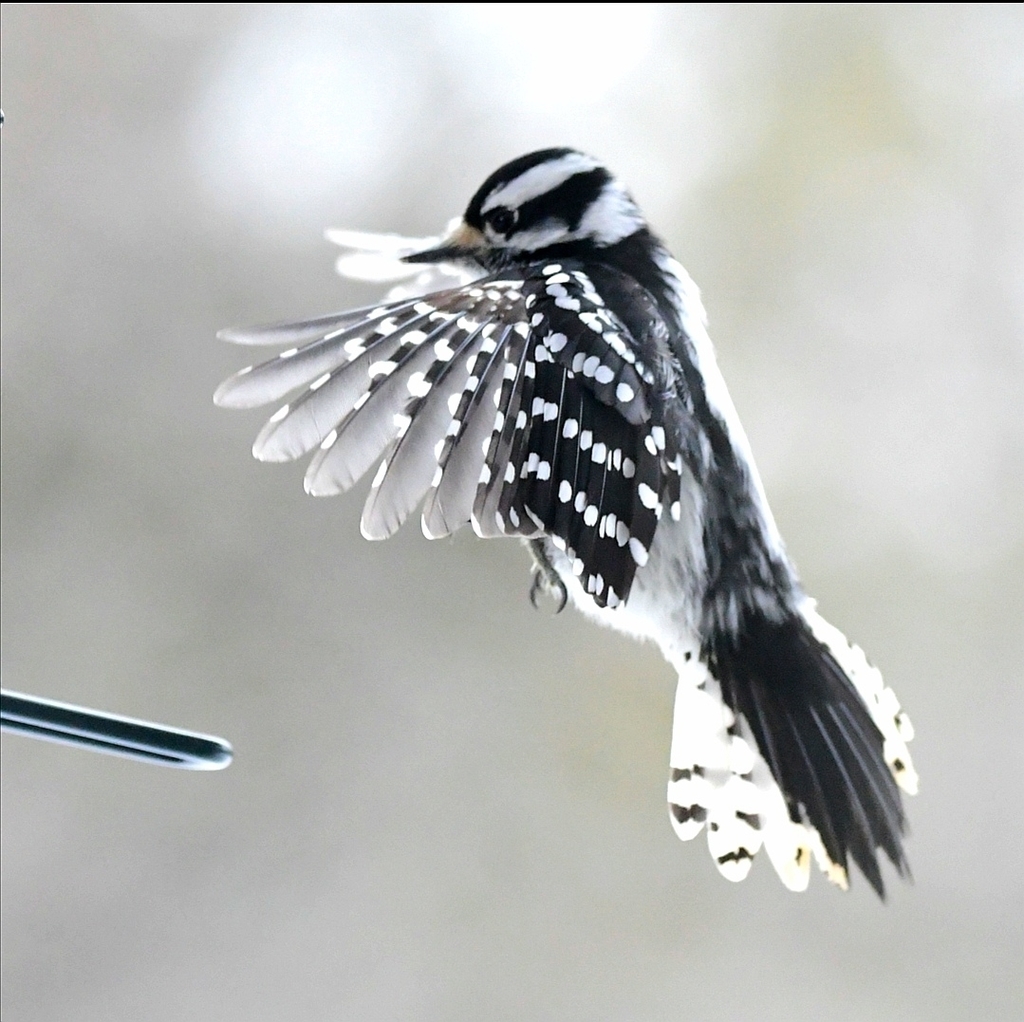
(c) Alexis Williams, some rights reserved (CC BY) · licence
Family: Picidae · Class: Aves · Order: Piciformes
Dryobates albolarvatus (White-headed Woodpecker) is a California animal in the Picidae family.
The White-headed Woodpecker is a medium-sized woodpecker measuring 20 to 23 cm (8 to 9 inches) in length with a wingspan of 40 to 42 cm (16 to 17 inches). Males weigh 55 to 85 grams (1.9 to 3.0 ounces), while females are slightly smaller. The species is distinguished by its striking black body plumage contrasting with a completely white head and neck. Males display a small red patch on the back of the head, which females lack. The wings show prominent white patches visible in flight, and the underparts are entirely black. The bill is dark gray to black, and the legs are dark gray. The White-headed Woodpecker occurs in the western United States, with California populations restricted to the Sierra Nevada and Cascade Range. The species ranges from southern British Columbia through Washington, Oregon, Idaho, and California, extending south to the southern Sierra Nevada in Tulare County. In California, populations are found primarily in coniferous forests above 1,200 meters (4,000 feet) elevation, reaching up to 2,740 meters (9,000 feet) in some areas. This species inhabits mature coniferous forests dominated by ponderosa pine, sugar pine, Douglas-fir, and white fir. White-headed Woodpeckers show strong associations with large-diameter ponderosa pines, which provide both nesting sites and foraging opportunities. The species requires forest stands with 40 to 60 percent canopy cover and significant numbers of snags and dying trees. Fire-adapted ecosystems with mixed-age forest structure provide optimal habitat conditions. White-headed Woodpeckers exhibit unique foraging behavior among North American woodpeckers, rarely excavating bark for insects. Instead, they glean insects from bark surfaces and forage extensively on pine seeds, particularly ponderosa pine. During breeding season, they consume wood-boring beetle larvae, ants, and other arthropods. The species nests in cavities excavated in dead or dying trees, typically 3 to 17 meters (10 to 56 feet) above ground. Breeding occurs from April through July, with females laying 3 to 5 white eggs. Incubation lasts 14 days, and young fledge after 26 to 28 days. The White-headed Woodpecker is not federally listed but faces population pressure from habitat loss and forest management practices. According to the North American Breeding Bird Survey, populations have declined by approximately 1.4 percent annually from 1966 to 2019. Primary threats include fire suppression leading to dense forest conditions, timber harvesting that removes large snags and mature trees, and climate change affecting forest composition. The species benefits from forest management that maintains open forest structure and preserves large-diameter trees and snags essential for nesting and foraging.
Classification
Class: Aves · Order: Piciformes · Family: Picidae
Frequently asked questions
How is Dryobates albolarvatus classified?
Dryobates albolarvatus belongs to class Aves, order Piciformes, family Picidae.
What family does Dryobates albolarvatus belong to?
Dryobates albolarvatus is in the Picidae family.
What is Dryobates albolarvatus?
The White-headed Woodpecker is a medium-sized woodpecker measuring 20 to 23 cm (8 to 9 inches) in length with a wingspan of 40 to 42 cm (16 to 17 inches).
Is Dryobates albolarvatus found in California?
Yes. Dryobates albolarvatus is recorded in California in The California Species Project's catalogue.
Related species
Other California species in the same genus, family, or bioregion.
Data from The California Species Project — 14,000+ California species with verified data from CNPS, CDFW, USFWS, and more.