Dryobates pubescens
Downy Woodpecker
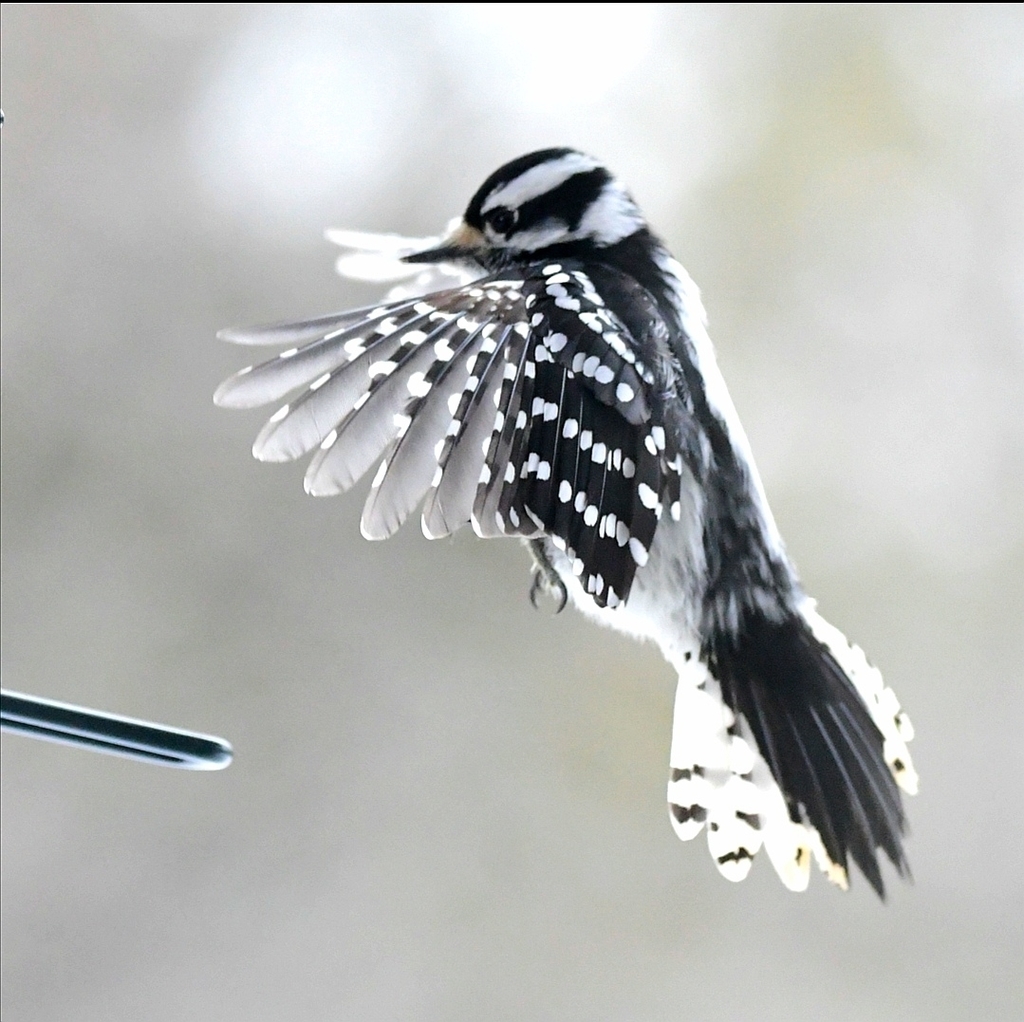
(c) Alexis Williams, some rights reserved (CC BY) · licence
Family: Picidae · Class: Aves · Order: Piciformes
Dryobates pubescens (Downy Woodpecker) is a California animal in the Picidae family.
The Downy Woodpecker is North America's smallest woodpecker species, measuring 14 to 18 cm (5.5 to 7.1 inches) in length with a wingspan of 25 to 31 cm (9.8 to 12.2 inches). Adults weigh between 20 and 33 grams (0.7 to 1.2 ounces). Both sexes display black and white plumage with a white back marked by black barring. Males are distinguished by a bright red patch on the back of the head, while females lack this red marking. The species has a short, straight, chisel-like bill typical of woodpeckers, and white outer tail feathers with black spots or bars. Downy Woodpeckers have an extensive range across North America, from southern Canada to the Gulf Coast states. In California, they occur throughout most of the state except for the driest desert regions and highest elevations. The species is resident year-round in suitable habitat, with populations found from sea level to approximately 2,100 meters (6,900 feet) elevation in mountainous areas. The species inhabits deciduous and mixed forests, riparian woodlands, parks, orchards, and suburban areas with mature trees. Downy Woodpeckers show preference for areas with a mix of dead and living trees, as dead wood provides nesting sites and foraging opportunities. They commonly occupy oak woodlands, cottonwood groves along streams, and urban environments with established tree cover. The species adapts well to human-modified landscapes provided adequate tree resources remain available. Downy Woodpeckers are primarily insectivorous, feeding on wood-boring beetle larvae, ants, caterpillars, and other arthropods extracted from bark crevices and dead wood. They also consume tree sap, particularly from sapsucker wells, and eat fruits and seeds seasonally. The species uses a gleaning foraging technique, searching for prey on tree surfaces rather than excavating deep holes like larger woodpecker species. Breeding occurs from March through July, with pairs excavating nest cavities in dead wood or dead portions of living trees. Females typically lay 3 to 8 glossy white eggs, which both parents incubate for 11 to 13 days. Young fledge after 18 to 21 days but remain dependent on parents for several weeks. Downy Woodpeckers maintain stable populations throughout most of their range and are not federally or state-listed as threatened or endangered. According to the North American Breeding Bird Survey, populations have remained relatively stable across North America since 1966, with some regional variations. The species benefits from forest management practices that retain snags and mature trees. Primary conservation concerns include habitat loss from urban development and intensive forest management that removes dead trees essential for nesting and foraging. Climate change may affect the species through alterations in insect prey availability and forest composition, though impacts remain largely unstudied.
Classification
Class: Aves · Order: Piciformes · Family: Picidae
Frequently asked questions
How is Dryobates pubescens classified?
Dryobates pubescens belongs to class Aves, order Piciformes, family Picidae.
What family does Dryobates pubescens belong to?
Dryobates pubescens is in the Picidae family.
What is Dryobates pubescens?
The Downy Woodpecker is North America's smallest woodpecker species, measuring 14 to 18 cm (5.5 to 7.1 inches) in length with a wingspan of 25 to 31 cm (9.8 to 12.2 inches).
Is Dryobates pubescens found in California?
Yes. Dryobates pubescens is recorded in California in The California Species Project's catalogue.
Related species
Other California species in the same genus, family, or bioregion.
Data from The California Species Project — 14,000+ California species with verified data from CNPS, CDFW, USFWS, and more.