Dryobates scalaris
Ladder-backed Woodpecker
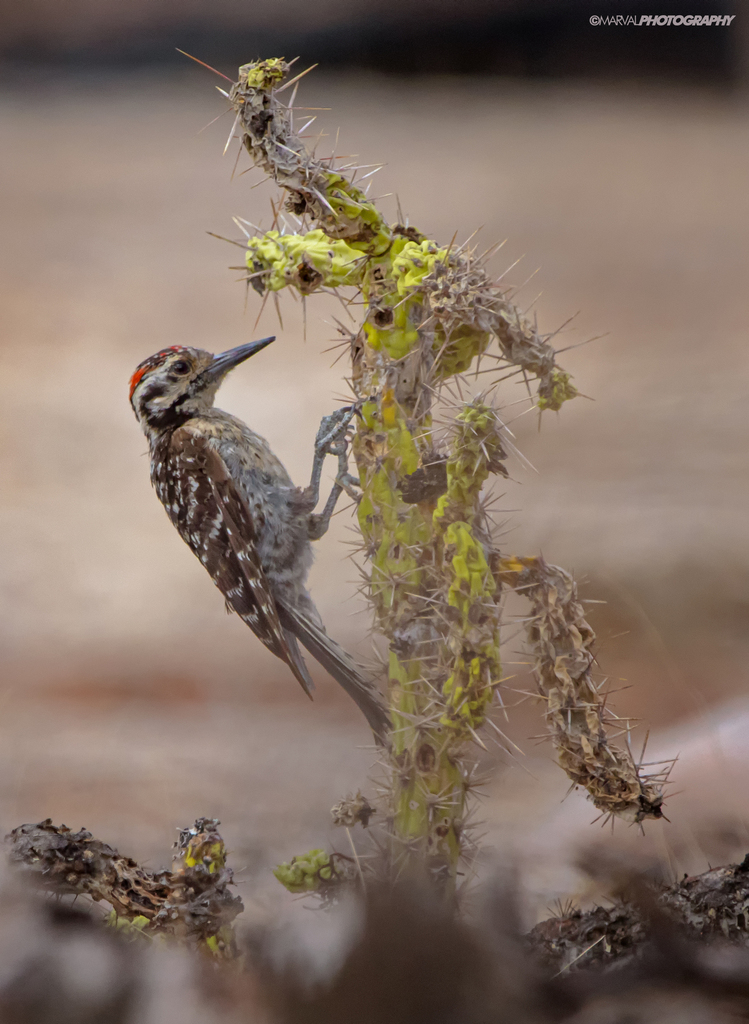
(c) MarvalPhotography19, some rights reserved (CC BY) · licence
Family: Picidae · Class: Aves · Order: Piciformes
Dryobates scalaris (Ladder-backed Woodpecker) is a California animal in the Picidae family.
The Ladder-backed Woodpecker (Dryobates scalaris) is a small woodpecker measuring 16.5 to 19 centimeters (6.5 to 7.5 inches) in length with a wingspan of 33 to 38 centimeters (13 to 15 inches). Adults weigh 21 to 36 grams (0.7 to 1.3 ounces). Males display a red crown and nape, while females have a black crown with white spotting. Both sexes exhibit distinctive black and white barred patterns on their backs and wings, resembling ladder rungs, which gives the species its common name. The face is marked with black and white stripes, and the underparts are grayish-white with black spots on the flanks. The bill is straight, pointed, and dark gray. In California, the Ladder-backed Woodpecker occurs primarily in the southeastern desert regions, including the Colorado and Sonoran deserts. The species ranges through Imperial, Riverside, and San Bernardino counties, with populations extending into the Mojave Desert. The California range represents the northwestern extent of a broader distribution that includes much of the southwestern United States and extends south through Mexico to Nicaragua. This woodpecker inhabits arid and semi-arid environments, favoring desert scrub communities dominated by mesquite, palo verde, ironwood, and various cacti. The species shows particular association with areas containing large columnar cacti such as saguaro and cardon, as well as desert washes with mature mesquite bosques. Elevation ranges from below sea level in the Salton Sea region to approximately 1,200 meters (4,000 feet) in desert mountain ranges. The species also occurs in riparian corridors within desert environments and occasionally in agricultural areas with suitable trees. Ladder-backed Woodpeckers are omnivorous, feeding primarily on insects including beetle larvae, ants, and caterpillars extracted from bark crevices and dead wood. They also consume fruits and seeds, particularly from cacti and desert shrubs. The species employs typical woodpecker foraging techniques, including drilling, bark gleaning, and occasional ground foraging. Breeding occurs from March through July, with pairs excavating nest cavities in dead branches of mesquite, palo verde, or large cacti. Females lay 2 to 7 white eggs, with both parents incubating for 12 to 13 days. Young fledge after 20 to 22 days but may remain with parents for several weeks. The Ladder-backed Woodpecker is not federally or state-listed and maintains stable populations throughout most of its California range. The species benefits from its adaptability to harsh desert conditions and diverse food sources. However, habitat loss from urban development and agriculture conversion in desert regions poses localized threats. Climate change may affect the species through altered precipitation patterns and extreme temperature events that impact insect prey availability and nesting success in desert environments.
Classification
Class: Aves · Order: Piciformes · Family: Picidae
Frequently asked questions
How is Dryobates scalaris classified?
Dryobates scalaris belongs to class Aves, order Piciformes, family Picidae.
What family does Dryobates scalaris belong to?
Dryobates scalaris is in the Picidae family.
What is Dryobates scalaris?
The Ladder-backed Woodpecker (Dryobates scalaris) is a small woodpecker measuring 16.5 to 19 centimeters (6.5 to 7.5 inches) in length with a wingspan of 33 to 38 centimeters (13 to 15 inches).
Is Dryobates scalaris found in California?
Yes. Dryobates scalaris is recorded in California in The California Species Project's catalogue.
Related species
Other California species in the same genus, family, or bioregion.
Data from The California Species Project — 14,000+ California species with verified data from CNPS, CDFW, USFWS, and more.