Dryobates villosus
Hairy Woodpecker
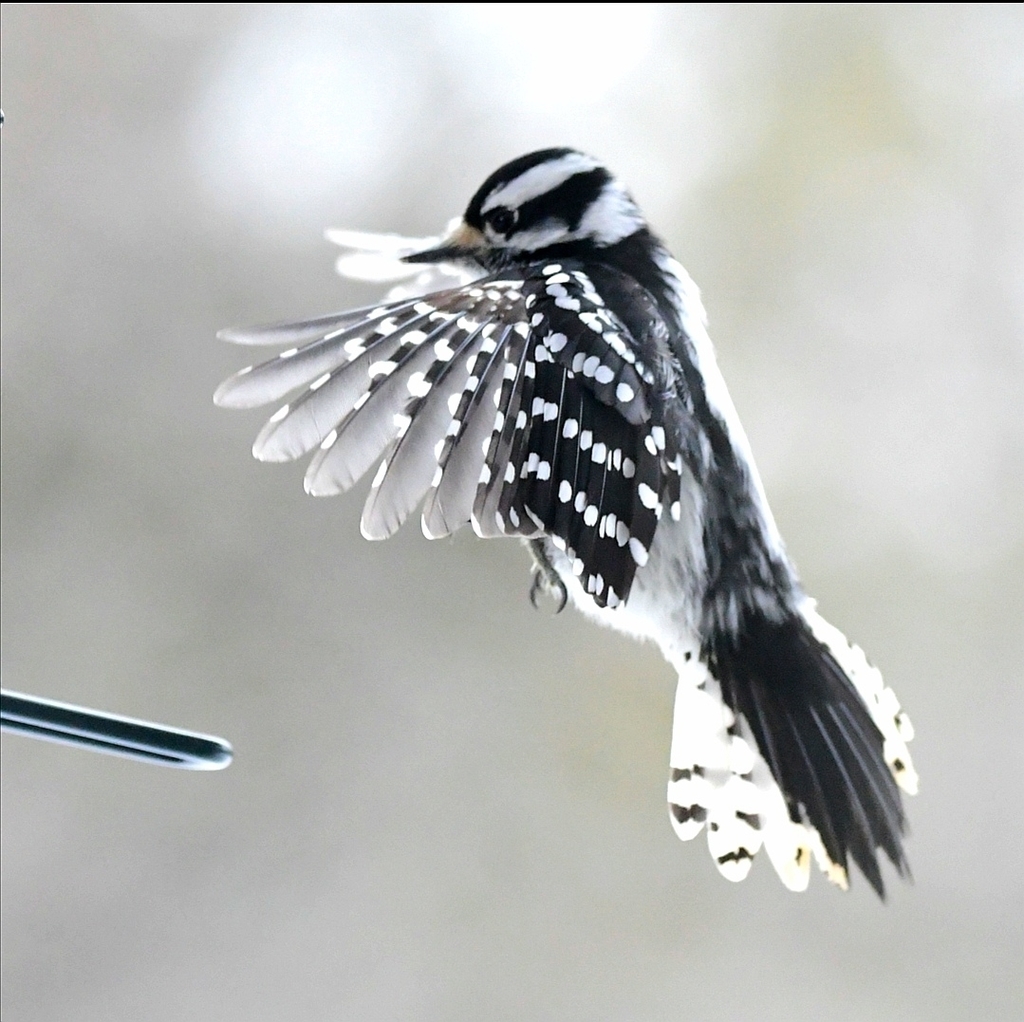
(c) Alexis Williams, some rights reserved (CC BY) · licence
Family: Picidae · Class: Aves · Order: Piciformes
Dryobates villosus (Hairy Woodpecker) is a California animal in the Picidae family.
The Hairy Woodpecker is a medium-sized North American woodpecker measuring 20 to 26 centimeters (8 to 10 inches) in length with a wingspan of 33 to 41 centimeters (13 to 16 inches). Adults weigh between 40 to 95 grams (1.4 to 3.4 ounces). The species exhibits distinct sexual dimorphism: males possess a red patch on the back of the head, while females lack this marking. Both sexes display black and white plumage with a solid black back, white underparts, and distinctive white patches on the wings. The bill is long, straight, and chisel-like, approximately equal in length to the head width, distinguishing it from the similar but smaller Downy Woodpecker. The Hairy Woodpecker maintains one of the most extensive ranges of North American woodpeckers, occurring from Alaska and Canada south through the United States to Central America. In California, the species is found throughout the state except in desert regions and areas lacking suitable tree cover. The subspecies D. v. orius occurs in the Sierra Nevada and Cascade ranges, while D. v. harrisii inhabits coastal regions and the Central Valley where wooded habitats exist. This species inhabits mature forests, woodland edges, parks, and wooded suburban areas with large trees. Hairy Woodpeckers show preference for coniferous and mixed forests but also utilize deciduous woodlands, riparian corridors, and urban areas with sufficient tree cover. They require standing dead trees or dying branches for nesting and foraging, typically selecting sites between 1.5 to 18 meters (5 to 60 feet) above ground. Hairy Woodpeckers are primarily insectivorous, feeding on wood-boring beetle larvae, ants, caterpillars, and other arthropods extracted from bark crevices and dead wood. They also consume nuts, seeds, and fruits seasonally. Breeding occurs from March through July, with pairs excavating new nest cavities annually in dead or dying wood. Females lay 3 to 6 glossy white eggs, which both parents incubate for 11 to 15 days. Young fledge after 28 to 30 days and may remain with parents for several weeks post-fledging. The species exhibits year-round territoriality, with pairs maintaining territories of 2 to 16 hectares depending on habitat quality. Hairy Woodpeckers communicate through drumming on resonant surfaces, producing rapid sequences of 25 to 30 beats lasting 1 to 2 seconds. Their vocal repertoire includes a sharp 'peek' call and various rattling calls used for territorial defense and mate attraction. Currently, the Hairy Woodpecker is not federally or state listed and maintains stable populations across most of its range. The species benefits from forest management practices that retain snags and mature trees. However, local populations may decline in areas experiencing intensive logging or urban development that removes large trees and dead wood essential for nesting and foraging.
Classification
Class: Aves · Order: Piciformes · Family: Picidae
Frequently asked questions
How is Dryobates villosus classified?
Dryobates villosus belongs to class Aves, order Piciformes, family Picidae.
What family does Dryobates villosus belong to?
Dryobates villosus is in the Picidae family.
What is Dryobates villosus?
The Hairy Woodpecker is a medium-sized North American woodpecker measuring 20 to 26 centimeters (8 to 10 inches) in length with a wingspan of 33 to 41 centimeters (13 to 16 inches).
Is Dryobates villosus found in California?
Yes. Dryobates villosus is recorded in California in The California Species Project's catalogue.
Related species
Other California species in the same genus, family, or bioregion.
Data from The California Species Project — 14,000+ California species with verified data from CNPS, CDFW, USFWS, and more.