Dysdera crocata
Woodlouse Spider
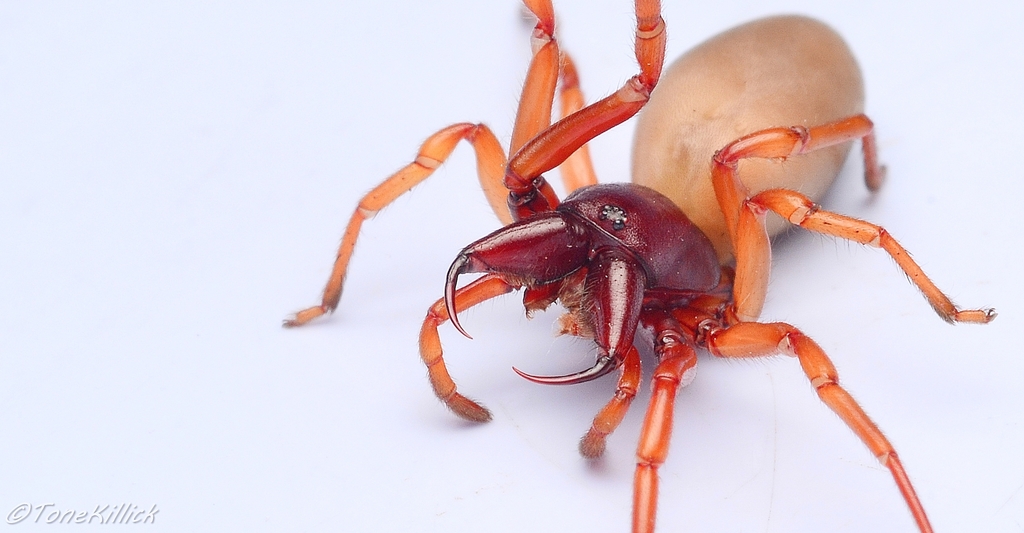
(c) Tone Killick, some rights reserved (CC BY) · licence
Family: Dysderidae · Class: Arachnida · Order: Araneae
Dysdera crocata (Woodlouse Spider) is a California animal in the Dysderidae family.
The woodlouse spider is a medium-sized arachnid measuring 9 to 15 millimeters (0.35 to 0.59 inches) in body length. This distinctive species exhibits pronounced sexual dimorphism in coloration. Males display a reddish-orange cephalothorax and legs with a grayish-white abdomen, while females show more uniform brownish coloration. The species is characterized by its robust build, prominent chelicerae (fangs), and six eyes arranged in a distinctive pattern, distinguishing it from most other spiders which possess eight eyes. Dysdera crocata is native to the Mediterranean region but has become widely established across California and other temperate regions worldwide. In California, the species occurs throughout coastal and inland areas, from sea level to moderate elevations. The spider has been documented in urban environments including the Los Angeles area and Orange County, where it inhabits gardens, parks, and residential landscapes (BugGuide). The species' distribution extends along the Pacific Coast states, making it one of the more commonly encountered introduced spiders in the region (Adams & Manolis 2014). Woodlouse spiders typically inhabit areas with abundant ground cover, including leaf litter, mulched garden beds, under rocks, logs, and in compost piles. They construct simple silk retreats in protected locations such as crevices in walls, under plant debris, or in soil cavities. Unlike web-building spiders, D. crocata does not construct capture webs but instead actively hunts its prey. The species shows preference for moist microhabitats that support their primary prey species. As their common name suggests, woodlouse spiders specialize in hunting terrestrial isopods, commonly known as pill bugs, roly-polies, or woodlice. Their enlarged chelicerae are specifically adapted to penetrate the hard exoskeleton of these crustaceans. The spiders use their powerful fangs to grasp and subdue woodlice, injecting venom to immobilize their prey. Reproduction typically occurs in spring and early summer, with females producing egg sacs containing 20 to 30 eggs. Juveniles undergo several molts before reaching maturity, and adults are primarily nocturnal, emerging at night to hunt. Dysdera crocata is not listed under federal or state conservation programs and is considered a non-native species in California. As an introduced species, it faces no conservation threats and appears to be well-established throughout its introduced range. The spider may provide some ecological benefit by controlling populations of introduced woodlice, which can be garden pests. However, as with many introduced species, its long-term ecological impacts on native arthropod communities remain understudied. The species' successful establishment demonstrates its adaptability to Mediterranean and urban climates similar to its native range.
Classification
Class: Arachnida · Order: Araneae · Family: Dysderidae
Frequently asked questions
How is Dysdera crocata classified?
Dysdera crocata belongs to class Arachnida, order Araneae, family Dysderidae.
What family does Dysdera crocata belong to?
Dysdera crocata is in the Dysderidae family.
What is Dysdera crocata?
The woodlouse spider is a medium-sized arachnid measuring 9 to 15 millimeters (0.35 to 0.59 inches) in body length.
Is Dysdera crocata found in California?
Yes. Dysdera crocata is recorded in California in The California Species Project's catalogue.
More California species
This species has no close relatives in our California data — here are other species to explore.
Data from The California Species Project — 14,000+ California species with verified data from CNPS, CDFW, USFWS, and more.