Echinargus isola
Reakirt's Blue
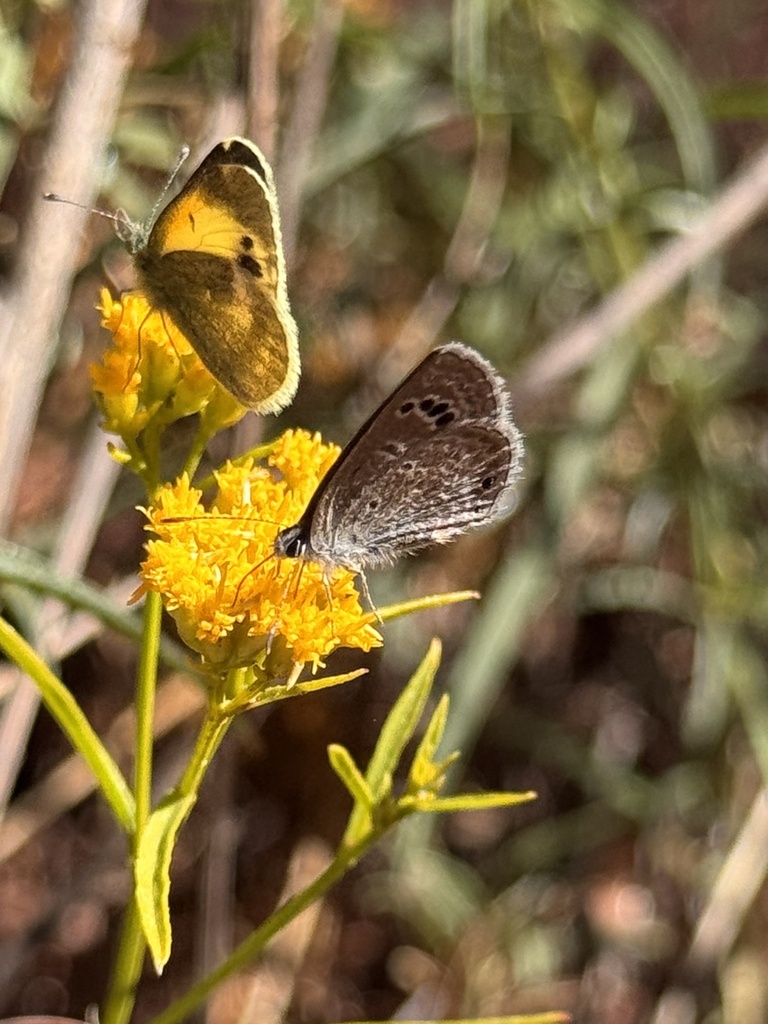
(c) Daniel McNair, some rights reserved (CC BY) · licence
Family: Lycaenidae · Class: Insecta · Order: Lepidoptera
Echinargus isola (Reakirt's Blue) is a California animal in the Lycaenidae family.
Reakirt's Blue (Echinargus isola) is a small butterfly in the family Lycaenidae, measuring 20 to 25 mm (0.8 to 1.0 inch) in wingspan. Males display bright blue dorsal wing surfaces with narrow black borders, while females are brown with blue scaling near the wing bases and orange submarginal spots. The undersides of both sexes are pale gray to white with distinctive black spots and orange crescents along the hindwing margins. A prominent white-ringed eyespot appears near the tail of each hindwing, and males possess short, thread-like tails on the hindwings. Reakirt's Blue exhibits a complex distribution pattern across North America. The species maintains resident populations from southern California eastward through the southwestern United States and Texas, extending south through Mexico and Central America to Costa Rica. During summer months, individuals migrate northward and eastward, reaching as far as Wisconsin and Ohio through the Mississippi River valley states. In California, the species occurs primarily in the southern regions, including the Sonoran and Mojave desert areas, Central Valley, and coastal southern counties. The species inhabits diverse open habitats including desert washes, grasslands, agricultural areas, roadsides, parks, and disturbed sites where host plants occur. Reakirt's Blue thrives in areas with abundant flowering plants that provide nectar sources for adults. The species tolerates a wide elevation range from sea level to approximately 2,100 meters (6,900 feet), demonstrating considerable ecological adaptability. Reakirt's Blue larvae feed exclusively on plants in the pea family (Fabaceae), including yellow sweet clover (Melilotus officinalis), various rattleweed species (Astragalus), mesquite (Prosopis), indigo bush (Dalea), mimosa (Albizia), and indigo species (Indigofera). Adults visit numerous flowering plants for nectar, showing particular preference for members of the sunflower family (Asteraceae) and mint family (Lamiaceae). The species produces multiple broods per year in suitable climates, with continuous breeding possible in southern regions. Females lay single pale green eggs on flower buds or young leaves of host plants. Larvae are green with pale stripes and are typically attended by ants, which provide protection in exchange for sugary secretions. Pupation occurs in leaf litter or attached to host plant stems. Reakirt's Blue is not federally or state listed and appears to maintain stable populations across much of its range. The species benefits from its broad host plant preferences and tolerance for disturbed habitats, including agricultural and urban environments. Climate change may be facilitating northward range expansion, as evidenced by increased records from northern states during recent decades. In California, the species faces potential habitat loss from urban development in southern counties, but its adaptability to modified landscapes and association with weedy host plants likely provides some resilience. The butterfly's strong dispersal abilities and multiple annual generations contribute to population stability, though localized declines may occur where intensive agriculture eliminates native host plants and nectar sources.
Classification
Class: Insecta · Order: Lepidoptera · Family: Lycaenidae
Frequently asked questions
How is Echinargus isola classified?
Echinargus isola belongs to class Insecta, order Lepidoptera, family Lycaenidae.
What family does Echinargus isola belong to?
Echinargus isola is in the Lycaenidae family.
What is Echinargus isola?
Reakirt's Blue (Echinargus isola) is a small butterfly in the family Lycaenidae, measuring 20 to 25 mm (0.8 to 1.0 inch) in wingspan.
Is Echinargus isola found in California?
Yes. Echinargus isola is recorded in California in The California Species Project's catalogue.
Related species
Other California species in the same genus, family, or bioregion.
Data from The California Species Project — 14,000+ California species with verified data from CNPS, CDFW, USFWS, and more.