Efferia albibarbis
Sand Hammertail
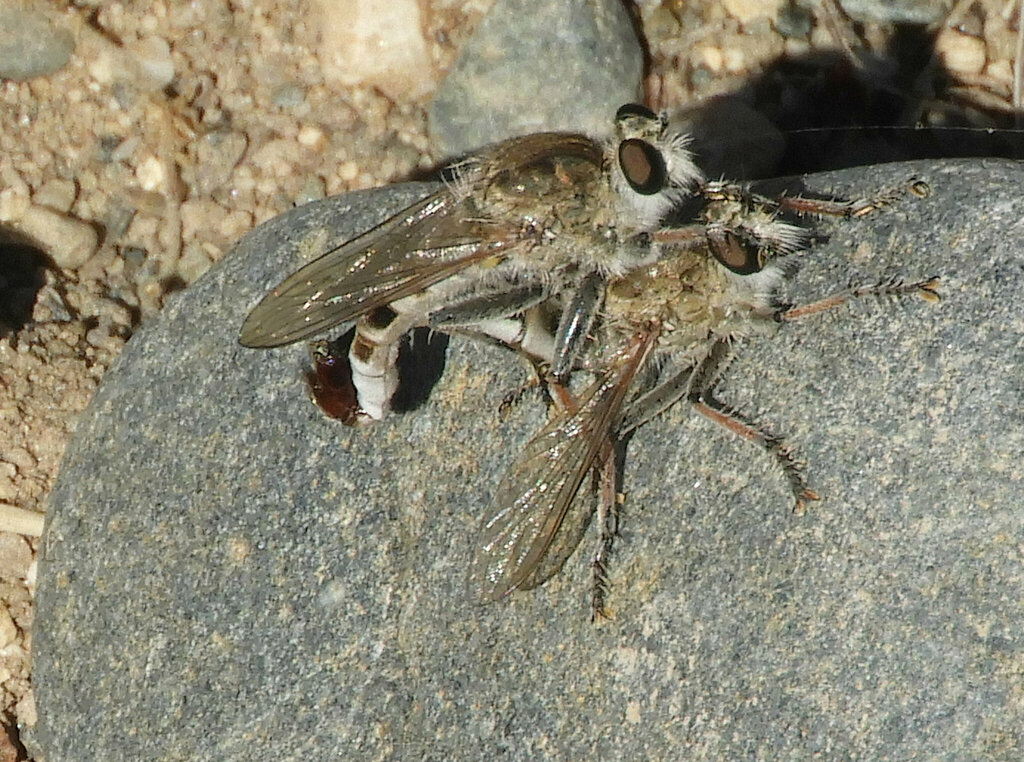
(c) Mary K. Hanson, some rights reserved (CC BY) · licence
Family: Asilidae · Class: Insecta · Order: Diptera
Efferia albibarbis (Sand Hammertail) is a California animal in the Asilidae family.
The sand hammertail (Efferia albibarbis) is a robber fly in the family Asilidae, subfamily Asilinae. This predatory dipteran belongs to the genus Efferia, which comprises the hammertail robber flies, characterized by their robust build and aggressive hunting behavior. As members of the Asilidae family, sand hammertails are aerial predators that capture other insects in flight using their powerful legs and piercing mouthparts. Sand hammertails occur across a broad geographic range in North America, with documented populations extending from British Columbia south through California, Arizona, and Colorado, and eastward to states including Alabama, Arkansas, Delaware, Florida, Georgia, and Illinois (BugGuide). In California, the species has been recorded from April through September, with peak activity occurring during the summer months from June through August. The species appears to have a widespread but potentially scattered distribution pattern across diverse habitats. The habitat preferences of sand hammertails encompass various terrestrial environments, though specific microhabitat requirements have not been thoroughly documented in the scientific literature. Based on distribution patterns and the common name suggesting an association with sandy substrates, the species likely inhabits areas with well-drained soils including sandy plains, open woodlands, and scrublands. The broad geographic range suggests considerable habitat flexibility, from desert regions in Arizona to more mesic environments in eastern states. Sand hammertails exhibit the typical predatory behavior of asilid flies, functioning as sit-and-wait predators that launch aerial attacks on flying insects. Adult flies perch on prominent objects such as bare branches, rocks, or posts, using their excellent vision to detect potential prey. When a suitable target approaches, they execute rapid pursuit flights to capture victims using their strong, spiny legs. The prey is then pierced with their rigid proboscis and consumed through external digestion. Flight activity data indicates adults are most active during warm, sunny conditions from late spring through early fall (BugGuide). Like other hammertail species, sand hammertails likely complete their larval development in soil, where the grub-like larvae prey on other soil-dwelling arthropods. Adult emergence timing varies geographically, with California populations showing activity from April through September. Mating behavior probably involves territorial displays by males, though specific courtship behaviors have not been well studied for this species. The conservation status of sand hammertails has not been formally assessed by state or federal agencies. The species does not appear on threatened or endangered species lists, and its wide distribution across multiple states suggests stable populations. However, like many native insects, sand hammertails may face pressures from habitat loss, pesticide use, and climate change. The lack of detailed ecological studies limits understanding of population trends and specific conservation needs. Continued monitoring of robber fly communities and preservation of diverse terrestrial habitats will benefit this and other native predatory insects.
Classification
Class: Insecta · Order: Diptera · Family: Asilidae
Frequently asked questions
How is Efferia albibarbis classified?
Efferia albibarbis belongs to class Insecta, order Diptera, family Asilidae.
What family does Efferia albibarbis belong to?
Efferia albibarbis is in the Asilidae family.
What is Efferia albibarbis?
The sand hammertail (Efferia albibarbis) is a robber fly in the family Asilidae, subfamily Asilinae.
Is Efferia albibarbis found in California?
Yes. Efferia albibarbis is recorded in California in The California Species Project's catalogue.
Related species
Other California species in the same genus, family, or bioregion.
Data from The California Species Project — 14,000+ California species with verified data from CNPS, CDFW, USFWS, and more.