Efferia macroxipha
Glamis Robberfly
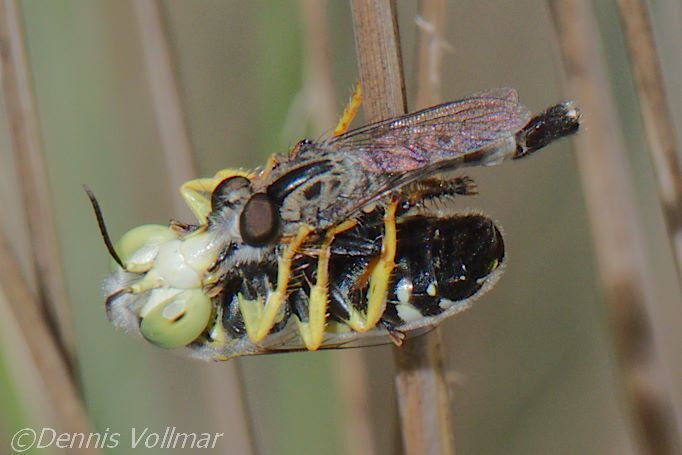
(c) Dennis Vollmar, some rights reserved (CC BY) · licence
Family: Asilidae · Class: Insecta · Order: Diptera
Conservation status: G1G2 S2S3
Efferia macroxipha (Glamis Robberfly) is a California animal in the Asilidae family.
The Glamis Robberfly (Efferia macroxipha) is a predaceous dipteran insect in the family Asilidae, commonly known as robber flies. Adults are characterized by their robust build and distinctive predatory adaptations, including a prominent proboscis and strong, grasping legs. The species displays the typical asilid morphology with a densely bristled thorax and abdomen, though specific size measurements have not been well documented in the scientific literature. The species' distribution appears to be centered in the southwestern United States, particularly in desert regions of California. The common name "Glamis" likely refers to the Glamis Dunes area in Imperial County, California, suggesting this region may represent an important part of the species' range. However, detailed distribution records and specific county occurrences require further documentation through systematic surveys. Habitat preferences for E. macroxipha have not been thoroughly studied, though the association with the Glamis name suggests adaptation to sandy desert environments. Most robber flies in the genus Efferia typically inhabit arid and semi-arid regions, often associated with open sandy areas, desert flats, and sparse vegetation zones. The species likely requires appropriate substrate for larval development, as asilid larvae are typically soil-dwelling predators that feed on other insect larvae and pupae. Like other members of the family Asilidae, adult Glamis Robberflies are aggressive aerial predators that capture other flying insects. They employ a sit-and-wait hunting strategy, perching on low vegetation or bare ground before launching rapid pursuit flights to capture prey. The powerful proboscis is used to pierce captured insects and inject digestive enzymes. Mating typically occurs during warmer months, with females depositing eggs in sandy soil where larvae develop as subterranean predators. Specific details regarding seasonal activity patterns, prey preferences, and reproductive biology remain poorly documented. The conservation status of Efferia macroxipha reflects significant uncertainty about the species' population status and trends. The Global/State Rank of G1G2 S2S3 indicates the species is considered critically imperiled to imperiled globally (G1G2) and imperiled to vulnerable in California (S2S3). This ranking suggests very small population size, very restricted range, or other factors making the species vulnerable to extinction. However, the species lacks formal federal or state listing status, and comprehensive population assessments have not been conducted. Primary conservation challenges likely include habitat modification in desert regions, recreational activities in dune systems, and the general lack of biological data necessary for effective management planning. The specialized habitat requirements typical of many desert-adapted insects, combined with increasing development pressure in southwestern California, may pose ongoing threats to population stability. Detailed ecological studies of this species are lacking. The above information synthesizes available taxonomic and conservation status data. We welcome contributions of verified scientific data, photographs, or field observations to enhance this species account. Additional research is needed to document basic biology, distribution, habitat requirements, and population trends for effective conservation planning.
Classification
Class: Insecta · Order: Diptera · Family: Asilidae
Conservation status
G1G2 S2S3
Frequently asked questions
How is Efferia macroxipha classified?
Efferia macroxipha belongs to class Insecta, order Diptera, family Asilidae.
What family does Efferia macroxipha belong to?
Efferia macroxipha is in the Asilidae family.
Is Efferia macroxipha protected or of conservation concern?
Efferia macroxipha carries the following status: G1G2 S2S3.
What is Efferia macroxipha?
The Glamis Robberfly (Efferia macroxipha) is a predaceous dipteran insect in the family Asilidae, commonly known as robber flies.
Is Efferia macroxipha found in California?
Yes. Efferia macroxipha is recorded in California in The California Species Project's catalogue.
Related species
Other California species in the same genus, family, or bioregion.
Data from The California Species Project — 14,000+ California species with verified data from CNPS, CDFW, USFWS, and more.