Elanoides forficatus
Swallow-tailed Kite
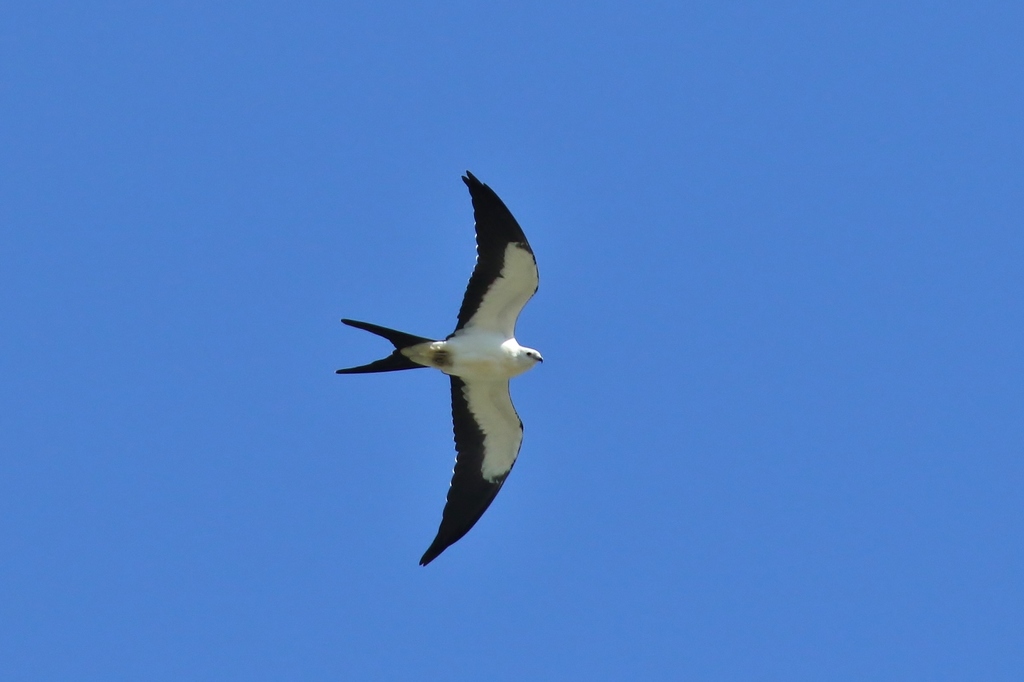
(c) Thibaud Aronson, some rights reserved (CC BY-SA) · licence
Family: Accipitridae · Class: Aves · Order: Accipitriformes
Elanoides forficatus (Swallow-tailed Kite) is a California animal in the Accipitridae family.
The Swallow-tailed Kite is a large raptor measuring 55 to 65 cm (22 to 26 inches) in length with a wingspan of 1.2 to 1.4 meters (4 to 4.5 feet). The species is distinguished by its deeply forked tail, which comprises nearly half of its total length. Adults display stark black and white plumage, with white heads, necks, underparts, and underwing coverts contrasting sharply with black flight feathers, back, and tail. The wings are long and pointed, adapted for soaring flight. Males and females are similar in appearance, though females are typically slightly larger. Historically, Swallow-tailed Kites bred across much of the southeastern United States, with populations extending north to Minnesota and west to the Great Plains. The species also occurred in California during the 19th century, with documented breeding records from the Central Valley and coastal regions. However, the California population was extirpated by the early 20th century due to habitat loss and direct persecution. Currently, the species breeds primarily in Florida, with smaller populations in South Carolina, Georgia, Alabama, Mississippi, Louisiana, and eastern Texas. The total North American breeding population is estimated at fewer than 5,000 pairs according to Partners in Flight. Swallow-tailed Kites inhabit forested wetlands, including cypress swamps, mixed hardwood forests, and pine flatwoods near water sources. They require tall trees for nesting, typically selecting canopy-level sites 15 to 30 meters (50 to 100 feet) above ground. The species shows strong preference for areas with open water or wet prairies nearby, which provide abundant prey. Nesting territories are established in spring, with pairs often returning to the same general area annually. These aerial specialists are highly maneuverable, capable of catching prey while in flight without landing. Their diet consists primarily of small vertebrates including frogs, lizards, snakes, and nestling birds, as well as large insects such as dragonflies, beetles, and wasps. Swallow-tailed Kites are known to drink by skimming water surfaces during flight. Breeding occurs from March through July, with pairs constructing stick nests lined with moss and lichen in tall trees. Females typically lay two to three white eggs marked with brown spots. Incubation lasts 24 to 28 days, with young fledging after 35 to 42 days. The species is migratory, with North American populations wintering in South America from Colombia to northern Argentina. Fall migration begins in July and August, with birds congregating in large flocks before crossing the Gulf of Mexico. Spring return occurs from February through April. The Swallow-tailed Kite is not federally listed but faces ongoing threats from habitat loss, particularly the conversion of forested wetlands. Climate change may affect prey availability and migration timing. Conservation efforts focus on protecting remaining breeding habitats and maintaining connectivity between fragmented forest patches. The species remains absent from California, with no recent recolonization attempts documented.
Classification
Class: Aves · Order: Accipitriformes · Family: Accipitridae
Frequently asked questions
How is Elanoides forficatus classified?
Elanoides forficatus belongs to class Aves, order Accipitriformes, family Accipitridae.
What family does Elanoides forficatus belong to?
Elanoides forficatus is in the Accipitridae family.
What is Elanoides forficatus?
The Swallow-tailed Kite is a large raptor measuring 55 to 65 cm (22 to 26 inches) in length with a wingspan of 1.2 to 1.4 meters (4 to 4.5 feet).
Is Elanoides forficatus found in California?
Yes. Elanoides forficatus is recorded in California in The California Species Project's catalogue.
Related species
Other California species in the same genus, family, or bioregion.
Data from The California Species Project — 14,000+ California species with verified data from CNPS, CDFW, USFWS, and more.