Elanus leucurus
White-tailed kite
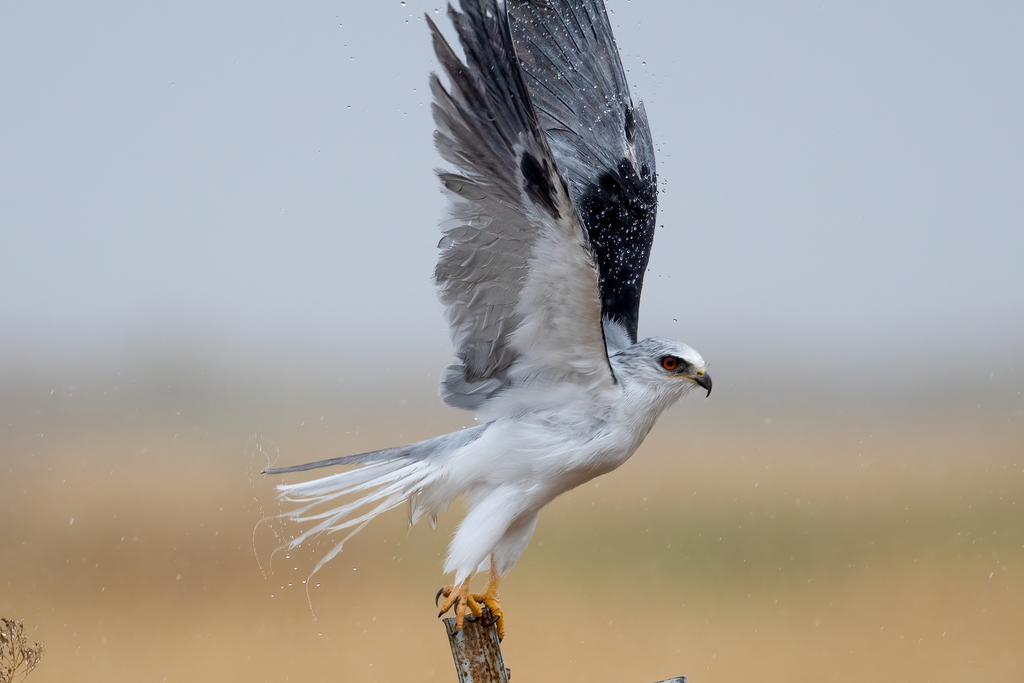
(c) Jonathan Eisen, some rights reserved (CC BY) · licence
Family: Accipitridae · Class: Aves · Order: Accipitriformes
Conservation status: FP · G5 S3S4
Elanus leucurus (White-tailed kite) is a California animal in the Accipitridae family.
The White-tailed kite is a medium-sized raptor measuring 35 to 43 cm (14 to 17 inches) in length with a wingspan of 88 to 102 cm (35 to 40 inches). Adults weigh between 280 to 361 grams (10 to 13 ounces). The species exhibits distinctive black shoulder patches contrasting with predominantly white and light gray plumage. The head, underparts, and tail are white, while the back and wings display pale gray coloration. Males and females appear similar, though females are slightly larger. Juveniles show rusty-brown streaking on the breast and head that fades with maturity. In flight, the species displays black wingtips and distinctive white patches on the underwing coverts. Historically, White-tailed kites occurred throughout California's Central Valley and coastal regions. The species experienced severe population declines in the early to mid-20th century, becoming extirpated from many areas by the 1940s. Recovery efforts and habitat protection have allowed populations to reestablish across much of the historical range. Current distribution includes the Central Valley from Shasta County south to Kern County, coastal regions from Humboldt County to San Diego County, and scattered locations in the Sierra Nevada foothills. The species also occurs through much of the western United States and Central and South America. White-tailed kites inhabit open grasslands, agricultural areas, oak savannas, and wetland margins from sea level to approximately 1,600 meters (5,200 feet) elevation. The species requires a combination of open hunting areas with scattered trees or tall shrubs for nesting and roosting. Suitable habitat includes cattle ranches, alfalfa fields, rice fields, restored grasslands, and riparian corridors. Nesting typically occurs in trees 3 to 15 meters (10 to 50 feet) tall, including oaks, willows, cottonwoods, and eucalyptus. White-tailed kites are specialized rodent predators, with voles comprising 80 to 95 percent of their diet. The species employs a distinctive hunting strategy of hovering 6 to 24 meters (20 to 80 feet) above ground before dropping to capture prey. Breeding occurs from February through October, with peak activity from March through July. Pairs construct platform nests of twigs lined with grass and other fine materials. Females lay 3 to 5 eggs, which are incubated for 30 to 32 days. Young fledge after 35 to 40 days but remain dependent on parents for an additional 5 to 8 weeks. The species may produce two broods annually during favorable years. The White-tailed kite is designated as Fully Protected under California law, providing complete protection from take or harassment. The species is ranked G5 (globally secure) but S3S4 (vulnerable to apparently secure) in California, reflecting ongoing conservation concerns despite population recovery. Primary threats include habitat loss from urban and agricultural development, pesticide use that reduces prey availability, and disturbance at nest sites. Climate change may affect rodent prey cycles and habitat suitability. Conservation efforts focus on protecting nesting areas, maintaining suitable grassland habitats, and reducing pesticide applications in agricultural areas.
Classification
Class: Aves · Order: Accipitriformes · Family: Accipitridae
Conservation status
FP · G5 S3S4
Frequently asked questions
How is Elanus leucurus classified?
Elanus leucurus belongs to class Aves, order Accipitriformes, family Accipitridae.
What family does Elanus leucurus belong to?
Elanus leucurus is in the Accipitridae family.
Is Elanus leucurus protected or of conservation concern?
Elanus leucurus carries the following status: FP · G5 S3S4.
What is Elanus leucurus?
The White-tailed kite is a medium-sized raptor measuring 35 to 43 cm (14 to 17 inches) in length with a wingspan of 88 to 102 cm (35 to 40 inches).
Is Elanus leucurus found in California?
Yes. Elanus leucurus is recorded in California in The California Species Project's catalogue.
Related species
Other California species in the same genus, family, or bioregion.
Data from The California Species Project — 14,000+ California species with verified data from CNPS, CDFW, USFWS, and more.