Elasmopalpus lignosellus
Lesser Cornstalk Borer
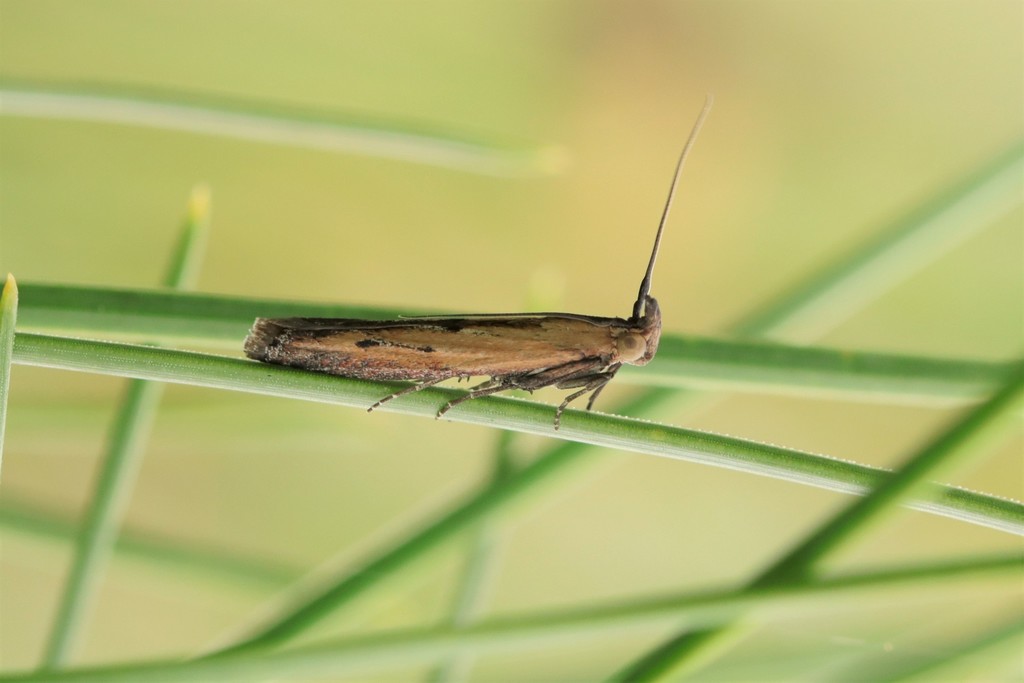
(c) Jake McCumber, some rights reserved (CC BY) · licence
Family: Pyralidae · Class: Insecta · Order: Lepidoptera
Elasmopalpus lignosellus (Lesser Cornstalk Borer) is a California animal in the Pyralidae family.
The lesser cornstalk borer (Elasmopalpus lignosellus) is a small pyralid moth belonging to the family Pyralidae. Adult moths have a wingspan of 20 to 25 mm (0.8 to 1.0 inches), with forewings that are pale yellow to light brown with darker brown or gray markings. Males are typically smaller and darker than females, with forewings displaying irregular dark bands and spots. The hindwings are whitish with a pale yellow tinge. At rest, the moth holds its wings in a triangular position close to the body. This species has a broad distribution across the United States, ranging from southern Canada to Mexico. In California, the lesser cornstalk borer occurs throughout the Central Valley and southern regions, particularly in agricultural areas. The species is also found across the southeastern United States, with populations extending from Florida to Texas and north to Kansas and North Carolina. The moth has been expanding its range northward in recent decades, likely due to climate warming and increased cultivation of host crops. The lesser cornstalk borer inhabits agricultural landscapes, preferring areas with sandy, well-drained soils. The species thrives in cultivated fields, particularly those containing corn, sorghum, sugarcane, and various legumes. Adults are commonly found in crop fields, field margins, and adjacent weedy areas. The moth shows a strong preference for warm, dry conditions and is most abundant in regions with hot summers and mild winters. Adult moths are primarily active during evening and nighttime hours, with peak flight activity occurring shortly after sunset. Females deposit eggs singly on or near host plants, typically at soil level or on lower plant stems. The species exhibits multiple generations per year, with three to four broods common in warmer regions. Larvae are the damaging stage, boring into plant stems at or below ground level. Young caterpillars are pale yellow with brown heads, becoming more reddish-brown as they mature, reaching 12 to 15 mm (0.5 to 0.6 inches) in length. Pupation occurs in earthen chambers in the soil. The lesser cornstalk borer is considered a significant agricultural pest rather than a conservation concern. Larvae cause economic damage by boring into stems of corn, sorghum, sugarcane, soybeans, and other crops, leading to plant wilting, stunting, or death. The species is particularly problematic during drought conditions when plants are stressed. Damage is most severe in sandy soils and areas with inadequate moisture. Management strategies include maintaining adequate soil moisture through irrigation, using resistant crop varieties, and applying targeted insecticide treatments when necessary. The moth's pest status has led to extensive research on its biology and control methods, but it is not subject to conservation measures as populations remain stable and widespread across its range.
Classification
Class: Insecta · Order: Lepidoptera · Family: Pyralidae
Frequently asked questions
How is Elasmopalpus lignosellus classified?
Elasmopalpus lignosellus belongs to class Insecta, order Lepidoptera, family Pyralidae.
What family does Elasmopalpus lignosellus belong to?
Elasmopalpus lignosellus is in the Pyralidae family.
What is Elasmopalpus lignosellus?
The lesser cornstalk borer (Elasmopalpus lignosellus) is a small pyralid moth belonging to the family Pyralidae.
Is Elasmopalpus lignosellus found in California?
Yes. Elasmopalpus lignosellus is recorded in California in The California Species Project's catalogue.
Related species
Other California species in the same genus, family, or bioregion.
Data from The California Species Project — 14,000+ California species with verified data from CNPS, CDFW, USFWS, and more.