Elasmostethus cruciatus
Red-cross Shield Bug
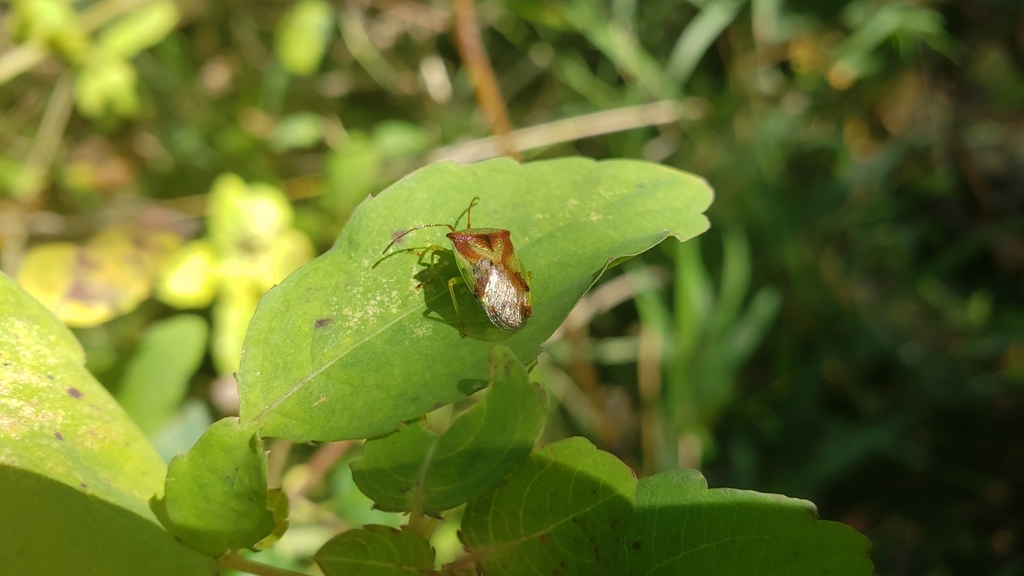
(c) Gavin Slater, some rights reserved (CC BY) · licence
Family: Acanthosomatidae · Class: Insecta · Order: Hemiptera
Elasmostethus cruciatus (Red-cross Shield Bug) is a California animal in the Acanthosomatidae family.
The Red-cross Shield Bug is a medium-sized hemipteran insect in the family Acanthosomatidae. Adults typically measure 8-12 mm in length and display a distinctive shield-shaped body characteristic of the family. The species is named for the prominent reddish cross-like marking that extends across the pronotum and scutellum on the dorsal surface. The body coloration ranges from brown to reddish-brown with darker punctations scattered across the surface. Unlike some related species, E. cruciatus possesses pale antennae rather than black antennae, which serves as a key diagnostic feature (BugGuide). Elasmostethus cruciatus has a broad North American distribution, extending from the Sierra Nevada of California eastward to Illinois and South Dakota, and northward through forested mountain ranges to the Yukon Territory of Canada. The species occurs across multiple Canadian provinces including British Columbia, Alberta, Manitoba, and Ontario. In California, the species is found primarily in mountainous regions, particularly the Sierra Nevada range, though specific county-level distribution data within the state remains limited. The Red-cross Shield Bug inhabits forested environments, showing a preference for coniferous and mixed forest ecosystems. The species is typically associated with woody plants and shrubs where both adults and nymphs feed. Like other members of the Acanthosomatidae, this species demonstrates a preference for cooler, shaded forest understory environments. Elevation ranges and specific microhabitat preferences in California have not been thoroughly documented. As a member of the true bugs (Hemiptera), E. cruciatus possesses piercing-sucking mouthparts and feeds on plant juices. The species exhibits typical pentatomoid biology with gradual metamorphosis through five nymphal instars before reaching adulthood. Adults are most commonly observed during summer months, with peak activity occurring from June through August. The species likely overwinters as adults in protected locations such as under bark or in leaf litter. Females deposit eggs on host plants, and nymphs develop through spring and early summer. Specific host plant associations and detailed reproductive biology require further study. Elasmostethus cruciatus currently holds no special conservation status at federal or state levels. The species appears to maintain stable populations across its range, though comprehensive population assessments have not been conducted. As with many forest-dwelling insects, potential threats include habitat loss due to logging activities and climate-induced changes to forest composition. The species' broad geographic distribution and apparent habitat flexibility suggest it faces minimal immediate conservation concerns. However, the lack of detailed ecological studies limits understanding of specific population trends or vulnerabilities. Scientific documentation for this species remains limited compared to more economically significant hemipterans. The above information synthesizes available data from taxonomic databases and field guides. Additional research on host plant specificity, population dynamics, and ecological interactions would enhance understanding of this species' role in forest ecosystems.
Classification
Class: Insecta · Order: Hemiptera · Family: Acanthosomatidae
Frequently asked questions
How is Elasmostethus cruciatus classified?
Elasmostethus cruciatus belongs to class Insecta, order Hemiptera, family Acanthosomatidae.
What family does Elasmostethus cruciatus belong to?
Elasmostethus cruciatus is in the Acanthosomatidae family.
What is Elasmostethus cruciatus?
The Red-cross Shield Bug is a medium-sized hemipteran insect in the family Acanthosomatidae.
Is Elasmostethus cruciatus found in California?
Yes. Elasmostethus cruciatus is recorded in California in The California Species Project's catalogue.
More California species
This species has no close relatives in our California data — here are other species to explore.
Data from The California Species Project — 14,000+ California species with verified data from CNPS, CDFW, USFWS, and more.