Eleodes armata
Armored Stink Beetle
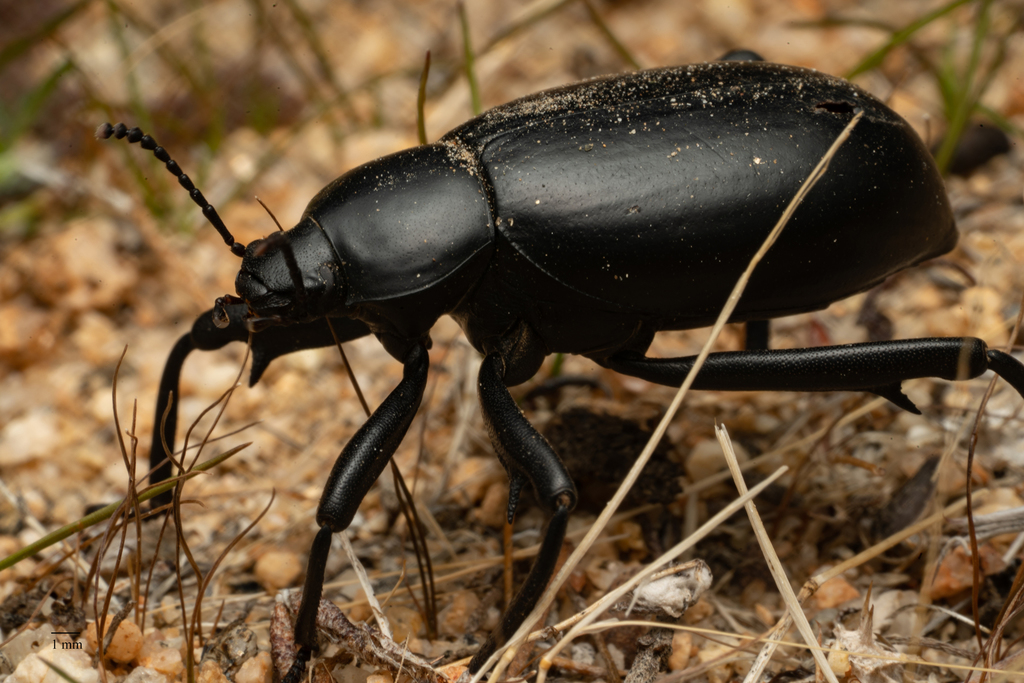
no rights reserved · CC0
Family: Tenebrionidae · Class: Insecta · Order: Coleoptera
Eleodes armata (Armored Stink Beetle) is a California animal in the Tenebrionidae family.
The Armored Stink Beetle is a large, robust darkling beetle measuring 17-33 mm (0.67-1.30 inches) in body length, with some specimens reaching up to 31 mm. This species is distinguished by its most diagnostic feature: prominent spurs on all six legs, making it one of the few Eleodes species that can be readily identified in the field (Evans & Hogue 2006). The body is typically dark brown to black with a matte finish, and the elytra (wing covers) are fused, rendering the species flightless like other members of the genus. Eleodes armata ranges across the southwestern United States and northwestern Mexico, with populations documented in California's desert regions including the Sonoran and Mojave deserts. In California, the species occurs in San Diego County, where it has been recorded from Anza-Borrego Desert State Park, and extends into other desert counties. The species also occurs in Arizona, Nevada, and Baja California, Mexico. This beetle inhabits arid desert environments, typically found in sandy washes, desert flats, and areas with sparse vegetation. Specimens have been collected at elevations ranging from approximately 700 feet to higher desert elevations. The species shows a preference for areas with loose sand and scattered desert shrubs, often taking shelter among vegetation at the base of sand dunes on wind-protected sides. Adults are commonly found walking on desert floors, particularly during cooler periods. Armored Stink Beetles are primarily nocturnal, becoming active after sunset to forage and seek mates. Like other Eleodes species, they are detritivores, feeding on decaying plant material, fungi, and organic debris. When threatened, they exhibit the characteristic defensive behavior of the genus by elevating their posterior end and releasing noxious secretions from abdominal glands, earning them the common name "stink beetle." Adults are long-lived for insects, potentially surviving multiple years. Females develop well-developed ova, and reproduction likely occurs during favorable environmental conditions, though specific breeding biology remains poorly documented. The species appears to maintain stable populations throughout its range and faces no immediate conservation concerns. As a desert-adapted species, Eleodes armata may be vulnerable to habitat modification from urban development, off-road vehicle activity, and potentially climate change impacts on desert ecosystems. However, the species' wide distribution across multiple desert regions and apparent adaptability to various microhabitats within its preferred desert environment suggest resilience to moderate habitat disturbances. The genus Eleodes contains numerous species that can be challenging to distinguish, but E. armata's unique leg armature makes it one of the more readily identifiable members of this diverse group. In the United States, the presence of spurs on all six legs is diagnostic for this species, though several additional species with similar characteristics occur in Baja California (BugGuide).
Classification
Class: Insecta · Order: Coleoptera · Family: Tenebrionidae
Frequently asked questions
How is Eleodes armata classified?
Eleodes armata belongs to class Insecta, order Coleoptera, family Tenebrionidae.
What family does Eleodes armata belong to?
Eleodes armata is in the Tenebrionidae family.
What is Eleodes armata?
The Armored Stink Beetle is a large, robust darkling beetle measuring 17-33 mm (0.67-1.30 inches) in body length, with some specimens reaching up to 31 mm.
Is Eleodes armata found in California?
Yes. Eleodes armata is recorded in California in The California Species Project's catalogue.
Related species
Other California species in the same genus, family, or bioregion.
Data from The California Species Project — 14,000+ California species with verified data from CNPS, CDFW, USFWS, and more.