Eleodes dentipes
Dentate Stink Beetle
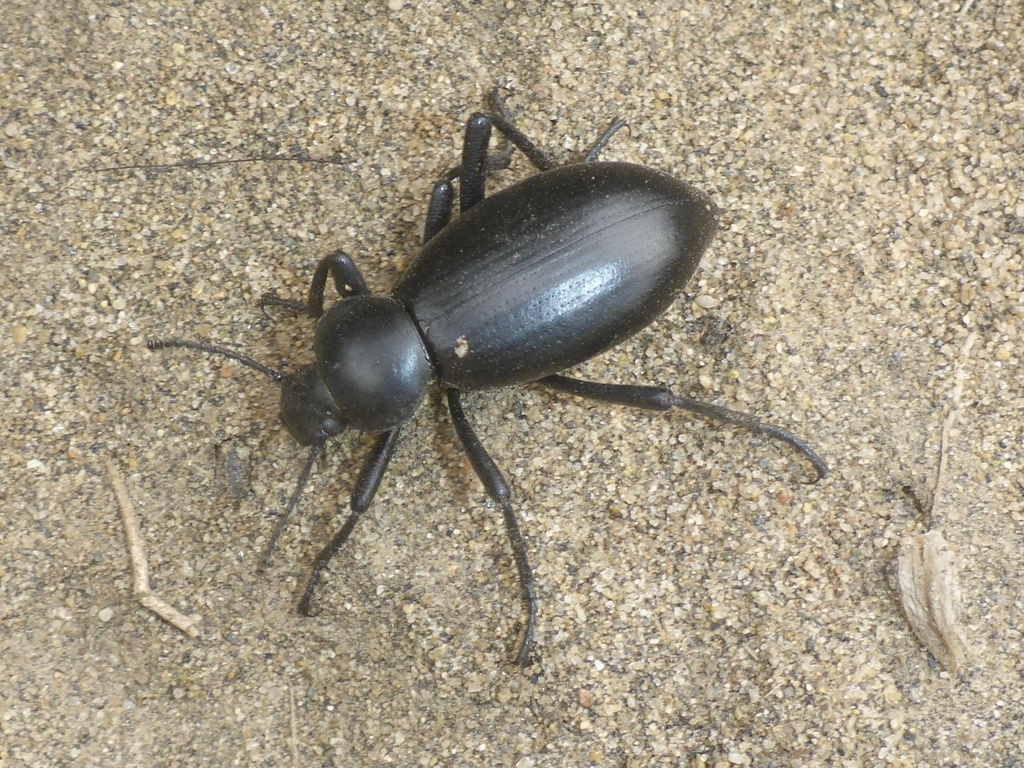
(c) Cricket Raspet, some rights reserved (CC BY) · licence
Family: Tenebrionidae · Class: Insecta · Order: Coleoptera
Eleodes dentipes (Dentate Stink Beetle) is a California animal in the Tenebrionidae family.
The Dentate Stink Beetle is a member of the darkling beetle family Tenebrionidae, classified within the genus Eleodes and subfamily Blaptinae. This species was first described by Eschscholtz in 1833 and belongs to the subgenus Eleodes within the larger Desert Stink Beetles group (BugGuide.Net). The common name "dentate" refers to tooth-like projections or serrated features characteristic of this species, though detailed morphological descriptions remain limited in the scientific literature. Physical specimens documented from California show considerable size variation within the species. Observations from Ventura County indicate that individuals can range from notably small specimens, described as "almost half the size" of typical Eleodes beetles, to more standard darkling beetle proportions (BugGuide.Net). Like other members of the genus Eleodes, this species likely exhibits the characteristic black or dark brown coloration typical of darkling beetles, with a robust, oval-shaped body form. The species has been documented in California, with specific records from Ventura County at locations such as Triunfo Creek Park along the Pentachaeta Trail (BugGuide.Net). The broader range of Eleodes dentipes requires further documentation, as current distributional data remains incomplete. Within California, the species appears to occur in areas with suitable habitat for darkling beetles, though comprehensive range mapping has not been completed. Habitat preferences for Eleodes dentipes have not been extensively studied, but documented occurrences suggest association with typical darkling beetle environments. The Ventura County observation from Triunfo Creek Park indicates the species utilizes areas within or adjacent to chaparral and oak woodland ecosystems. Like other Eleodes species, this beetle likely inhabits areas with loose soil, leaf litter, and debris where it can forage and find shelter. Behavioral and ecological information for this species remains largely undocumented in the scientific literature. As a member of the darkling beetle family, Eleodes dentipes is presumed to be detritivorous, feeding on decaying organic matter including dead plant material, fungi, and decomposing animal matter. The species likely exhibits nocturnal activity patterns typical of many tenebrionids, seeking shelter during daylight hours under rocks, logs, or in soil crevices. Reproductive biology, seasonal activity patterns, and specific dietary preferences have not been well studied. No specific conservation status has been assigned to Eleodes dentipes at federal or state levels. The species does not appear on current endangered species lists or species of special concern designations. However, the limited documentation of this beetle's distribution, habitat requirements, and population status indicates a significant knowledge gap that hampers effective conservation assessment. Climate change and habitat modification in California's Mediterranean ecosystems may pose potential threats to specialized beetle species, though specific impacts on Eleodes dentipes cannot be evaluated without more comprehensive ecological studies. Scientific documentation for this species remains limited. The information presented here is based on available sources including BugGuide.Net taxonomic records and photographic documentation. Additional field research is needed to better understand the distribution, ecology, and conservation needs of the Dentate Stink Beetle in California.
Classification
Class: Insecta · Order: Coleoptera · Family: Tenebrionidae
Frequently asked questions
How is Eleodes dentipes classified?
Eleodes dentipes belongs to class Insecta, order Coleoptera, family Tenebrionidae.
What family does Eleodes dentipes belong to?
Eleodes dentipes is in the Tenebrionidae family.
What is Eleodes dentipes?
The Dentate Stink Beetle is a member of the darkling beetle family Tenebrionidae, classified within the genus Eleodes and subfamily Blaptinae.
Is Eleodes dentipes found in California?
Yes. Eleodes dentipes is recorded in California in The California Species Project's catalogue.
Related species
Other California species in the same genus, family, or bioregion.
Data from The California Species Project — 14,000+ California species with verified data from CNPS, CDFW, USFWS, and more.