Elgaria coerulea
Northern Alligator Lizard
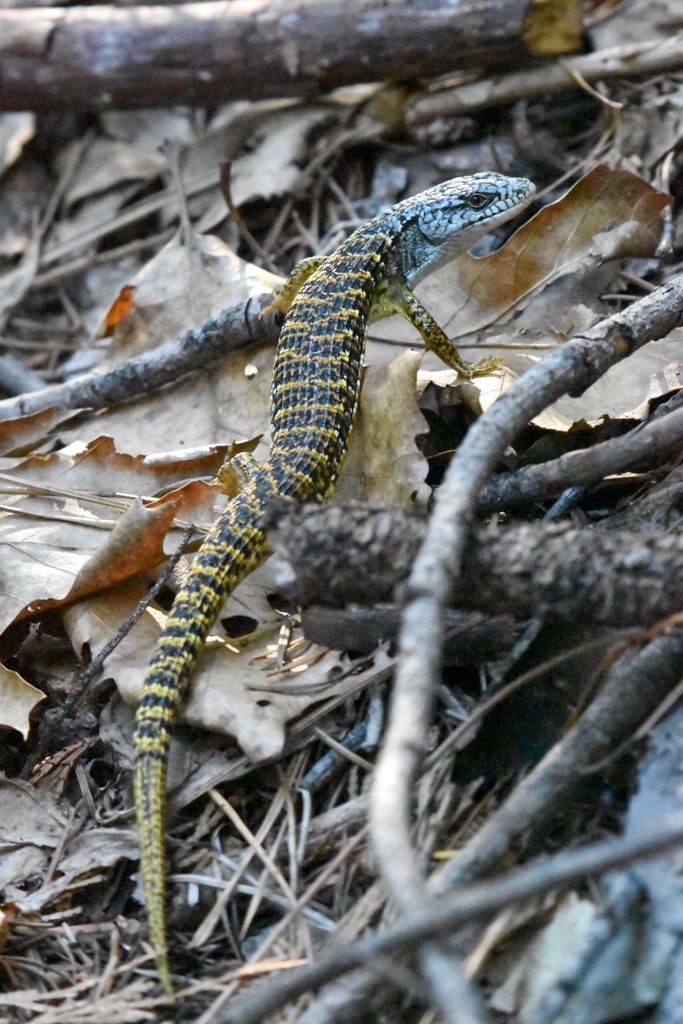
(c) Trevor Van Loon, some rights reserved (CC BY) · licence
Family: Anguidae · Class: Reptilia · Order: Squamata
Elgaria coerulea (Northern Alligator Lizard) is a California animal in the Anguidae family.
The Northern Alligator Lizard is a medium-sized reptile native to western North America, including California. Adults typically measure 20 to 27 centimeters (8 to 11 inches) in snout-to-vent length, with total length including the tail reaching up to 63 centimeters (25 inches). The body is elongated and cylindrical with short legs relative to body size. Dorsal coloration ranges from brown to gray-green with darker crossbands or blotches. The ventral surface is pale yellow to white. Scales are arranged in distinct rows with a fold of skin along each side of the body, giving the species its characteristic alligator-like appearance. The tail is long, typically 1.3 to 2 times the snout-to-vent length, and can be regenerated if lost. The Northern Alligator Lizard occurs throughout much of California, from sea level to elevations of approximately 3,350 meters (11,000 feet). The species ranges from the northern counties south through the Sierra Nevada, Coast Ranges, and Transverse Ranges. It is absent from the Central Valley floor and most desert regions. The distribution extends north into Oregon, Washington, and southern British Columbia, and east into Idaho and western Montana. This species inhabits diverse habitats including oak woodlands, mixed coniferous forests, chaparral, grasslands, and riparian zones. It shows particular affinity for areas with abundant ground cover such as leaf litter, fallen logs, rock piles, and dense vegetation. The species occurs in both mesic and xeric environments but requires some moisture availability. Northern Alligator Lizards are often found near streams, springs, or other water sources, particularly during dry periods. Northern Alligator Lizards are primarily terrestrial but capable climbers, often observed in low shrubs and trees. They are active during daylight hours, with peak activity occurring during morning and late afternoon when temperatures are moderate. The diet consists primarily of insects, spiders, snails, and other small invertebrates, though larger individuals may consume small vertebrates including mice and smaller lizards. Reproduction occurs in spring, with mating typically taking place from April through June. Females are viviparous, giving birth to live young after a gestation period of approximately 90 to 120 days. Litter sizes range from 2 to 15 offspring, with an average of 6 to 8 young. Newborns measure approximately 7 centimeters (2.8 inches) in total length. The Northern Alligator Lizard is not federally listed or considered a species of conservation concern in California as of December 2025. Populations appear stable throughout most of the species' range, though local declines may occur due to habitat loss from urban development and intensive agriculture. The species' broad habitat tolerance and extensive distribution contribute to its overall stability. Climate change may affect populations at higher elevations or in areas experiencing increased drought frequency, but current data suggest the species remains widespread and abundant across suitable habitats in California.
Classification
Class: Reptilia · Order: Squamata · Family: Anguidae
Frequently asked questions
How is Elgaria coerulea classified?
Elgaria coerulea belongs to class Reptilia, order Squamata, family Anguidae.
What family does Elgaria coerulea belong to?
Elgaria coerulea is in the Anguidae family.
What is Elgaria coerulea?
The Northern Alligator Lizard is a medium-sized reptile native to western North America, including California.
Is Elgaria coerulea found in California?
Yes. Elgaria coerulea is recorded in California in The California Species Project's catalogue.
Related species
Other California species in the same genus, family, or bioregion.
Data from The California Species Project — 14,000+ California species with verified data from CNPS, CDFW, USFWS, and more.