Elops afinis
Machete
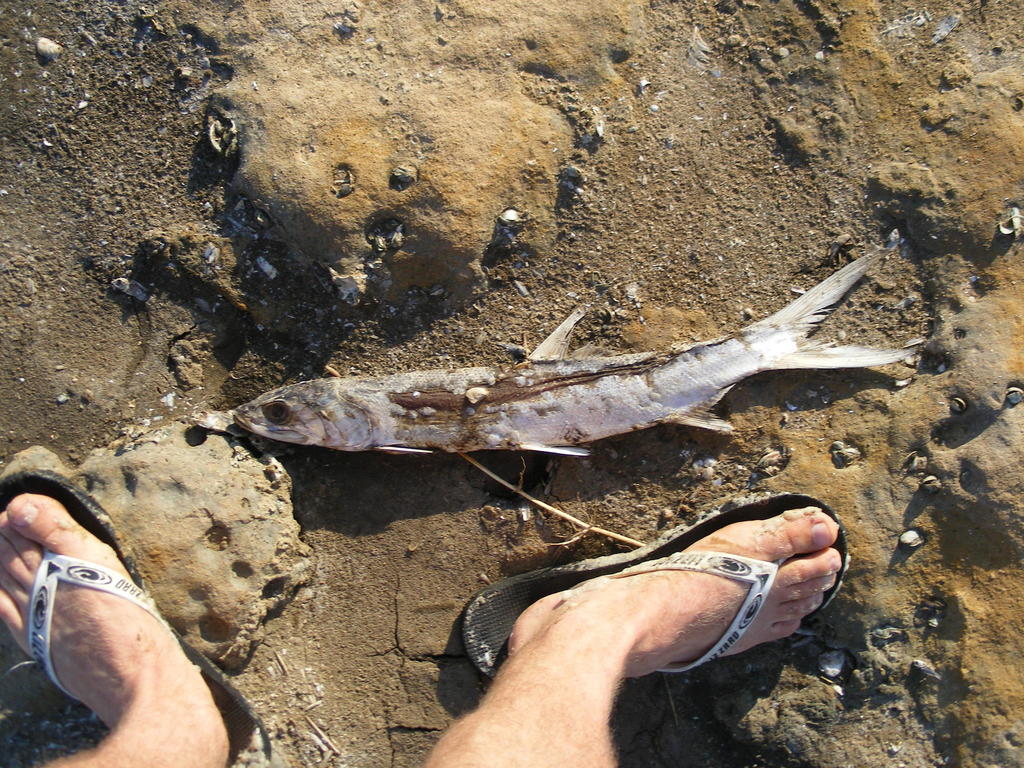
(c) Robert Taylor, some rights reserved (CC BY) · licence
Family: Elopidae · Class: Actinopterygii · Order: Elopiformes
Elops afinis (Machete) is a California animal in the Elopidae family.
The machete (Elops afinis) is a large, elongated marine fish belonging to the family Elopidae, commonly known as tarpons and ladyfish. Adults typically reach lengths of 90 to 120 centimeters (35 to 47 inches) and can exceed 150 centimeters (59 inches) in exceptional cases. The body is streamlined and silvery, with a deeply forked tail fin and a single dorsal fin positioned near the middle of the back. The species displays a metallic silver coloration along the sides with a bluish-green dorsal surface. The mouth is large and terminal, equipped with small, pointed teeth arranged in bands on both jaws. Juvenile machete are notably different in appearance, being ribbon-like and transparent, a larval form known as leptocephalus that is characteristic of elopiform fishes. The machete occurs along the eastern Pacific coast from southern California to Peru, including the Gulf of California. In California waters, the species is found primarily in the warmer southern coastal areas, particularly around San Diego County and occasionally north to Orange County during warmer water periods. The distribution extends throughout the tropical and subtropical eastern Pacific, with populations recorded from Baja California, Mexico, southward along the Central and South American coasts. This species inhabits coastal marine waters, typically in nearshore areas including bays, estuaries, and shallow coastal zones. Machete prefer water temperatures above 20°C (68°F) and are commonly found in depths ranging from the surface to approximately 30 meters (98 feet). Juveniles often inhabit mangrove areas, tidal pools, and protected coastal lagoons where they find shelter and abundant food sources. Adults may venture into deeper waters but generally remain within the continental shelf region. Machete are opportunistic predators that feed primarily on small fish, crustaceans, and marine worms. The species exhibits schooling behavior, often forming large aggregations in coastal waters. Reproduction involves a complex life cycle with the distinctive leptocephalus larval stage that can persist for several months before metamorphosing into the juvenile form. Spawning is believed to occur in offshore waters, with larvae eventually recruiting to nearshore nursery habitats. The species is known for its jumping ability when hooked, similar to other members of the Elopidae family. Currently, the machete holds no federal or state conservation listing status in California. The species is not assessed by the International Union for Conservation of Nature (IUCN) as a distinct species, as taxonomic uncertainty has historically existed within the Elops genus. Recent molecular studies have clarified species boundaries within this group, confirming Elops afinis as a valid species distinct from Atlantic forms. While no specific population trends have been documented for California waters, the species appears to maintain stable populations throughout its range. Climate change may influence the northern extent of the species' distribution in California, as warming ocean temperatures could allow for range expansion northward along the coast.
Classification
Class: Actinopterygii · Order: Elopiformes · Family: Elopidae
Frequently asked questions
How is Elops afinis classified?
Elops afinis belongs to class Actinopterygii, order Elopiformes, family Elopidae.
What family does Elops afinis belong to?
Elops afinis is in the Elopidae family.
What is Elops afinis?
The machete (Elops afinis) is a large, elongated marine fish belonging to the family Elopidae, commonly known as tarpons and ladyfish.
Is Elops afinis found in California?
Yes. Elops afinis is recorded in California in The California Species Project's catalogue.
More California species
This species has no close relatives in our California data — here are other species to explore.
Data from The California Species Project — 14,000+ California species with verified data from CNPS, CDFW, USFWS, and more.