Emberiza pusilla
Little Bunting
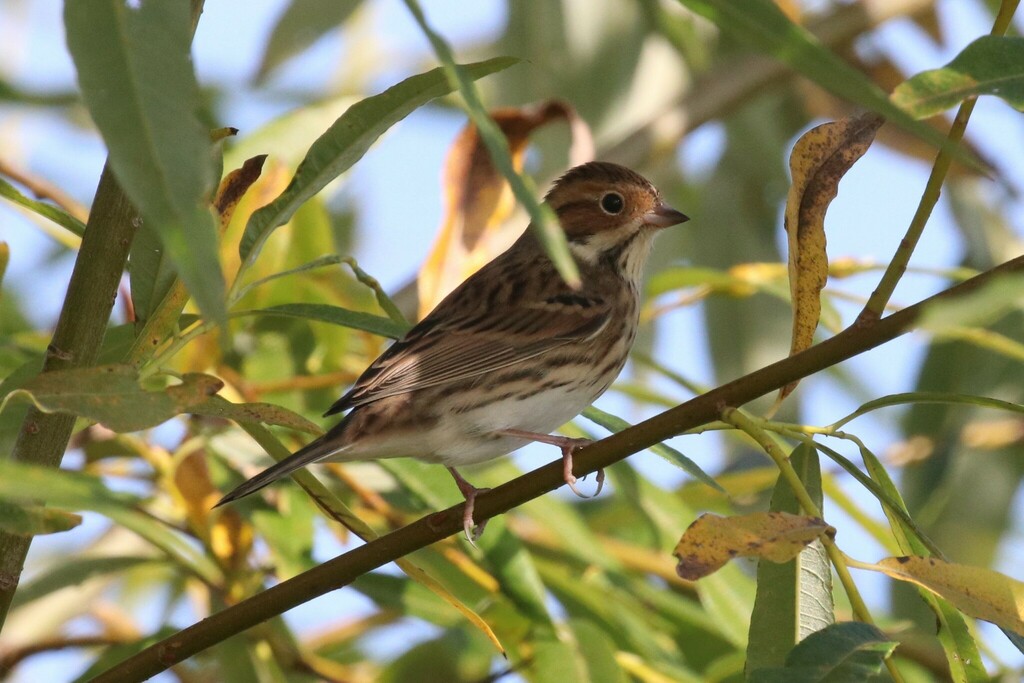
(c) Константин Селивёрстов, some rights reserved (CC BY) · licence
Family: Emberizidae · Class: Aves · Order: Passeriformes
Emberiza pusilla (Little Bunting) is a California animal in the Emberizidae family.
The Little Bunting is a small passerine bird measuring 12-14 cm (4.7-5.5 inches) in length with a wingspan of 18-20 cm (7.1-7.9 inches). Adults weigh 12-16 grams. During breeding season, males display a distinctive black-striped head pattern with a prominent white eyebrow stripe and russet-colored crown. The upperparts are brown with darker streaking, while the underparts are pale buff with fine dark streaks on the breast. Non-breeding adults and juveniles show more subdued coloration with less distinct facial markings. The species has a short, conical bill typical of seed-eating birds and relatively long legs for ground foraging. The Little Bunting breeds across northern Eurasia from Scandinavia east to Kamchatka and south to northern Mongolia. The species is highly migratory, wintering primarily in Southeast Asia, southern China, and the Indian subcontinent. In North America, Little Buntings are extremely rare vagrants, with fewer than 20 documented records. Most North American observations have occurred along the Pacific Coast, particularly in Alaska's western Aleutian Islands, with scattered records from California, Washington, and British Columbia. California records are exceptionally rare, with only a handful of confirmed sightings since the 1980s. Breeding habitat consists of open taiga and forest-tundra ecotones with scattered birch, willow, and pine trees. The species favors areas with dense ground vegetation including sedges, grasses, and low shrubs near wetlands or forest clearings. During migration and winter, Little Buntings occupy grasslands, agricultural areas, reed beds, and scrubland. Vagrant individuals in California have been observed in coastal grasslands, park settings, and urban areas with mixed vegetation. Little Buntings are primarily granivorous, feeding on seeds of grasses, sedges, and herbs during most of the year. During the breeding season, adults supplement their diet with insects including beetles, flies, caterpillars, and spiders, which provide essential protein for growing chicks. The species typically forages on the ground, using a distinctive scratching motion with both feet to uncover food items. Breeding occurs from May through July, with females constructing cup-shaped nests on or near the ground in dense vegetation. Clutch size ranges from 4-6 eggs, which are incubated for 11-13 days. Nestlings fledge after 9-11 days but remain dependent on parents for several additional weeks. The Little Bunting is not federally listed in the United States, as it is not a resident species. The global population is considered stable by the International Union for Conservation of Nature, which lists the species as Least Concern. However, some northern populations have experienced declines due to habitat loss from logging and agricultural expansion. Climate change may affect breeding ranges in the Arctic and subarctic regions. In California, the species remains an extremely rare vagrant with no established population or conservation concerns. Observers should report any suspected Little Bunting sightings to eBird or local ornithological organizations for verification and documentation.
Classification
Class: Aves · Order: Passeriformes · Family: Emberizidae
Frequently asked questions
How is Emberiza pusilla classified?
Emberiza pusilla belongs to class Aves, order Passeriformes, family Emberizidae.
What family does Emberiza pusilla belong to?
Emberiza pusilla is in the Emberizidae family.
What is Emberiza pusilla?
The Little Bunting is a small passerine bird measuring 12-14 cm (4.7-5.5 inches) in length with a wingspan of 18-20 cm (7.1-7.9 inches).
Is Emberiza pusilla found in California?
Yes. Emberiza pusilla is recorded in California in The California Species Project's catalogue.
Related species
Other California species in the same genus, family, or bioregion.
Data from The California Species Project — 14,000+ California species with verified data from CNPS, CDFW, USFWS, and more.