Emberiza rustica
Rustic Bunting
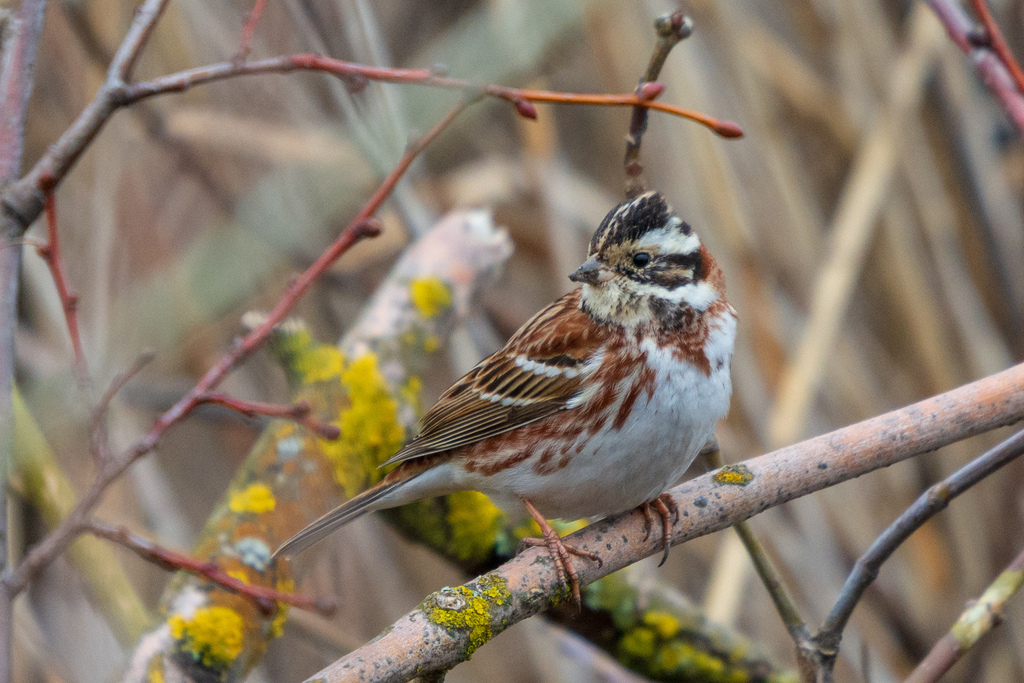
(c) Людмила Алимова, some rights reserved (CC BY) · licence
Family: Emberizidae · Class: Aves · Order: Passeriformes
Emberiza rustica (Rustic Bunting) is a California animal in the Emberizidae family.
The Rustic Bunting is a small passerine bird measuring 14 to 16 centimeters (5.5 to 6.3 inches) in length with a wingspan of 21 to 24 centimeters (8.3 to 9.4 inches). Males in breeding plumage display distinctive black and white head markings, with a black crown and ear coverts contrasting sharply with white eyebrows and throat. The upperparts are rusty-brown with dark streaking, while the underparts are white with rusty flanks and breast band. Females and non-breeding males are more subdued, showing brown and buff tones with less distinct markings. Both sexes have a characteristic white outer tail feathers visible in flight. The Rustic Bunting breeds across the boreal forests of northern Eurasia, from Scandinavia east through Siberia to the Russian Far East. In North America, the species is considered a rare vagrant, with occasional records in Alaska, primarily in the western Aleutian Islands and Bering Sea region. California records are extremely rare, with fewer than five documented occurrences, typically involving single individuals detected during fall or winter months along the coast or at inland migrant traps. During the breeding season, Rustic Buntings inhabit coniferous and mixed forests, particularly areas with dense understory vegetation near wetlands, forest edges, and clearings. They prefer habitats with abundant ground cover, including shrubs, fallen logs, and leaf litter. On wintering grounds in East Asia, the species occupies reed beds, grasslands, agricultural areas, and scrubland. Vagrant individuals in North America are typically found in coastal scrub, park settings, or areas with dense vegetation that provide cover and foraging opportunities. Rustic Buntings are primarily ground-foragers, searching for seeds, insects, and other invertebrates among leaf litter and low vegetation. During breeding season, their diet includes beetles, caterpillars, flies, and spiders, which provide essential protein for nestlings. Seeds become increasingly important during fall and winter, with preferences for grasses, sedges, and small shrub seeds. Breeding occurs from May through July, with females constructing cup-shaped nests of grasses and moss lined with fine materials, typically placed on the ground or in low shrubs. Clutch size ranges from four to six eggs, which are incubated for 12 to 14 days. The Rustic Bunting is classified as Vulnerable by the International Union for Conservation of Nature, reflecting significant population declines across its range. European populations have experienced particularly steep declines, with some estimates suggesting reductions of 50% or more since 1990. Primary threats include habitat loss from logging and agricultural conversion, climate change affecting boreal forest ecosystems, and changes in insect abundance during breeding season. The species' rarity in North America makes California occurrences noteworthy events for the birding community, with most records documented through eBird and regional rare bird alert systems.
Classification
Class: Aves · Order: Passeriformes · Family: Emberizidae
Frequently asked questions
How is Emberiza rustica classified?
Emberiza rustica belongs to class Aves, order Passeriformes, family Emberizidae.
What family does Emberiza rustica belong to?
Emberiza rustica is in the Emberizidae family.
What is Emberiza rustica?
The Rustic Bunting is a small passerine bird measuring 14 to 16 centimeters (5.5 to 6.3 inches) in length with a wingspan of 21 to 24 centimeters (8.3 to 9.4 inches).
Is Emberiza rustica found in California?
Yes. Emberiza rustica is recorded in California in The California Species Project's catalogue.
Related species
Other California species in the same genus, family, or bioregion.
Data from The California Species Project — 14,000+ California species with verified data from CNPS, CDFW, USFWS, and more.