Empidonax alnorum
Alder Flycatcher
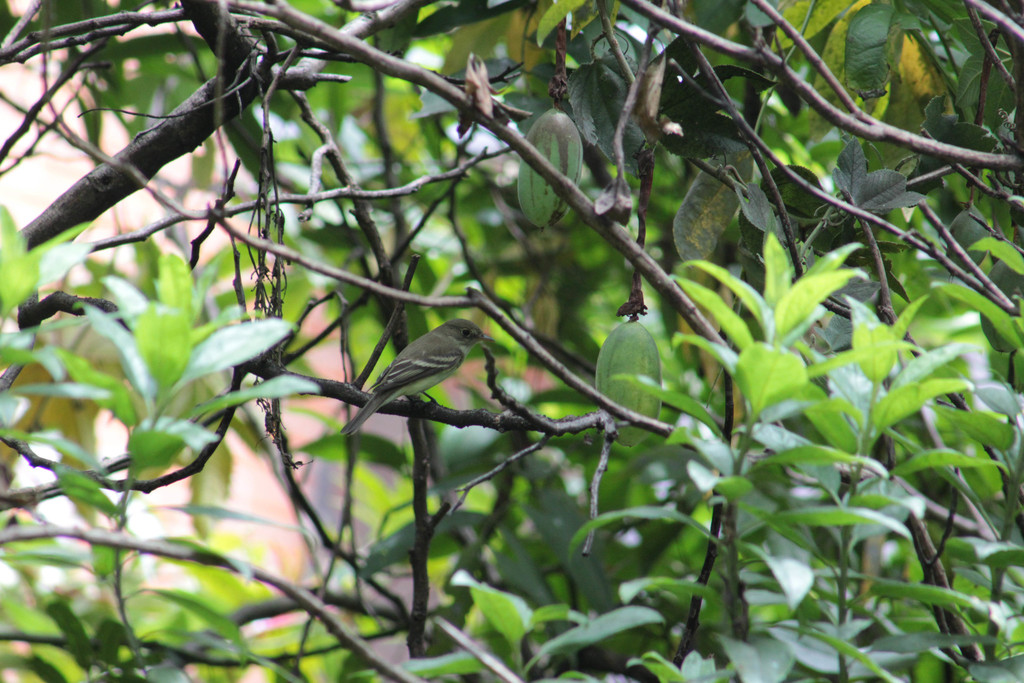
(c) GERMAN LEONEL SARMIENTO CRUZ, some rights reserved (CC BY) · licence
Family: Tyrannidae · Class: Aves · Order: Passeriformes
Empidonax alnorum (Alder Flycatcher) is a California animal in the Tyrannidae family.
The Alder Flycatcher is a small passerine bird measuring 13 to 17 centimeters (5.1 to 6.7 inches) in length with a wingspan of 22 to 24 centimeters (8.7 to 9.4 inches). Adults weigh 11 to 14 grams (0.39 to 0.49 ounces). The species exhibits olive-brown upperparts with darker wings and tail, while underparts are whitish with pale yellow wash on the belly and flanks. Two prominent white wing bars distinguish it from similar species. The bill is relatively broad and dark with an orange-yellow base on the lower mandible. A thin white eye ring is present but less conspicuous than in closely related flycatchers. Historically, the Alder Flycatcher bred in the northeastern United States and across Canada, with limited breeding populations extending into the mountainous regions of western North America. In California, the species occurs primarily as a rare migrant during spring and fall passage periods, typically observed from late May through early June and again from late July through September. Most California records originate from the Sierra Nevada, Cascade Range, and coastal mountain ranges, with occasional sightings in desert oases during migration. During the breeding season, Alder Flycatchers inhabit dense thickets of alder, willow, and birch shrubs in wet areas such as swamps, bogs, and riparian zones. They prefer early successional habitats with shrub heights of 2 to 4 meters (6.6 to 13.1 feet) and canopy cover between 50 and 80 percent. In California, migrants are typically found in riparian woodlands, mountain meadows with willow thickets, and occasionally in parks and gardens with suitable vegetation structure. The species generally occurs at elevations below 2,000 meters (6,562 feet) in western regions. Alder Flycatchers are insectivorous, capturing prey through hawking flights from exposed perches. Their diet consists primarily of flying insects including flies, moths, beetles, and flying ants. Males establish territories averaging 0.5 to 1.0 hectares (1.2 to 2.5 acres) upon arrival at breeding grounds. The distinctive "fee-bee-o" or "free-beer" call serves as the primary method for species identification, as visual separation from the nearly identical Willow Flycatcher requires acoustic confirmation. Breeding occurs from June through August, with females constructing cup-shaped nests in shrub forks 1 to 3 meters (3.3 to 9.8 feet) above ground. Typical clutch size ranges from 2 to 4 eggs, with an incubation period of 12 to 14 days. The Alder Flycatcher is not federally listed and maintains stable populations across most of its North American range. According to the North American Breeding Bird Survey, populations have remained relatively stable since 1970, though some regional declines have been documented in portions of the breeding range. In California, the species' status as an uncommon migrant reflects its peripheral occurrence relative to core breeding areas. Primary conservation concerns include habitat loss in breeding areas due to wetland drainage and succession of shrubland habitats to mature forest. Climate change may affect migration timing and availability of insect prey during critical migration periods.
Classification
Class: Aves · Order: Passeriformes · Family: Tyrannidae
Frequently asked questions
How is Empidonax alnorum classified?
Empidonax alnorum belongs to class Aves, order Passeriformes, family Tyrannidae.
What family does Empidonax alnorum belong to?
Empidonax alnorum is in the Tyrannidae family.
What is Empidonax alnorum?
The Alder Flycatcher is a small passerine bird measuring 13 to 17 centimeters (5.1 to 6.7 inches) in length with a wingspan of 22 to 24 centimeters (8.7 to 9.4 inches).
Is Empidonax alnorum found in California?
Yes. Empidonax alnorum is recorded in California in The California Species Project's catalogue.
Related species
Other California species in the same genus, family, or bioregion.
Data from The California Species Project — 14,000+ California species with verified data from CNPS, CDFW, USFWS, and more.