Empidonax difficilis
Western Flycatcher
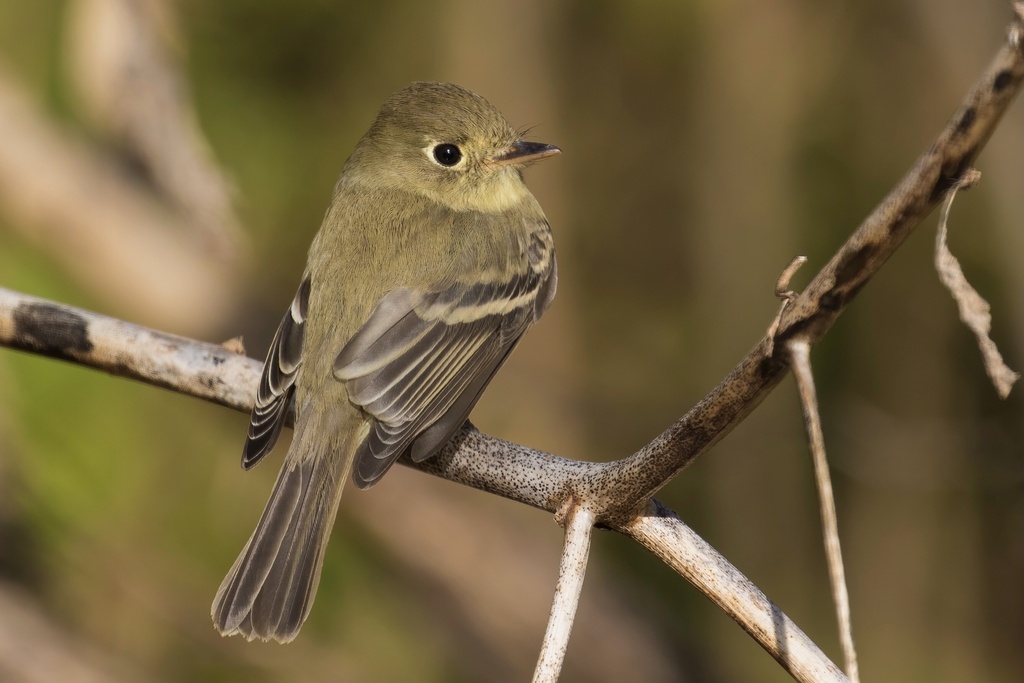
(c) Matt Felperin, some rights reserved (CC BY) · licence
Family: Tyrannidae · Class: Aves · Order: Passeriformes
Empidonax difficilis (Western Flycatcher) is a California animal in the Tyrannidae family.
The Western Flycatcher is a small passerine bird in the tyrant flycatcher family (Tyrannidae). This species represents a complex taxonomic history, with the American Ornithological Society previously separating it into Pacific-slope Flycatcher and Cordilleran Flycatcher, though recent molecular studies continue to support their distinctiveness as separate species. Adults measure approximately 13-17 cm (5.1-6.7 inches) in length with olive-green to grayish upperparts and pale yellowish underparts. The species exhibits a prominent whitish eye-ring, two distinct wing bars, and a slightly peaked crown. The bill is relatively broad at the base with a dark upper mandible and orange-yellow lower mandible. The Western Flycatcher complex occupies an enormous range across western North America, extending from the Isthmus of Tehuantepec in southern Mexico northward to the Canadian Rockies and coastal regions from British Columbia to Baja California (Birds of the World). In California, these flycatchers are widely distributed throughout suitable habitat, from coastal forests to montane environments. The Pacific-slope populations primarily inhabit coastal and near-coastal regions, while Cordilleran populations occupy interior mountain ranges. This species demonstrates broad habitat versatility, occupying coniferous and mixed forests, riparian woodlands, oak woodlands, and chaparral. Western Flycatchers show a preference for areas with dense canopy cover and are commonly found in Douglas fir, redwood, pine, and oak forests. They typically inhabit elevations from sea level to approximately 3,000 meters (9,800 feet), with coastal populations generally occurring at lower elevations than interior mountain populations. The species requires suitable perching sites for foraging and nesting cavities or platform sites. Western Flycatchers are primarily insectivorous, employing a sit-and-wait foraging strategy. They sally from perches to capture flying insects including flies, moths, beetles, and other small arthropods, occasionally gleaning prey from foliage. Breeding occurs from May through July, with females constructing cup-shaped nests typically placed on horizontal branches, in tree cavities, or on human-made structures. Clutch size ranges from 2-4 eggs, with incubation lasting approximately 14-15 days. Both parents participate in feeding nestlings, which fledge after 14-16 days. The species is migratory, with most populations wintering in Mexico and Central America. According to NatureServe, the Western Flycatcher has a global conservation rank of G5, indicating the species has a large range and stable population size. The IUCN Red List classifies Pacific-slope Flycatcher populations as Least Concern (Animal Diversity Web). BirdLife International notes that this species has an extremely large range and does not approach vulnerability thresholds. While long-term population trends have not been fully quantified, the species appears stable across most of its range. The taxonomic status of this complex continues to be refined as molecular and acoustic studies provide additional insights into relationships between Pacific-slope and Cordilleran populations.
Classification
Class: Aves · Order: Passeriformes · Family: Tyrannidae
Frequently asked questions
How is Empidonax difficilis classified?
Empidonax difficilis belongs to class Aves, order Passeriformes, family Tyrannidae.
What family does Empidonax difficilis belong to?
Empidonax difficilis is in the Tyrannidae family.
What is Empidonax difficilis?
The Western Flycatcher is a small passerine bird in the tyrant flycatcher family (Tyrannidae).
Is Empidonax difficilis found in California?
Yes. Empidonax difficilis is recorded in California in The California Species Project's catalogue.
Related species
Other California species in the same genus, family, or bioregion.
Data from The California Species Project — 14,000+ California species with verified data from CNPS, CDFW, USFWS, and more.