Empidonax flaviventris
Yellow-bellied Flycatcher
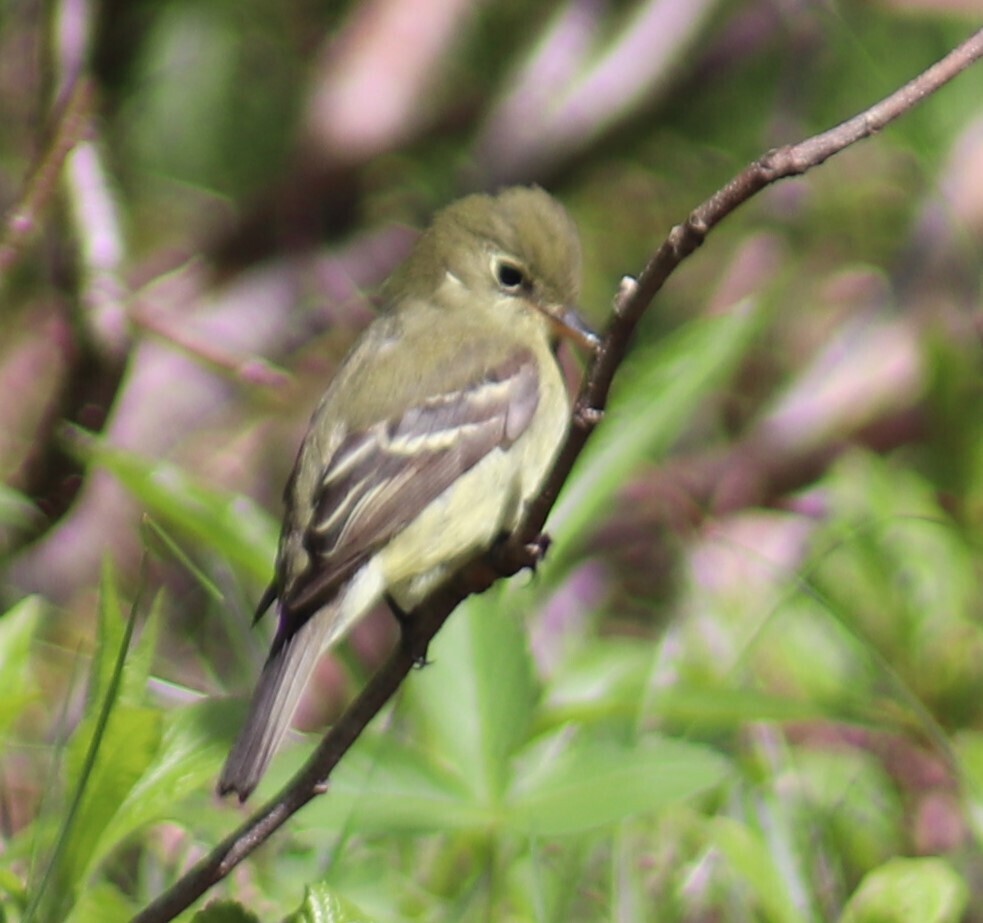
(c) Sean Frey, some rights reserved (CC BY) · licence
Family: Tyrannidae · Class: Aves · Order: Passeriformes
Empidonax flaviventris (Yellow-bellied Flycatcher) is a California animal in the Tyrannidae family.
The Yellow-bellied Flycatcher is a small tyrannid flycatcher measuring 13 to 15 cm (5.1 to 5.9 inches) in length with a wingspan of 19 to 22 cm (7.5 to 8.7 inches). Adults weigh 8 to 14 grams. The species exhibits olive-green upperparts and yellowish underparts, with the belly showing the most pronounced yellow coloration that gives the species its common name. The throat is typically pale yellow, distinguishing it from the whitish throats of most other Empidonax flycatchers. A prominent white eye-ring and two white wing bars are present. The bill is relatively broad with a dark upper mandible and orange-yellow lower mandible. The Yellow-bellied Flycatcher breeds across the boreal forests of Canada and the northern United States, with its range extending from southeastern Alaska east to Newfoundland and south to northern Minnesota, northern Wisconsin, northern Michigan, northern New York, and northern New England. The species is primarily a transient migrant through California during spring and fall migration periods. In California, Yellow-bellied Flycatchers have been documented as rare but regular migrants, primarily along the coast and in montane areas. Records exist from various counties including Los Angeles, Orange, San Bernardino, and Riverside counties, typically occurring from mid-May through early June and again from late August through September. During the breeding season, this species inhabits mature coniferous and mixed forests, particularly favoring areas with dense canopy cover and understory near water sources such as bogs, swamps, and stream corridors. Breeding habitat typically occurs at elevations from sea level to 1,500 meters. During migration through California, Yellow-bellied Flycatchers utilize riparian woodlands, oak groves, parks with mature trees, and occasionally desert oases. Yellow-bellied Flycatchers are insectivorous, employing typical flycatcher hunting techniques including sally-hawking to capture flying insects and gleaning prey from foliage surfaces. Their diet consists primarily of flies, moths, beetles, ants, and other small arthropods. The species constructs cup-shaped nests on the ground or in low shrubs, typically concealed in moss or among tree roots near water. Females lay 3 to 5 creamy white eggs with brown spotting, incubating them for 12 to 14 days. Young fledge after 11 to 14 days in the nest. The species typically produces one brood per year, with breeding occurring from June through July in northern habitats. The Yellow-bellied Flycatcher is not federally or state listed in California, reflecting its status as a migrant rather than a breeding resident. The species is classified as Least Concern globally by the IUCN, though North American Breeding Bird Survey data indicates stable to slightly declining long-term population trends. In California, the species remains a regular but uncommon migrant, with occurrence patterns consistent with historical records. Climate change may affect migration timing and stopover habitat quality, but the species faces no immediate conservation concerns within the state.
Classification
Class: Aves · Order: Passeriformes · Family: Tyrannidae
Frequently asked questions
How is Empidonax flaviventris classified?
Empidonax flaviventris belongs to class Aves, order Passeriformes, family Tyrannidae.
What family does Empidonax flaviventris belong to?
Empidonax flaviventris is in the Tyrannidae family.
What is Empidonax flaviventris?
The Yellow-bellied Flycatcher is a small tyrannid flycatcher measuring 13 to 15 cm (5.1 to 5.9 inches) in length with a wingspan of 19 to 22 cm (7.5 to 8.7 inches).
Is Empidonax flaviventris found in California?
Yes. Empidonax flaviventris is recorded in California in The California Species Project's catalogue.
Related species
Other California species in the same genus, family, or bioregion.
Data from The California Species Project — 14,000+ California species with verified data from CNPS, CDFW, USFWS, and more.