Empidonax hammondii
Hammond's Flycatcher
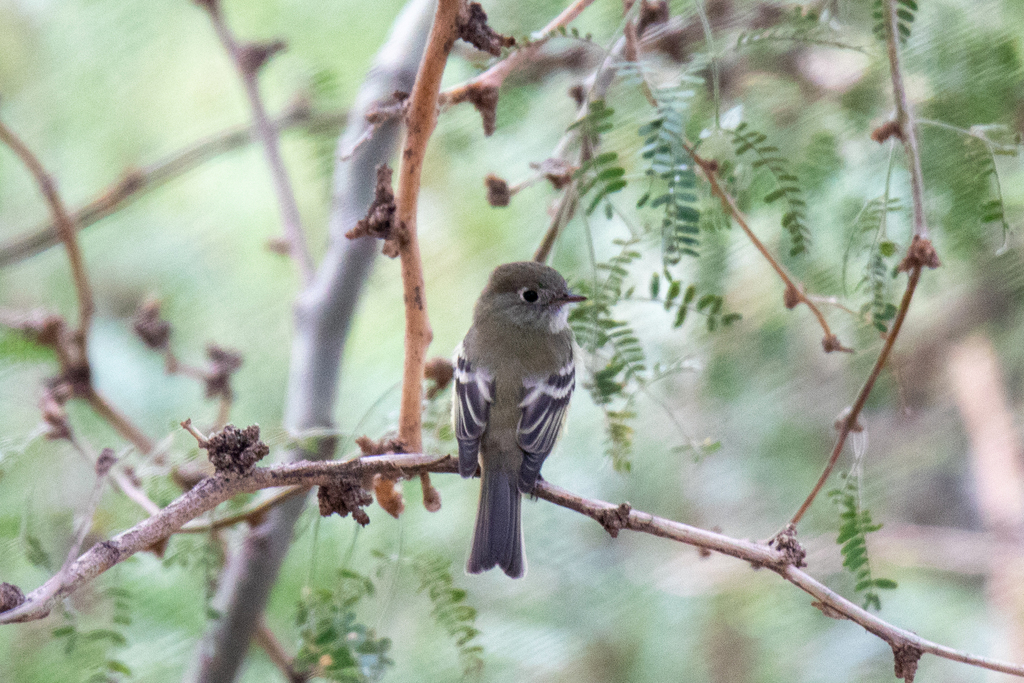
(c) Kevin Floyd, some rights reserved (CC BY) · licence
Family: Tyrannidae · Class: Aves · Order: Passeriformes
Empidonax hammondii (Hammond's Flycatcher) is a California animal in the Tyrannidae family.
Hammond's Flycatcher (Empidonax hammondii) is a small passerine bird in the tyrant flycatcher family. Adults measure 12.5 to 14 centimeters (4.9 to 5.5 inches) in length with a wingspan of 19 to 23 centimeters (7.5 to 9.1 inches) and weigh 8 to 12 grams (0.28 to 0.42 ounces). The species exhibits typical Empidonax characteristics with olive-gray to brownish upperparts, pale yellowish to whitish underparts, and two prominent white wing bars. The head features a distinct white eye ring and a relatively short, broad bill with a dark upper mandible and orange-yellow lower mandible. Hammond's Flycatcher can be distinguished from other Empidonax species by its proportionally shorter tail, more compact build, and distinctive vocalizations. The species breeds across western North America from southeastern Alaska through British Columbia and western United States. In California, Hammond's Flycatcher occurs primarily in the Sierra Nevada, Cascade Range, and northern Coast Ranges. The breeding range extends from Siskiyou and Modoc counties southward through the Sierra Nevada to Tulare County. During migration, the species can be found throughout California, including coastal areas and desert regions. Winter range extends from central Mexico to northern Central America. Hammond's Flycatcher inhabits mature coniferous forests, typically at elevations ranging from 1,200 to 3,000 meters (3,900 to 9,800 feet). The species shows strong preference for dense, multilayered forest canopies dominated by fir, spruce, pine, and hemlock. Breeding territories are established in areas with substantial understory vegetation and openings that provide foraging opportunities. During migration, Hammond's Flycatcher utilizes a broader range of habitats including mixed woodlands, riparian forests, and parks with mature trees. Hammond's Flycatcher is an aerial insectivore, capturing prey through hawking flights from exposed perches typically 3 to 15 meters above ground. The diet consists primarily of flying insects including flies, beetles, moths, ants, and small wasps. Males establish territories in late April to early May, defending areas of 0.5 to 2 hectares through song and aggressive displays. The distinctive song consists of a series of rough, burry notes described as "sebit-sup-see" or "se-wip." Nesting occurs from May through July, with females constructing cup-shaped nests in horizontal forks of conifer branches 2 to 18 meters above ground. Clutches contain 3 to 4 white eggs with fine reddish-brown spots. Incubation lasts 12 to 15 days, and nestlings fledge after 14 to 18 days. Hammond's Flycatcher is not federally or state listed in California. According to the North American Breeding Bird Survey, populations have remained relatively stable across the species' range over the past several decades, though some regional declines have been documented. The species faces threats from habitat loss due to logging, wildfire, and climate change effects on montane forest ecosystems. Forest management practices that maintain mature, dense coniferous forests with complex vertical structure benefit Hammond's Flycatcher populations.
Classification
Class: Aves · Order: Passeriformes · Family: Tyrannidae
Frequently asked questions
How is Empidonax hammondii classified?
Empidonax hammondii belongs to class Aves, order Passeriformes, family Tyrannidae.
What family does Empidonax hammondii belong to?
Empidonax hammondii is in the Tyrannidae family.
What is Empidonax hammondii?
Hammond's Flycatcher (Empidonax hammondii) is a small passerine bird in the tyrant flycatcher family.
Is Empidonax hammondii found in California?
Yes. Empidonax hammondii is recorded in California in The California Species Project's catalogue.
Related species
Other California species in the same genus, family, or bioregion.
Data from The California Species Project — 14,000+ California species with verified data from CNPS, CDFW, USFWS, and more.