Empidonax minimus
Least Flycatcher
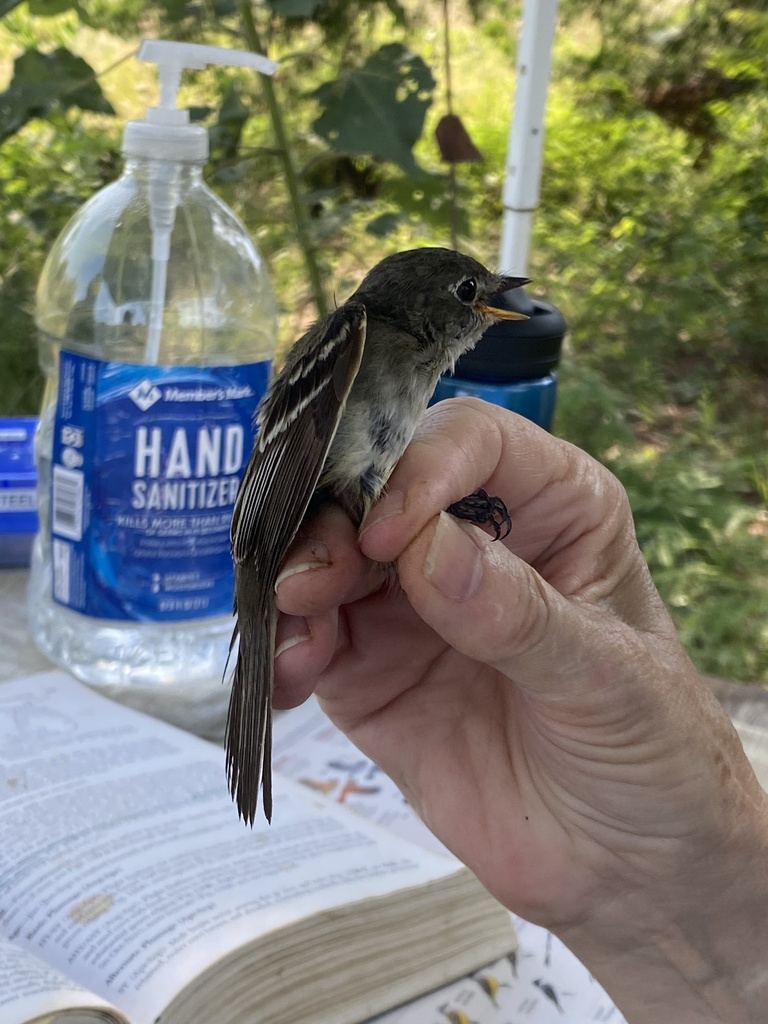
(c) Haley Daniels, some rights reserved (CC BY) · licence
Family: Tyrannidae · Class: Aves · Order: Passeriformes
Empidonax minimus (Least Flycatcher) is a California animal in the Tyrannidae family.
The Least Flycatcher is a small tyrant flycatcher measuring 11.5 to 14 cm (4.5 to 5.5 inches) in length with a wingspan of 19 to 22 cm (7.5 to 8.7 inches). Adults weigh 8 to 13 grams (0.3 to 0.5 ounces). The species exhibits olive-brown to grayish-brown upperparts with darker wings and tail. Two distinct white wing bars contrast against the darker wing coverts. The underparts are whitish to pale yellow, with a grayish wash across the breast. A conspicuous white eye ring surrounds dark eyes, and the bill is dark above with a yellowish-orange lower mandible. Males and females appear similar, though males may show slightly more pronounced coloration during breeding season. The Least Flycatcher breeds across southern Canada from British Columbia to the Maritime Provinces, extending south through the northern United States to Pennsylvania, northern Iowa, and in mountainous regions to North Carolina. The species winters primarily in Central America from Mexico to Panama. In California, the Least Flycatcher occurs as an uncommon migrant and occasional vagrant, typically observed during spring and fall migration periods. Records exist from scattered locations throughout the state, with most sightings occurring along the coast and in mountain areas. During breeding season, Least Flycatchers inhabit deciduous and mixed forests, particularly favoring forest edges, clearings, and second-growth woodlands. They select areas with moderate canopy cover and abundant perching sites at heights of 3 to 15 meters (10 to 50 feet). The species shows preference for forests dominated by aspen, birch, maple, and oak. In California, migrants are typically found in riparian woodlands, parks, and gardens with mature trees. Least Flycatchers are insectivorous, capturing prey through aerial hawking from exposed perches. Their diet consists primarily of flying insects including flies, beetles, moths, ants, and mosquitoes. They also glean insects from foliage and occasionally consume small berries. The species is known for its distinctive "che-bek" call, repeated frequently during breeding season. Breeding occurs from May through August, with females constructing compact cup nests in tree forks or against trunks at heights of 2 to 20 meters (6 to 65 feet). Clutches typically contain 3 to 4 white or cream-colored eggs, incubated for 13 to 15 days. Young fledge after 13 to 16 days in the nest. The Least Flycatcher is not federally listed and maintains stable populations across most of its range. According to the North American Breeding Bird Survey, continental populations have remained relatively stable since 1970, though some regional declines have been noted. The species faces typical threats associated with forest habitat loss, pesticide use, and climate change impacts on insect prey availability. As a Neotropical migrant, the species is vulnerable to habitat degradation in both breeding and wintering areas.
Classification
Class: Aves · Order: Passeriformes · Family: Tyrannidae
Frequently asked questions
How is Empidonax minimus classified?
Empidonax minimus belongs to class Aves, order Passeriformes, family Tyrannidae.
What family does Empidonax minimus belong to?
Empidonax minimus is in the Tyrannidae family.
What is Empidonax minimus?
The Least Flycatcher is a small tyrant flycatcher measuring 11.5 to 14 cm (4.5 to 5.5 inches) in length with a wingspan of 19 to 22 cm (7.5 to 8.7 inches).
Is Empidonax minimus found in California?
Yes. Empidonax minimus is recorded in California in The California Species Project's catalogue.
Related species
Other California species in the same genus, family, or bioregion.
Data from The California Species Project — 14,000+ California species with verified data from CNPS, CDFW, USFWS, and more.