Empidonax oberholseri
Dusky Flycatcher
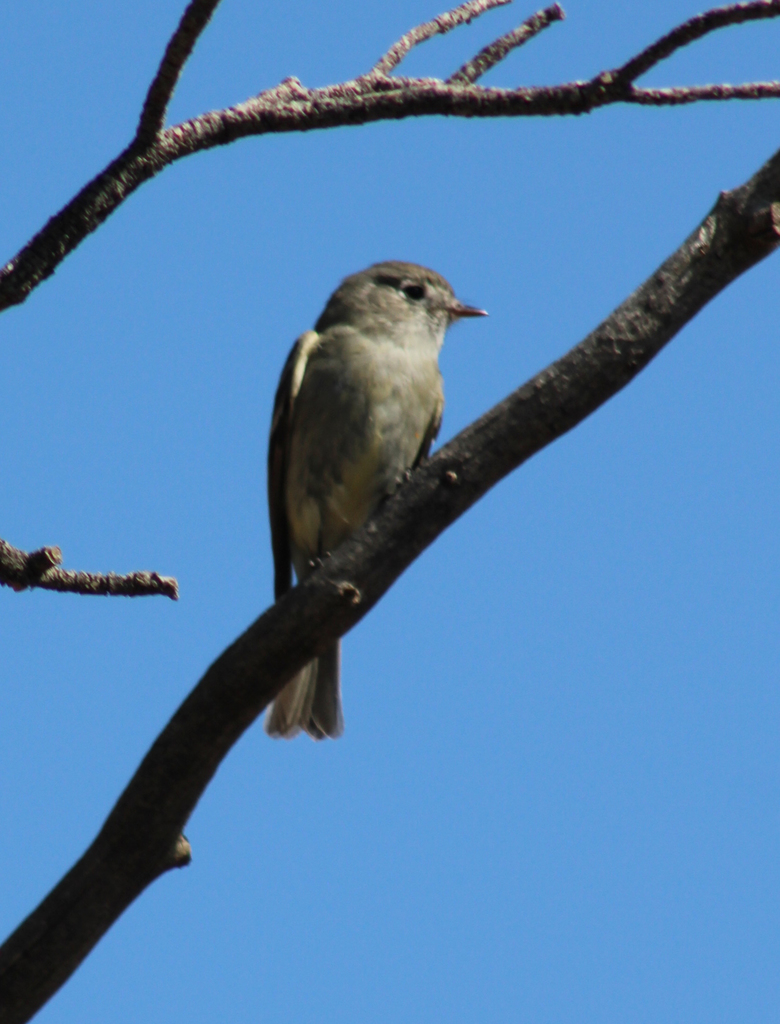
(c) Wendy St. John, some rights reserved (CC BY-SA) · licence
Family: Tyrannidae · Class: Aves · Order: Passeriformes
Empidonax oberholseri (Dusky Flycatcher) is a California animal in the Tyrannidae family.
The Dusky Flycatcher is a small passerine bird measuring 13 to 15 cm (5.1 to 5.9 inches) in length with a wingspan of 21 to 24 cm (8.3 to 9.4 inches). Adults weigh 8 to 12 grams. The species exhibits typical Empidonax flycatcher characteristics with olive-gray to brownish-gray upperparts and pale yellowish or whitish underparts. The head shows a faint eye-ring that is often broken or incomplete, distinguishing it from similar species. The bill is dark above with an orange or yellow base on the lower mandible. Wing bars are whitish to pale yellow, and the tail appears slightly notched. Sexual dimorphism is minimal, though males may show slightly more contrasted plumage during breeding season. The Dusky Flycatcher breeds throughout mountainous regions of western North America, including the Sierra Nevada, Cascade Range, and portions of the Coast Ranges in California. The species occurs from British Columbia south to Baja California and east to the Rocky Mountains. In California, breeding populations are found primarily in montane areas from approximately 1,200 to 3,400 meters (4,000 to 11,200 feet) elevation. Winter range extends from central Mexico through Central America to Panama. Breeding habitat consists of open montane forests, particularly those dominated by conifers such as Douglas fir, white fir, and ponderosa pine. The species favors forest edges, clearings, and areas with mixed coniferous and deciduous vegetation. Aspen groves within coniferous forests provide optimal nesting sites. During migration, Dusky Flycatchers utilize riparian corridors, oak woodlands, and desert oases. Wintering habitat in Central America includes pine-oak forests, cloud forests, and forest edges from 1,000 to 3,000 meters elevation. Dusky Flycatchers are aerial insectivores that hunt from exposed perches, making short sallies to capture flying insects before returning to the same or nearby perch. Diet consists primarily of flies, beetles, moths, ants, and other small arthropods. Breeding season extends from May through August. Males establish territories through song and aggressive displays. The cup-shaped nest is constructed of twigs, bark strips, and plant fibers, typically placed in the fork of a deciduous tree or shrub 1 to 4 meters above ground. Females lay 3 to 4 cream-colored eggs with brown spotting. Incubation lasts 12 to 15 days, and nestlings fledge after 14 to 18 days. The species is generally single-brooded but may attempt second broods in favorable conditions. The Dusky Flycatcher is not federally or state listed and maintains stable populations across most of its range. Breeding Bird Survey data indicate relatively stable long-term population trends, though some regional declines have been documented. Primary conservation concerns include habitat loss from logging, fire suppression altering forest structure, and climate change affecting montane ecosystems. The species benefits from forest management practices that maintain diverse age classes and natural openings within coniferous forests.
Classification
Class: Aves · Order: Passeriformes · Family: Tyrannidae
Frequently asked questions
How is Empidonax oberholseri classified?
Empidonax oberholseri belongs to class Aves, order Passeriformes, family Tyrannidae.
What family does Empidonax oberholseri belong to?
Empidonax oberholseri is in the Tyrannidae family.
What is Empidonax oberholseri?
The Dusky Flycatcher is a small passerine bird measuring 13 to 15 cm (5.1 to 5.9 inches) in length with a wingspan of 21 to 24 cm (8.3 to 9.4 inches).
Is Empidonax oberholseri found in California?
Yes. Empidonax oberholseri is recorded in California in The California Species Project's catalogue.
Related species
Other California species in the same genus, family, or bioregion.
Data from The California Species Project — 14,000+ California species with verified data from CNPS, CDFW, USFWS, and more.