Empidonax occidentalis
Cordilleran Flycatcher
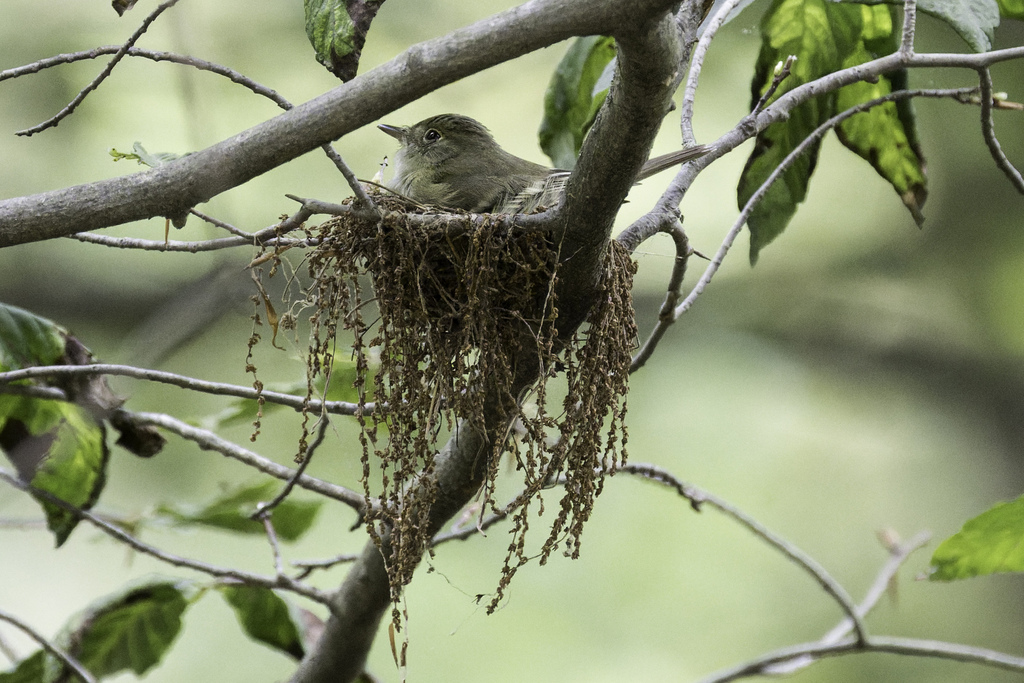
no rights reserved · CC0
Family: Tyrannidae · Class: Aves · Order: Passeriformes
Empidonax occidentalis (Cordilleran Flycatcher) is a California animal in the Tyrannidae family.
The Cordilleran Flycatcher is a small passerine bird in the tyrant flycatcher family, measuring 13-15 centimeters (5.1-5.9 inches) in length with a wingspan of 20-23 centimeters (7.9-9.1 inches). Adults weigh 8-14 grams (0.28-0.49 ounces). The species displays olive-brown to grayish upperparts with darker wings and tail. The underparts are pale yellow to whitish, with a distinct yellowish wash on the belly and undertail coverts. Two prominent white wing bars are present, and the bill is relatively broad and dark with an orange base to the lower mandible. A pale eye ring is visible, and the head shows a slight crest when raised. Males and females appear similar, though males may show slightly brighter coloration during breeding season. The Cordilleran Flycatcher breeds in mountainous regions of western North America, with California populations occurring primarily in the Sierra Nevada, Cascade Range, and northern Coast Ranges. The species' range extends from British Columbia south through the western United States to Central America. In California, breeding occurs at elevations typically between 1,200 and 3,400 meters (3,900-11,200 feet), though birds may be found at lower elevations during migration. Winter range extends from central Mexico south to Panama. This species inhabits coniferous and mixed coniferous-deciduous forests, particularly favoring areas near water sources such as streams, springs, or wet meadows. Preferred breeding habitat includes Douglas fir, ponderosa pine, white fir, and mixed-conifer forests with relatively open understories. The species also utilizes riparian zones with cottonwoods, willows, and alders. Nesting sites are typically located on horizontal branches or in crotches of trees, often near or over water. Forest edges, clearings, and burned areas within forested landscapes may also provide suitable habitat. Cordilleran Flycatchers are insectivorous, employing a sit-and-wait hunting strategy from exposed perches. They sally forth to capture flying insects including flies, mosquitoes, gnats, small beetles, moths, and flying ants. Foraging typically occurs from perches 2-15 meters (6.5-49 feet) above ground. The species constructs cup-shaped nests of moss, plant fibers, and spider webs, lined with fine materials such as hair or feathers. Females lay 3-4 creamy white eggs with brown spots, primarily at the larger end. Incubation lasts 14-15 days, performed exclusively by females. Nestlings fledge after 14-18 days, and parents continue feeding young for several days post-fledging. The Cordilleran Flycatcher is not federally listed and maintains stable populations across most of its range as of December 2025. However, the species faces potential threats from habitat loss due to logging, development, and altered fire regimes in montane forests. Climate change may affect breeding habitat suitability at higher elevations and alter insect prey availability. Forest management practices that maintain diverse forest structure and protect riparian areas benefit this species. Population monitoring through breeding bird surveys indicates generally stable trends, though local variations may occur due to habitat changes or climatic factors.
Classification
Class: Aves · Order: Passeriformes · Family: Tyrannidae
Frequently asked questions
How is Empidonax occidentalis classified?
Empidonax occidentalis belongs to class Aves, order Passeriformes, family Tyrannidae.
What family does Empidonax occidentalis belong to?
Empidonax occidentalis is in the Tyrannidae family.
What is Empidonax occidentalis?
The Cordilleran Flycatcher is a small passerine bird in the tyrant flycatcher family, measuring 13-15 centimeters (5.1-5.9 inches) in length with a wingspan of 20-23 centimeters (7.9-9.1 inches).
Is Empidonax occidentalis found in California?
Yes. Empidonax occidentalis is recorded in California in The California Species Project's catalogue.
Related species
Other California species in the same genus, family, or bioregion.
Data from The California Species Project — 14,000+ California species with verified data from CNPS, CDFW, USFWS, and more.