Empidonax traillii
Willow flycatcher
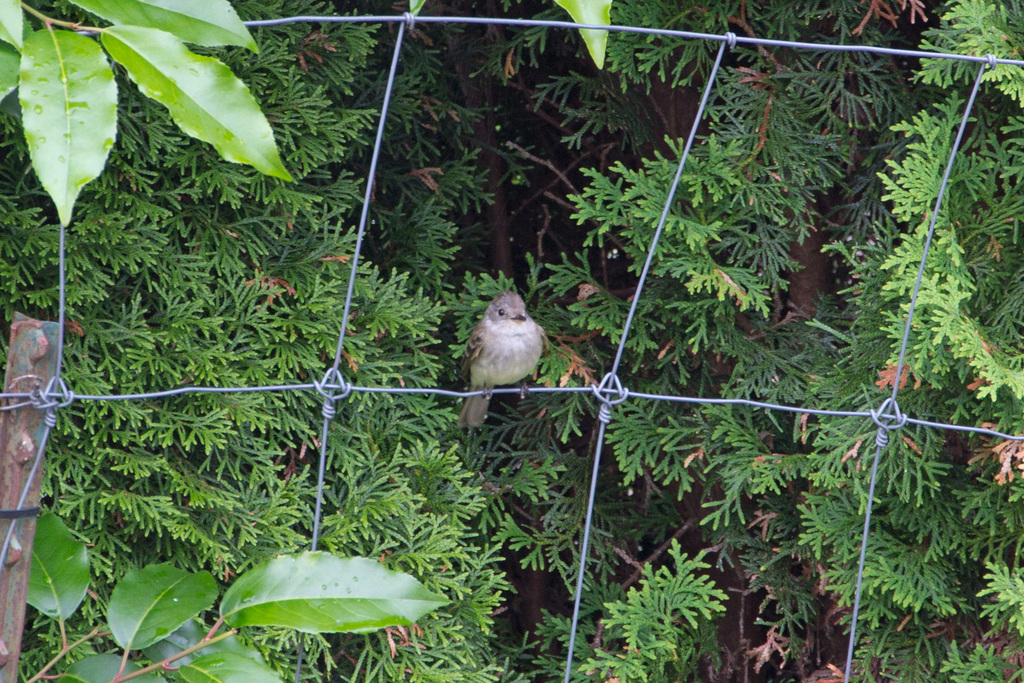
(c) Eric Habisch, some rights reserved (CC BY) · licence
Family: Tyrannidae · Class: Aves · Order: Passeriformes
Conservation status: SE · G5 S3
Empidonax traillii (Willow flycatcher) is a California animal in the Tyrannidae family.
The willow flycatcher is a small passerine bird measuring approximately 13-15 cm (5.1-5.9 inches) in length with a wingspan of 19-24 cm (7.5-9.4 inches). Adults display brownish-olive to gray-green upperparts and pale grayish-white to yellowish underparts. The species exhibits two conspicuous whitish wingbars and lacks the prominent pale eye-ring characteristic of many other Empidonax flycatchers. Juveniles appear browner above and more yellow below, with buff or yellowish-brown wingbars (USFWS 2024). The willow flycatcher ranges across North America from Maine to British Columbia, with breeding populations extending south into California and the southwestern United States. In California, the species occurs primarily in riparian areas throughout much of the state, though populations have declined significantly in many regions. The southwestern subspecies (E. t. extimus) is federally endangered, while the little willow flycatcher (E. t. brewsteri) is a federal candidate species. This species inhabits moist, shrubby areas typically associated with standing or running water. In California, willow flycatchers are strikingly restricted to thickets of willows and other riparian vegetation (Birds of the World). Dense riparian habitat is essential for nesting, with birds typically found below 2,590 meters (8,500 feet) elevation. The species requires areas with sufficient shrub density to provide both nesting sites and foraging opportunities. Willow flycatchers are insectivorous, feeding primarily on flying insects captured through aerial sallying from exposed perches. Males characteristically flick their tails slightly upward while perched and produce a liquid, sharply whistled 'whit' call. The species arrives on breeding grounds in late April to early May, with nesting beginning in late May and early June. Females typically lay three to four eggs per clutch at one-day intervals, incubating them for approximately 12 days. Fledging occurs from late June to mid-August, with most pairs raising only one brood per year (USFWS 2024). The willow flycatcher is listed as endangered in California, with state listing encompassing all subspecies according to the California Department of Fish and Wildlife. The species has experienced severe population declines due to habitat loss and degradation, particularly the destruction and fragmentation of riparian ecosystems. Water management practices, agricultural conversion, and urban development have eliminated much suitable breeding habitat. Invasive plant species and brown-headed cowbird parasitism pose additional threats. The global population is considered secure (G5), but California populations are vulnerable (S3), reflecting the species' precarious status within the state. Conservation efforts focus on riparian habitat restoration, water management modifications to maintain suitable breeding conditions, and cowbird control programs in key breeding areas.
Classification
Class: Aves · Order: Passeriformes · Family: Tyrannidae
Conservation status
SE · G5 S3
Frequently asked questions
How is Empidonax traillii classified?
Empidonax traillii belongs to class Aves, order Passeriformes, family Tyrannidae.
What family does Empidonax traillii belong to?
Empidonax traillii is in the Tyrannidae family.
Is Empidonax traillii protected or of conservation concern?
Empidonax traillii carries the following status: SE · G5 S3.
What is Empidonax traillii?
The willow flycatcher is a small passerine bird measuring approximately 13-15 cm (5.1-5.9 inches) in length with a wingspan of 19-24 cm (7.5-9.4 inches).
Is Empidonax traillii found in California?
Yes. Empidonax traillii is recorded in California in The California Species Project's catalogue.
Related species
Other California species in the same genus, family, or bioregion.
Data from The California Species Project — 14,000+ California species with verified data from CNPS, CDFW, USFWS, and more.