Empidonax traillii brewsteri
Little Willow Flycatcher
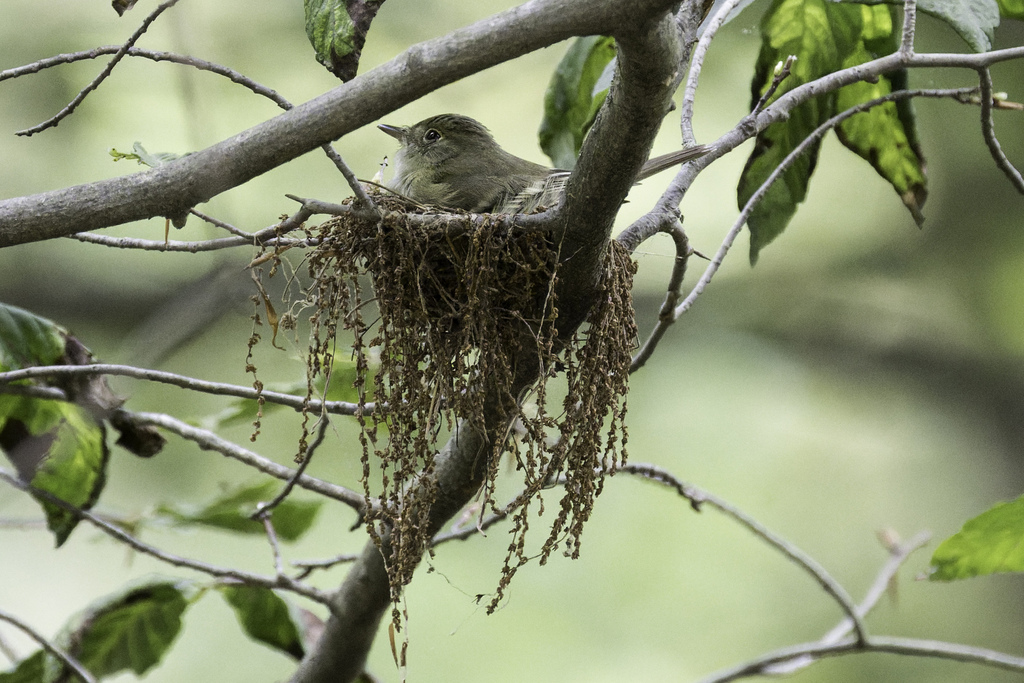
no rights reserved · CC0
Family: Tyrannidae · Class: Aves · Order: Passeriformes
Conservation status: SE · G5T3T4 S3
Empidonax traillii brewsteri (Little Willow Flycatcher) is a California animal in the Tyrannidae family.
The Little Willow Flycatcher (Empidonax traillii brewsteri) is a small passerine bird and one of four subspecies of the Willow Flycatcher. This subspecies exhibits the typical characteristics of Empidonax flycatchers: olive-brown to grayish upperparts, pale underparts with varying degrees of yellow wash, whitish throat, and two prominent whitish wing bars. Adults measure approximately 13-17 cm (5.1-6.7 inches) in length with a wingspan of 19-24 cm (7.5-9.4 inches). The species has a relatively broad, flat bill adapted for aerial insect capture, and like other Empidonax species, can be difficult to distinguish from congeners without vocal identification. The Little Willow Flycatcher breeds west of the Cascade Range and in the Sierra Nevada from southwestern California to southwestern British Columbia (NatureServe Explorer). This subspecies represents the Pacific Coast breeding population of the Willow Flycatcher complex. The breeding range includes suitable riparian habitats throughout California's Central Valley, coastal regions, and montane areas, with populations extending north through Oregon, Washington, and into British Columbia. This subspecies is strongly associated with moist, shrubby riparian habitats, particularly areas dominated by willow (Salix spp.) thickets. According to Birds of the World, the species shows a striking restriction to willow thickets in California, typically selecting areas with standing or running water. Suitable breeding habitat includes wetlands, swamps, brushy second growth, and riparian corridors with dense shrub layers. The species generally occupies elevations from sea level to moderate montane zones, favoring areas where water availability supports lush vegetation growth. Little Willow Flycatchers are aerial insectivores that capture prey through sally-and-return foraging behavior, launching from exposed perches to catch flying insects before returning to the same or nearby perch. Their diet consists primarily of flying insects including flies, mosquitoes, midges, small beetles, and flying ants. Breeding occurs from late May through July, with pairs constructing cup-shaped nests in the fork of shrub branches, typically 1-4 meters above ground. Females lay 2-4 eggs, which are incubated for approximately 12-13 days. Both parents feed the nestlings, which fledge after 12-14 days. The Little Willow Flycatcher is listed as endangered by the State of California, reflecting significant population declines and habitat loss throughout its range. The subspecies faces primary threats from riparian habitat destruction, water diversions, urban development, and agricultural conversion. Brown-headed Cowbird parasitism also impacts reproductive success in some areas. Climate change poses additional challenges through altered precipitation patterns and increased drought frequency, which affect the water-dependent riparian ecosystems essential for breeding. Conservation efforts focus on riparian habitat restoration, water management practices that maintain natural flow regimes, and cowbird control programs in critical breeding areas.
Classification
Class: Aves · Order: Passeriformes · Family: Tyrannidae
Conservation status
SE · G5T3T4 S3
Frequently asked questions
How is Empidonax traillii brewsteri classified?
Empidonax traillii brewsteri belongs to class Aves, order Passeriformes, family Tyrannidae.
What family does Empidonax traillii brewsteri belong to?
Empidonax traillii brewsteri is in the Tyrannidae family.
Is Empidonax traillii brewsteri protected or of conservation concern?
Empidonax traillii brewsteri carries the following status: SE · G5T3T4 S3.
What is Empidonax traillii brewsteri?
The Little Willow Flycatcher (Empidonax traillii brewsteri) is a small passerine bird and one of four subspecies of the Willow Flycatcher.
Is Empidonax traillii brewsteri found in California?
Yes. Empidonax traillii brewsteri is recorded in California in The California Species Project's catalogue.
Related species
Other California species in the same genus, family, or bioregion.
Data from The California Species Project — 14,000+ California species with verified data from CNPS, CDFW, USFWS, and more.