Empidonax wrightii
Gray Flycatcher
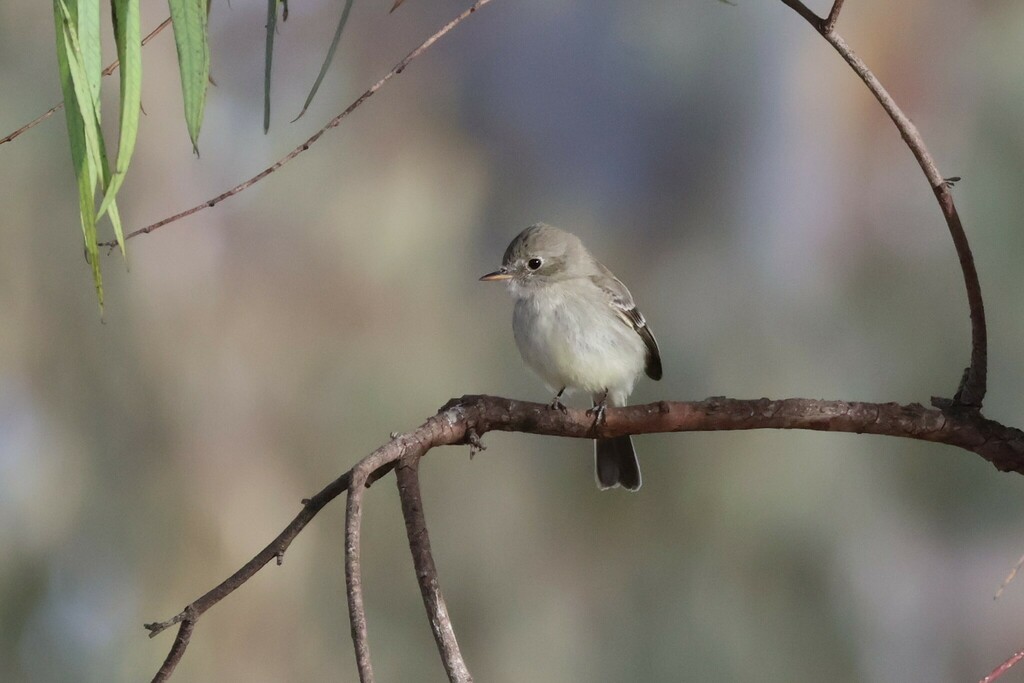
(c) Millie Basden, some rights reserved (CC BY) · licence
Family: Tyrannidae · Class: Aves · Order: Passeriformes
Empidonax wrightii (Gray Flycatcher) is a California animal in the Tyrannidae family.
The Gray Flycatcher is a small, drab passerine bird measuring 14 to 16 centimeters (5.5 to 6.3 inches) in length with a wingspan of 22 to 25 centimeters (8.7 to 9.8 inches). Adults weigh 11 to 14 grams (0.4 to 0.5 ounces). The upperparts are grayish-brown with a slight olive tinge, while the underparts are pale gray to whitish with a faint yellowish wash on the belly. The species displays a prominent white eye ring and two distinct whitish wing bars. The bill is relatively long and narrow with a dark upper mandible and pale lower mandible. Gray Flycatchers are distinguished from other Empidonax flycatchers by their longer tail, which they characteristically pump downward rather than flick upward, and their grayer overall coloration with less prominent yellow tones. The Gray Flycatcher breeds throughout much of the western United States, with its California range primarily in the northeastern portion of the state. The species occurs in the Cascade Range, Sierra Nevada, and mountains of the Great Basin region, including Modoc, Lassen, Plumas, Sierra, and Mono counties. During winter, populations migrate to northwestern Mexico and extreme southwestern United States, including desert regions of southeastern California. This species inhabits dry, open woodlands and forest edges at elevations ranging from 1,200 to 3,200 meters (4,000 to 10,500 feet). Preferred habitat includes pinyon-juniper woodlands, ponderosa pine forests, mixed conifer forests, and montane chaparral. Gray Flycatchers favor areas with scattered trees and open understory, often selecting habitat with sagebrush, bitterbrush, or manzanita in the understory. They require suitable nesting sites in the forks of small trees or shrubs, typically 1 to 6 meters (3 to 20 feet) above ground. Gray Flycatchers are insectivorous, employing a sit-and-wait hunting strategy from exposed perches. They sally forth to capture flying insects including flies, mosquitoes, moths, beetles, and flying ants, occasionally gleaning prey from foliage. Breeding occurs from May through July, with peak activity in June. Females construct cup-shaped nests of twigs, bark strips, and plant fibers, lined with fine materials including feathers and hair. Clutch size ranges from 3 to 4 eggs, which are incubated for 14 to 15 days. Young fledge after 16 to 18 days but remain dependent on parents for an additional 2 to 3 weeks. The species typically produces one brood per season. The Gray Flycatcher is not federally listed and maintains stable populations across most of its range according to the North American Breeding Bird Survey. However, some local populations have experienced declines due to habitat loss from logging, urban development, and altered fire regimes. Climate change poses potential long-term threats through shifts in suitable habitat elevation and changes in insect prey availability. Conservation efforts focus on maintaining diverse forest management practices that preserve the open woodland structure preferred by this species.
Classification
Class: Aves · Order: Passeriformes · Family: Tyrannidae
Frequently asked questions
How is Empidonax wrightii classified?
Empidonax wrightii belongs to class Aves, order Passeriformes, family Tyrannidae.
What family does Empidonax wrightii belong to?
Empidonax wrightii is in the Tyrannidae family.
What is Empidonax wrightii?
The Gray Flycatcher is a small, drab passerine bird measuring 14 to 16 centimeters (5.5 to 6.3 inches) in length with a wingspan of 22 to 25 centimeters (8.7 to 9.8 inches).
Is Empidonax wrightii found in California?
Yes. Empidonax wrightii is recorded in California in The California Species Project's catalogue.
Related species
Other California species in the same genus, family, or bioregion.
Data from The California Species Project — 14,000+ California species with verified data from CNPS, CDFW, USFWS, and more.