Enallagma civile
Familiar Bluet
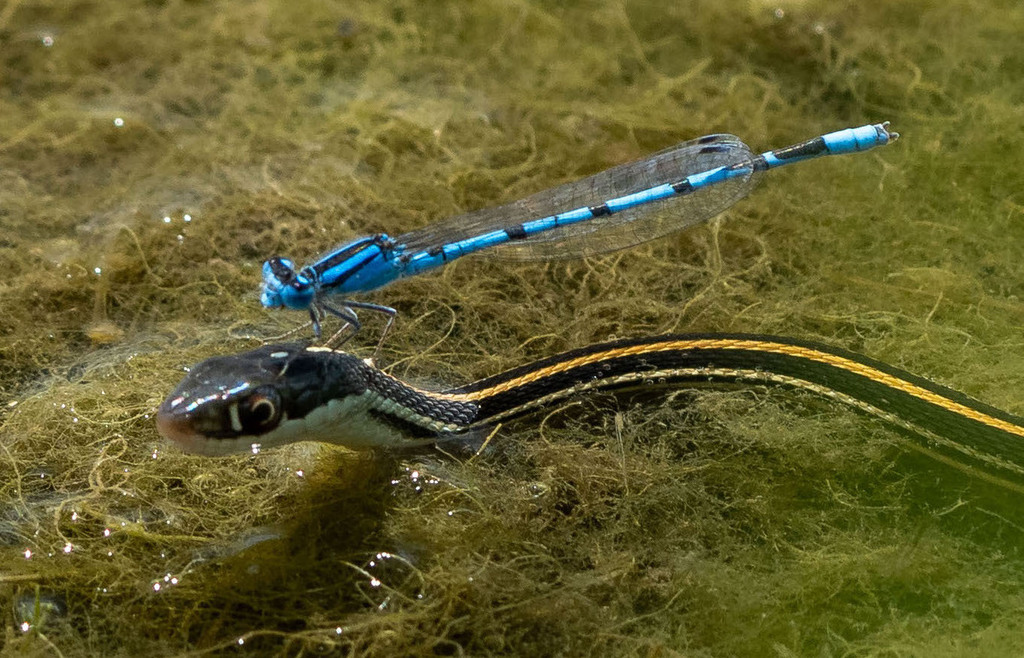
(c) evangrimes, some rights reserved (CC BY) · licence
Family: Coenagrionidae · Class: Insecta · Order: Odonata
Enallagma civile (Familiar Bluet) is a California animal in the Coenagrionidae family.
The Familiar Bluet is a small damselfly in the family Coenagrionidae, widely distributed across North America. Adults measure approximately 25-35 mm (1.0-1.4 inches) in length with a wingspan of 35-45 mm. Males display bright blue coloration on the head, thorax, and most abdominal segments, with black markings that distinguish them from other bluet species. The distinctive black shoulder stripe extends from the rear of the eye to the wing base. Females exhibit more variable coloration, ranging from blue similar to males to tan or brownish hues, particularly in older individuals. Both sexes possess clear wings held vertically above the body when at rest, a characteristic feature of damselflies. The species occurs throughout most of the United States and southern Canada, with populations documented from coast to coast. In California, the Familiar Bluet has been recorded from multiple counties including Alameda County, where observations have been documented near Oakland at elevations around 900 feet (BugGuide 2007). The species demonstrates considerable adaptability to various aquatic environments across its extensive range. Familiar Bluets inhabit a diverse array of freshwater habitats including ponds, lakes, slow-moving streams, marshes, and constructed wetlands. They prefer areas with emergent vegetation and moderate sunlight exposure. Adults are commonly observed in grassy areas adjacent to water sources, particularly in locations with seasonal streams or permanent water bodies. The species tolerates both natural and modified aquatic environments, contributing to its widespread distribution. Adults are active during warm, sunny days from late spring through early fall, with peak activity occurring during midday hours. Males establish territories near water and engage in aerial courtship displays to attract females. Mating occurs in tandem, with pairs remaining connected while the female deposits eggs on submerged vegetation or directly into the water. Eggs overwinter and hatch the following spring. Nymphs are aquatic predators, feeding on small invertebrates including mosquito larvae, midge larvae, and other aquatic insects. Development from egg to adult typically requires one year. Adults are opportunistic predators, capturing small flying insects including mosquitoes, midges, and aphids. The Familiar Bluet is not federally listed and appears to maintain stable populations across most of its range. The species benefits from its habitat flexibility and ability to utilize both natural and artificial water sources. However, like many aquatic insects, populations may be locally affected by water pollution, habitat destruction, and pesticide use. Urban development near wetlands and the draining of seasonal pools can impact breeding success. Climate change may influence the timing of emergence and breeding cycles, though the species' broad geographic range likely provides some resilience to regional environmental changes. Conservation efforts focused on protecting freshwater habitats and maintaining water quality benefit this species along with other aquatic invertebrates.
Classification
Class: Insecta · Order: Odonata · Family: Coenagrionidae
Frequently asked questions
How is Enallagma civile classified?
Enallagma civile belongs to class Insecta, order Odonata, family Coenagrionidae.
What family does Enallagma civile belong to?
Enallagma civile is in the Coenagrionidae family.
What is Enallagma civile?
The Familiar Bluet is a small damselfly in the family Coenagrionidae, widely distributed across North America.
Is Enallagma civile found in California?
Yes. Enallagma civile is recorded in California in The California Species Project's catalogue.
Related species
Other California species in the same genus, family, or bioregion.
Data from The California Species Project — 14,000+ California species with verified data from CNPS, CDFW, USFWS, and more.