Enargia infumata
Smoked Sallow
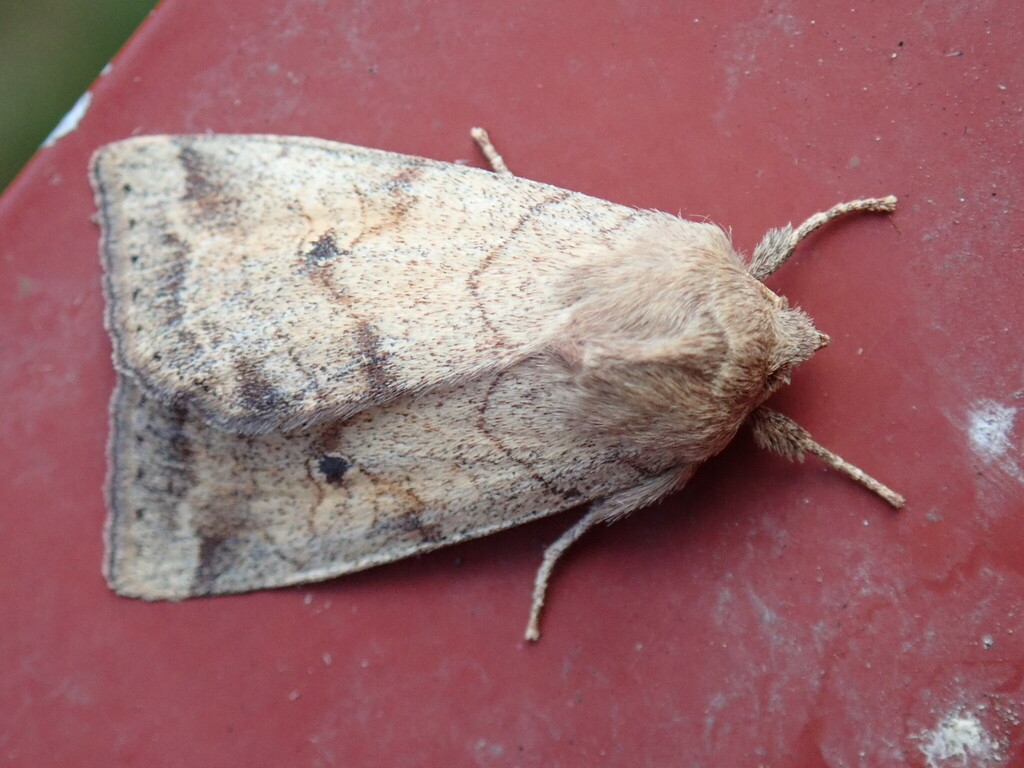
(c) Cricket Raspet, some rights reserved (CC BY) · licence
Family: Noctuidae · Class: Insecta · Order: Lepidoptera
Enargia infumata (Smoked Sallow) is a California animal in the Noctuidae family.
The Smoked Sallow (Enargia infumata) is a medium-sized moth in the family Noctuidae, subfamily Noctuinae. Adults have a wingspan of approximately 35-40 mm (1.4-1.6 inches). The forewings display a smoky gray to dark brownish-gray coloration with subtle darker markings, giving the species its common name. The hindwings are typically lighter, ranging from pale gray to whitish with darker marginal bands. Males can be distinguished from females by their more feathered antennae and slightly smaller size. This species occurs across western North America, with confirmed records from British Columbia south through California. In California, the Smoked Sallow has been documented from several counties including those in the Sierra Nevada foothills and coastal ranges, though specific distribution data remains limited. The species appears to have a disjunct distribution pattern typical of many western Noctuidae. Smoked Sallow moths inhabit mixed coniferous and deciduous forests, particularly areas dominated by willows and poplars. Adults are typically found at elevations ranging from near sea level to approximately 1,500 meters (4,900 feet). The species shows a preference for riparian corridors and forest edges where host plants are abundant. Larvae develop on various Salicaceae, primarily willow species (Salix spp.) and possibly cottonwoods (Populus spp.). Adults are nocturnal and attracted to artificial lights, making them occasionally encountered at moth sheets and light traps. The flight period varies by location and elevation but generally occurs from late summer through early fall, typically August through October. Females deposit eggs on or near host plant foliage, where larvae feed and develop through several instars before pupating in soil or leaf litter. The species appears to be univoltine, producing one generation per year. Like many specialized Lepidoptera, the Smoked Sallow faces potential conservation challenges from habitat loss and fragmentation, particularly in riparian zones where development pressure is high. Climate change may also affect the species through altered precipitation patterns that impact host plant availability and quality. However, the species currently lacks formal conservation status designation at federal or state levels. Population trends and distribution patterns remain poorly documented, reflecting the general need for enhanced survey efforts targeting western North American Noctuidae. The moth's association with willow-dominated habitats makes it potentially vulnerable to changes in water availability and riparian ecosystem health throughout its range.
Classification
Class: Insecta · Order: Lepidoptera · Family: Noctuidae
Frequently asked questions
How is Enargia infumata classified?
Enargia infumata belongs to class Insecta, order Lepidoptera, family Noctuidae.
What family does Enargia infumata belong to?
Enargia infumata is in the Noctuidae family.
What is Enargia infumata?
The Smoked Sallow (Enargia infumata) is a medium-sized moth in the family Noctuidae, subfamily Noctuinae.
Is Enargia infumata found in California?
Yes. Enargia infumata is recorded in California in The California Species Project's catalogue.
Related species
Other California species in the same genus, family, or bioregion.
Data from The California Species Project — 14,000+ California species with verified data from CNPS, CDFW, USFWS, and more.