Endothenia hebesana
Verbena Bud Moth
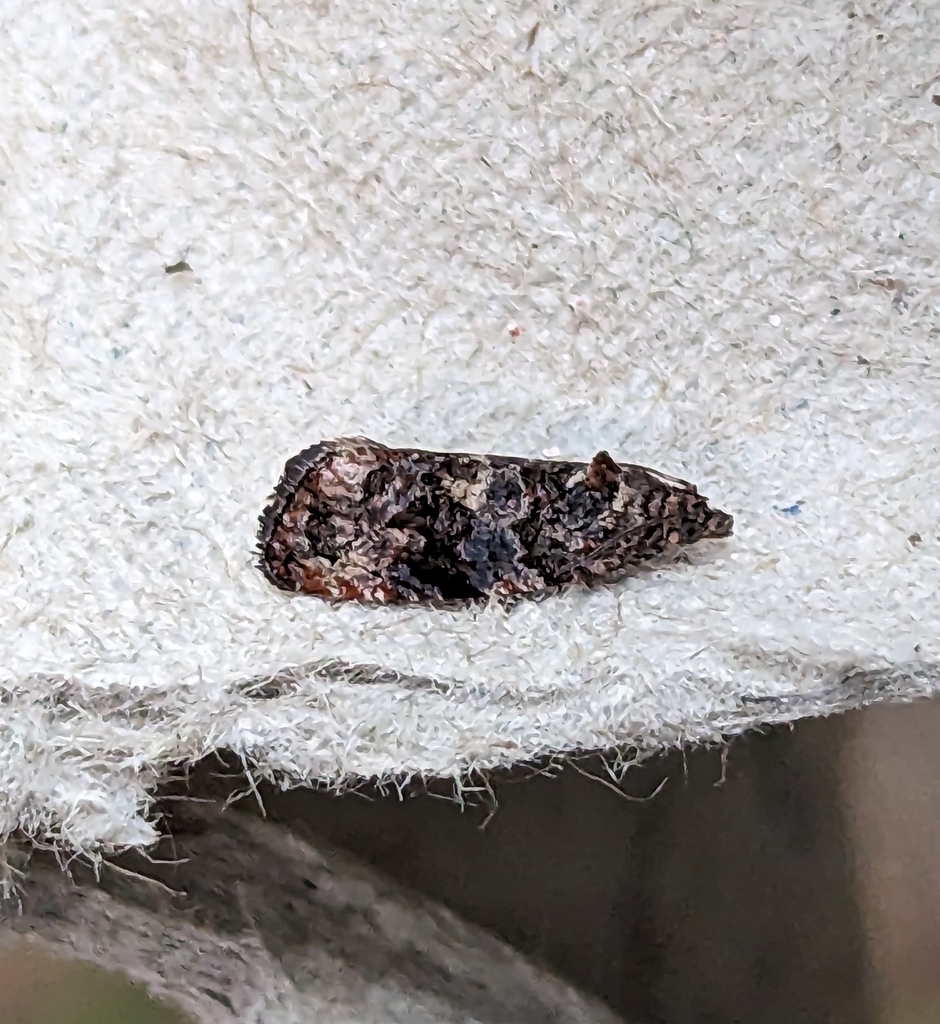
no rights reserved · CC0
Family: Tortricidae · Class: Insecta · Order: Lepidoptera
Endothenia hebesana (Verbena Bud Moth) is a California animal in the Tortricidae family.
The Verbena Bud Moth is a small tortricid moth with forewings measuring 4.5 to 8.5 mm in length (Moth Photographers Group). Adults display a distinctive wing pattern with a uniformly blackish gray basal patch marked by transverse black striations. The dorsal half of the blackish median fascia is typically overlaid with olive-gold scaling, while the postmedian band shows extensive olive-gold suffusion (Moth Photographers Group). Endothenia hebesana has a holarctic distribution and is common across North America (Moth Photographers Group). In California, the species has been documented with flight records from May through June, based on BugGuide observation data. The species occurs throughout much of the United States from southern Canada southward, with confirmed records from numerous states including Alabama, Arizona, Arkansas, California, Colorado, Florida, Georgia, Illinois, Indiana, and Iowa (BugGuide). The moth inhabits diverse habitats across its range. In California, it has been collected at Quaking Aspen Meadow Campground in Tulare County at elevation suitable for aspen communities (Lepidopterists' Society). Federal refuge documentation indicates the species occurs in protected habitats that support native plant communities. The species appears to favor areas with appropriate host plant availability, though specific microhabitat requirements in California remain poorly documented. Flight period extends from mid-April through September across the species' range, with California records concentrated in late spring and early summer months (Moth Photographers Group, BugGuide). Like other tortricid moths, larvae likely develop within plant tissues, though detailed life history information for this species remains limited. The few documented cases suggest larvae feed in seeds, stems, and flowers of host plants, consistent with typical tortricid biology (Moth Photographers Group). Endothenia hebesana has been associated with blowout penstemon (Penstemon haydenii), where adults are active on the plant, though the full range of host plants remains incompletely known (USFWS Recovery Plan). Currently, Endothenia hebesana appears to have no federal or state conservation listing status in California. The species was included in California Department of Fish and Wildlife's Special Animals List as of 2016, indicating it receives some tracking attention within the state's biodiversity monitoring programs (BugGuide). However, no specific conservation concerns or population trend data are available for California populations. The species' wide North American distribution suggests it may be relatively stable overall, though local population dynamics and specific threats within California have not been well studied. The moth's association with native plant communities and presence in federal refuge systems indicates its potential value as an indicator of habitat quality for native ecosystems. Additional research into host plant relationships, population trends, and habitat requirements would improve understanding of this species' conservation needs in California.
Classification
Class: Insecta · Order: Lepidoptera · Family: Tortricidae
Frequently asked questions
How is Endothenia hebesana classified?
Endothenia hebesana belongs to class Insecta, order Lepidoptera, family Tortricidae.
What family does Endothenia hebesana belong to?
Endothenia hebesana is in the Tortricidae family.
What is Endothenia hebesana?
The Verbena Bud Moth is a small tortricid moth with forewings measuring 4.5 to 8.5 mm in length (Moth Photographers Group).
Is Endothenia hebesana found in California?
Yes. Endothenia hebesana is recorded in California in The California Species Project's catalogue.
Related species
Other California species in the same genus, family, or bioregion.
Data from The California Species Project — 14,000+ California species with verified data from CNPS, CDFW, USFWS, and more.