Endrosis sarcitrella
White-shouldered House Moth
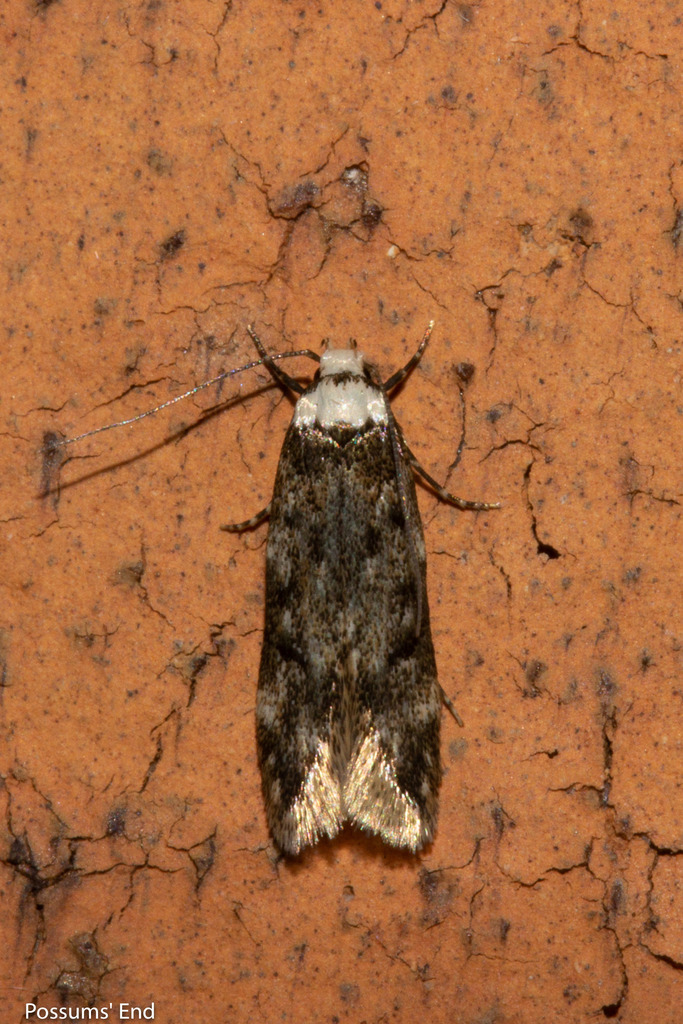
(c) Possums' End, some rights reserved (CC BY) · licence
Family: Oecophoridae · Class: Insecta · Order: Lepidoptera
Endrosis sarcitrella (White-shouldered House Moth) is a California animal in the Oecophoridae family.
The White-shouldered House Moth (Endrosis sarcitrella) is a small cosmopolitan moth in the family Oecophoridae. Adults measure 8-14 mm in wingspan, with forewings displaying a distinctive mottled pattern of brown, gray, and cream scales. The common name derives from the prominent white or pale yellow patches on the forewings that create a shoulder-like appearance when the wings are folded at rest. The hindwings are pale gray to whitish with long fringes. Adults have thread-like antennae and a wingspan that rarely exceeds 15 mm. This species has a nearly worldwide distribution, occurring across Europe, North America, Australia, and parts of Asia and Africa. In California, Endrosis sarcitrella is widespread throughout the state, from coastal regions to inland valleys and mountainous areas. The species likely arrived in North America through human commerce and has become thoroughly established across diverse climatic zones. It occurs from sea level to moderate elevations, adapting to both urban and rural environments. The White-shouldered House Moth inhabits a wide range of environments but shows a strong association with human-modified habitats. Adults are commonly found in and around buildings, warehouses, granaries, and residential structures. The species thrives in environments where organic matter accumulates, including attics, basements, storage areas, and areas with poor sanitation. Outdoors, they may be found in bird nests, animal burrows, and areas with decaying organic material. The moth tolerates a broad range of temperatures and humidity levels, contributing to its successful establishment across diverse geographic regions. Endrosis sarcitrella exhibits multiple overlapping generations per year, with continuous breeding possible in heated indoor environments. Females deposit eggs singly or in small clusters on or near food sources. Larvae are scavenging detritivores, feeding on a diverse array of organic materials including dead insects, feathers, hair, wool, dried plant material, stored grain products, and various household organic debris. The larval stage can extend from several weeks to several months depending on temperature and food availability. Pupation occurs within a silken cocoon, often in crevices or protected locations. Adults are primarily nocturnal and are attracted to artificial lights. The species demonstrates high adaptability in its feeding habits, allowing populations to persist in varied environments with different food resources available. Endrosis sarcitrella is not listed under any federal or state conservation programs and is not considered a species of conservation concern. As a cosmopolitan species well-adapted to human environments, populations appear stable throughout its range. In fact, the moth is often considered a minor household pest rather than a conservation priority. Its ability to exploit human-created environments and diverse food sources suggests that climate change and urbanization are unlikely to negatively impact this species. The White-shouldered House Moth serves as an example of a successful synanthropic species that has benefited from human activities and global commerce, establishing self-sustaining populations far beyond its likely native range.
Classification
Class: Insecta · Order: Lepidoptera · Family: Oecophoridae
Frequently asked questions
How is Endrosis sarcitrella classified?
Endrosis sarcitrella belongs to class Insecta, order Lepidoptera, family Oecophoridae.
What family does Endrosis sarcitrella belong to?
Endrosis sarcitrella is in the Oecophoridae family.
What is Endrosis sarcitrella?
The White-shouldered House Moth (Endrosis sarcitrella) is a small cosmopolitan moth in the family Oecophoridae.
Is Endrosis sarcitrella found in California?
Yes. Endrosis sarcitrella is recorded in California in The California Species Project's catalogue.
Related species
Other California species in the same genus, family, or bioregion.
Data from The California Species Project — 14,000+ California species with verified data from CNPS, CDFW, USFWS, and more.