Engraulis mordax
Northern Anchovy
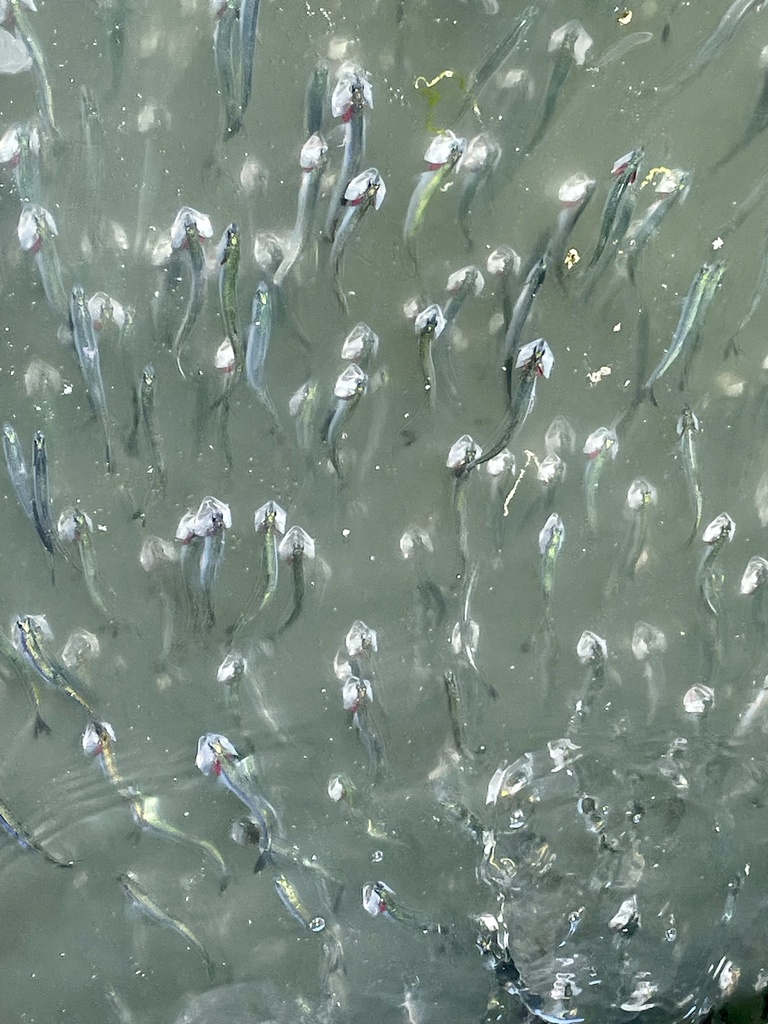
no rights reserved · CC0
Family: Engraulidae · Class: Actinopterygii · Order: Clupeiformes
Engraulis mordax (Northern Anchovy) is a California animal in the Engraulidae family.
The Northern anchovy is a slender, schooling fish measuring 10 to 25 centimeters (4 to 10 inches) in length, with a maximum recorded length of 30 centimeters (12 inches). The body is elongated and laterally compressed, with a silvery coloration and a distinctive protruding lower jaw. The species displays a characteristic overhanging snout that extends beyond the tip of the lower jaw, and large eyes positioned toward the front of the head. The dorsal fin is positioned near the middle of the back, while the anal fin is located posteriorly. Northern anchovy occur along the Pacific coast from British Columbia, Canada, to Baja California, Mexico. In California waters, the species is found from the Oregon border south to the Mexican border, inhabiting both nearshore and offshore areas. The population exhibits complex stock structure, with northern and central subpopulations centered off California that display different migration patterns and spawning behaviors. This pelagic species inhabits coastal and oceanic waters from the surface to depths of approximately 300 meters (984 feet). Northern anchovy prefer areas with water temperatures ranging from 13 to 26 degrees Celsius (55 to 79 degrees Fahrenheit) and are commonly found in upwelling zones where nutrient-rich waters support high plankton productivity. The species occurs in estuaries, bays, and open ocean environments, often forming dense schools in areas of high prey concentration. Northern anchovy are filter feeders that consume zooplankton, particularly copepods, euphausids, and larval fish. Schools typically feed near the surface during nighttime hours and move to deeper waters during daylight. Spawning occurs year-round with peak activity from February through September, varying by latitude and water temperature. Females release pelagic eggs that hatch within 2 to 7 days depending on water temperature. Juveniles reach sexual maturity at approximately one year of age and 10 to 12 centimeters (4 to 5 inches) in length. The species has a relatively short lifespan of 2 to 4 years. Northern anchovy serve as a critical forage species in Pacific coast marine ecosystems, supporting numerous predator species including seabirds, marine mammals, and larger fish. The species is an important commercial fishery resource and constitutes prey for white seabass, California sea lions, and various seabird species. Population abundance fluctuates dramatically in response to oceanographic conditions, particularly El Niño and La Niña events, with warm water periods typically associated with population declines. Commercial fishing is managed through the Pacific Fishery Management Council's Coastal Pelagic Species Fishery Management Plan, which sets annual catch limits based on stock assessments. The species is not currently listed under state or federal endangered species legislation, reflecting its generally stable population status despite natural fluctuations.
Classification
Class: Actinopterygii · Order: Clupeiformes · Family: Engraulidae
Frequently asked questions
How is Engraulis mordax classified?
Engraulis mordax belongs to class Actinopterygii, order Clupeiformes, family Engraulidae.
What family does Engraulis mordax belong to?
Engraulis mordax is in the Engraulidae family.
What is Engraulis mordax?
The Northern anchovy is a slender, schooling fish measuring 10 to 25 centimeters (4 to 10 inches) in length, with a maximum recorded length of 30 centimeters (12 inches).
Is Engraulis mordax found in California?
Yes. Engraulis mordax is recorded in California in The California Species Project's catalogue.
More California species
This species has no close relatives in our California data — here are other species to explore.
Data from The California Species Project — 14,000+ California species with verified data from CNPS, CDFW, USFWS, and more.