Enhydra lutris nereis
Southern sea otter
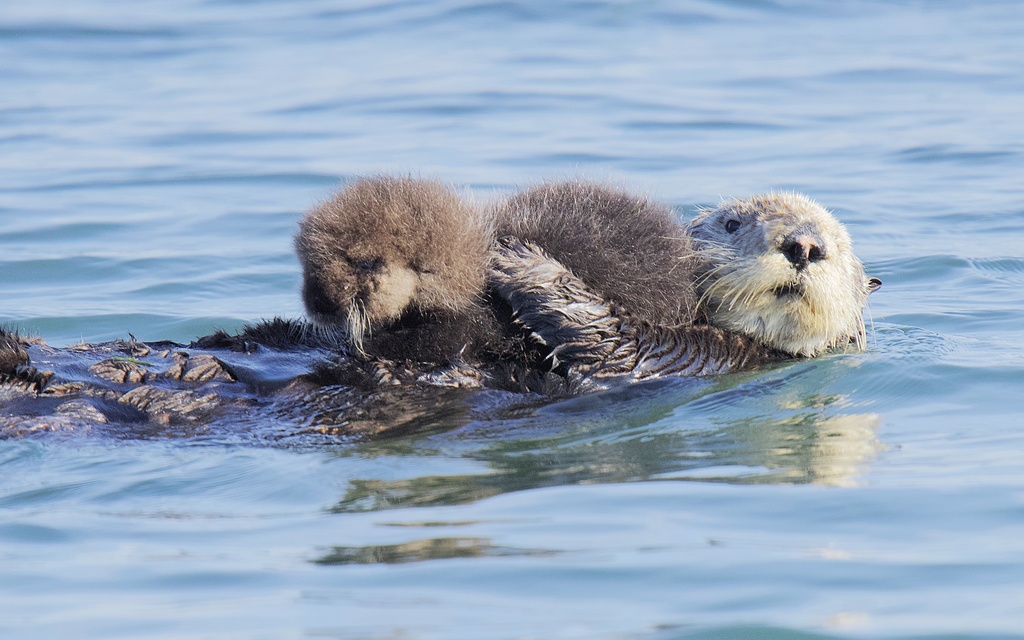
(c) benjchristensen, some rights reserved (CC BY) · licence
Family: Mustelidae · Class: Mammalia · Order: Carnivora
Conservation status: FP · Threatened · G4T2 S3
Enhydra lutris nereis (Southern sea otter) is a California animal in the Mustelidae family.
The southern sea otter is a marine mammal measuring 1.2 to 1.5 meters (4 to 5 feet) in length and weighing 14 to 45 kilograms (31 to 99 pounds), with males significantly larger than females. The dense fur coat consists of dark brown to reddish-brown guard hairs overlying a lighter undercoat, with older individuals often displaying grizzled or silvered heads. The streamlined body features webbed hind feet, small forefeet with retractable claws, and a flattened tail that serves as a rudder during swimming. Currently restricted to the central California coast, southern sea otters range from San Mateo County in the north to Santa Barbara County in the south, occupying approximately 13 percent of their historical range (USFWS 2015). Prior to the fur trade, this subspecies ranged from Oregon south to Baja California, Mexico. The population declined to near extinction by the early 1900s, surviving only in a small area near Bixby Creek in Monterey County. A translocated population exists at San Nicolas Island, established through USFWS efforts beginning in 1987. Southern sea otters inhabit nearshore marine waters, typically foraging in depths of 3 to 20 meters (10 to 66 feet), with peak abundance occurring at 5 meters (16 feet) depth (Tinker et al. 2021). They prefer rocky substrates and kelp forest ecosystems but also utilize sandy bottom areas. The species demonstrates strong site fidelity, with individuals maintaining relatively small home ranges along the coast. As the only fully marine member of the weasel family, southern sea otters are specialized for aquatic life. They are opportunistic foragers, diving to capture invertebrate prey including sea urchins, abalone, crabs, clams, and mussels. Tool use is common, with otters employing rocks to break open hard-shelled prey while floating on their backs. Females give birth to single pups after a gestation period of approximately 6 months, with pups remaining dependent for 5 to 6 months. Reproduction occurs year-round, though peak pupping occurs in spring and early summer. Listed as threatened under the Endangered Species Act since 1977, the southern sea otter population has recovered slowly from near extinction. Current population estimates indicate approximately 3,000 individuals (USFWS 2023). The species faces ongoing threats including white shark predation, which has halted range expansion for over 20 years, particularly at the northern and southern range boundaries. Additional threats include oil spills, disease, entanglement in fishing gear, and climate change impacts on prey availability. Recovery efforts focus on reducing human-caused mortality, habitat protection, and potential reintroduction programs. The estimated carrying capacity for California waters is 17,226 otters, indicating substantial recovery potential (Tinker et al. 2021).
Classification
Class: Mammalia · Order: Carnivora · Family: Mustelidae
Conservation status
FP · Threatened · G4T2 S3
Frequently asked questions
How is Enhydra lutris nereis classified?
Enhydra lutris nereis belongs to class Mammalia, order Carnivora, family Mustelidae.
What family does Enhydra lutris nereis belong to?
Enhydra lutris nereis is in the Mustelidae family.
Is Enhydra lutris nereis protected or of conservation concern?
Enhydra lutris nereis carries the following status: FP · Threatened · G4T2 S3.
What is Enhydra lutris nereis?
The southern sea otter is a marine mammal measuring 1.2 to 1.5 meters (4 to 5 feet) in length and weighing 14 to 45 kilograms (31 to 99 pounds), with males significantly larger than females.
Is Enhydra lutris nereis found in California?
Yes. Enhydra lutris nereis is recorded in California in The California Species Project's catalogue.
Related species
Other California species in the same genus, family, or bioregion.
Data from The California Species Project — 14,000+ California species with verified data from CNPS, CDFW, USFWS, and more.