Ensatina eschscholtzii
Ensatina
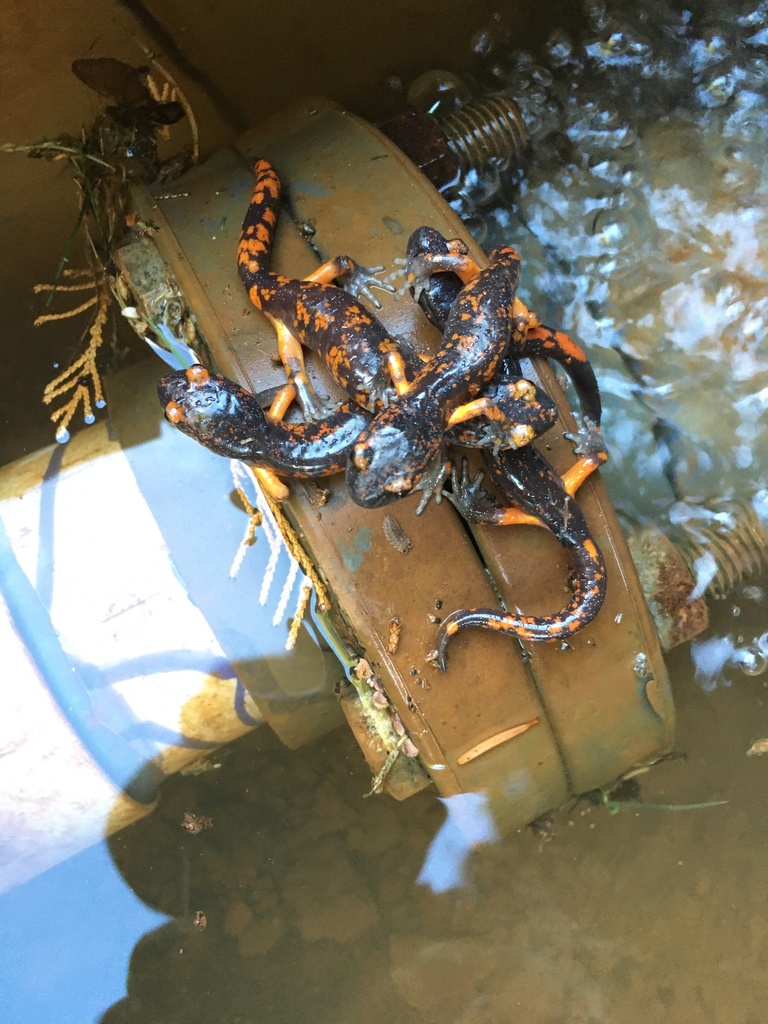
(c) rickr, some rights reserved (CC BY) · licence
Family: Plethodontidae · Class: Amphibia · Order: Caudata
Ensatina eschscholtzii (Ensatina) is a California animal in the Plethodontidae family.
The Ensatina is a medium-sized terrestrial salamander native to the Pacific Coast of North America. Adults typically measure 75 to 150 mm (3 to 6 inches) in total length, with a robust body and relatively short legs. The species exhibits considerable morphological variation across its range, with coloration ranging from uniform brown or gray to patterns of yellow, orange, or red blotches on a darker background. The tail is constricted at the base and lacks the groove found in many other plethodontid salamanders. Ensatinas possess the characteristic nasolabial grooves of lungless salamanders, extending from the nostrils to the upper lip. Ensatina eschscholtzii occurs along the Pacific Coast from British Columbia south through California to Baja California, Mexico. In California, the species is widely distributed in forested regions of the Coast Ranges, Sierra Nevada, and Transverse Ranges. Seven subspecies are recognized, forming a ring distribution around California's Central Valley. According to genetic studies, populations show evidence of reproductive isolation at contact zones, particularly between the coastal and inland forms in Southern California. The species inhabits coniferous and mixed forests from sea level to approximately 2,100 meters (6,900 feet) elevation. Ensatinas require cool, moist microhabitats and are commonly found under logs, rocks, bark, and leaf litter in Douglas fir, redwood, pine, and oak woodlands. They prefer areas with dense canopy cover that maintain consistent moisture levels. During dry periods, individuals retreat to underground refugia, including rodent burrows and natural crevices. Ensatinas are primarily nocturnal and surface-active during periods of high humidity, particularly following rainfall. Adults are terrestrial throughout their life cycle, with no aquatic larval stage. Females deposit clusters of 8 to 25 large, unpigmented eggs in underground chambers or beneath logs during fall and winter months. Eggs undergo direct development over 4 to 6 months, with juveniles emerging as miniature adults. The species exhibits territorial behavior, with adults defending small home ranges. Diet consists primarily of small invertebrates, including beetles, ants, spiders, and springtails, captured using a projectile tongue. Ensatina eschscholtzii is not currently listed under federal or state endangered species acts. However, populations face threats from habitat fragmentation due to urban development, particularly in coastal California. Climate change poses additional risks through altered precipitation patterns and increased temperatures, which may reduce suitable habitat. Logging practices that remove coarse woody debris and reduce canopy cover can degrade habitat quality. Recent surveys indicate that populations in the San Francisco Bay Area have experienced local extirpations due to urbanization, while some montane populations show signs of upslope range shifts in response to warming temperatures. The species serves as an indicator of forest ecosystem health and has been the subject of extensive evolutionary research due to its ring species complex. Population trends vary regionally, with some coastal populations experiencing decline while interior montane populations appear stable.
Classification
Class: Amphibia · Order: Caudata · Family: Plethodontidae
Frequently asked questions
How is Ensatina eschscholtzii classified?
Ensatina eschscholtzii belongs to class Amphibia, order Caudata, family Plethodontidae.
What family does Ensatina eschscholtzii belong to?
Ensatina eschscholtzii is in the Plethodontidae family.
What is Ensatina eschscholtzii?
The Ensatina is a medium-sized terrestrial salamander native to the Pacific Coast of North America.
Is Ensatina eschscholtzii found in California?
Yes. Ensatina eschscholtzii is recorded in California in The California Species Project's catalogue.
Related species
Other California species in the same genus, family, or bioregion.
Data from The California Species Project — 14,000+ California species with verified data from CNPS, CDFW, USFWS, and more.