Entosphenus folletti
Northern California brook lamprey
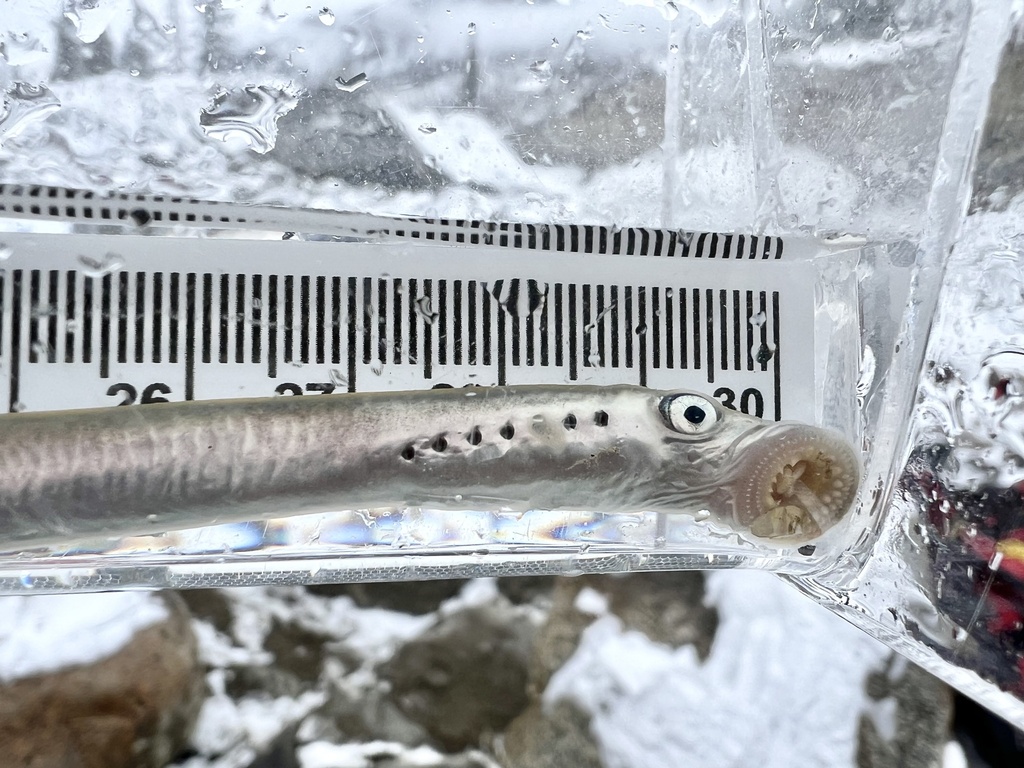
(c) Jason Alexander, some rights reserved (CC BY) · licence
Family: Petromyzontidae · Class: Petromyzontida · Order: Petromyzontiformes
Conservation status: G1G2Q S1S2
Entosphenus folletti (Northern California brook lamprey) is a California animal in the Petromyzontidae family.
The Northern California brook lamprey (Entosphenus folletti) is a small, eel-like fish native to coastal watersheds of Northern California. Adults typically measure 150 to 200 mm (5.9 to 7.9 inches) in total length, with a slender, cylindrical body that lacks paired fins and scales. The species displays a mottled brown to olive-green coloration on the dorsal surface, fading to yellow or cream on the ventral side. The oral disc is relatively small and circular, lacking the rasping teeth characteristic of parasitic lampreys, as this species is non-parasitic throughout its life cycle. The Northern California brook lamprey occurs in a limited range along the Pacific coast from Humboldt County south to Sonoma County, California. The species is found in several coastal drainages including the Russian River system, tributaries to San Francisco Bay, and smaller coastal streams. Its distribution is highly fragmented, with populations isolated in individual watersheds. According to NatureServe, the species' range has contracted significantly from historical levels due to habitat modifications and water diversions. This lamprey inhabits cool, clear streams and creeks with gravel and cobble substrates. Adults are typically found in areas with moderate to swift current and well-oxygenated water. The species requires specific substrate conditions for successful reproduction, preferring areas with clean gravel beds for nest construction. Stream temperatures generally remain below 20°C (68°F) in occupied habitats. The larvae, called ammocoetes, burrow into fine sediments in quiet backwaters and stream margins where organic matter accumulates. Northern California brook lampreys exhibit a complex life cycle typical of non-parasitic lampreys. Adults spawn in spring, typically from March through May, constructing shallow nests in gravel riffles. Females deposit between 1,000 and 2,000 small eggs, which are fertilized externally by males. After spawning, adults die within days to weeks. The larval stage lasts approximately four to seven years, during which ammocoetes filter-feed on organic detritus, algae, and microorganisms in stream sediments. Metamorphosis occurs in late summer or fall, when larvae transform into adults that do not feed and live only long enough to reproduce the following spring. The Northern California brook lamprey is considered imperiled, with a global rank of G1G2Q, indicating the species is critically imperiled to imperiled globally, with the 'Q' denoting taxonomic uncertainty. In California, it receives a state rank of S1S2, reflecting critical imperilment to imperilment at the state level. The species faces multiple threats including habitat degradation from logging, agricultural practices, and urban development. Water diversions and dam construction have fragmented populations and altered natural flow regimes. Sedimentation from erosion degrades spawning gravels and larval habitat. Climate change poses additional risks through altered precipitation patterns and increased stream temperatures. Currently, no specific recovery programs target this species, though some populations may benefit from broader watershed restoration efforts.
Classification
Class: Petromyzontida · Order: Petromyzontiformes · Family: Petromyzontidae
Conservation status
G1G2Q S1S2
Frequently asked questions
How is Entosphenus folletti classified?
Entosphenus folletti belongs to class Petromyzontida, order Petromyzontiformes, family Petromyzontidae.
What family does Entosphenus folletti belong to?
Entosphenus folletti is in the Petromyzontidae family.
Is Entosphenus folletti protected or of conservation concern?
Entosphenus folletti carries the following status: G1G2Q S1S2.
What is Entosphenus folletti?
The Northern California brook lamprey (Entosphenus folletti) is a small, eel-like fish native to coastal watersheds of Northern California.
Is Entosphenus folletti found in California?
Yes. Entosphenus folletti is recorded in California in The California Species Project's catalogue.
Related species
Other California species in the same genus, family, or bioregion.
Data from The California Species Project — 14,000+ California species with verified data from CNPS, CDFW, USFWS, and more.