Entosphenus lethophagus
Pit-Klamath brook lamprey
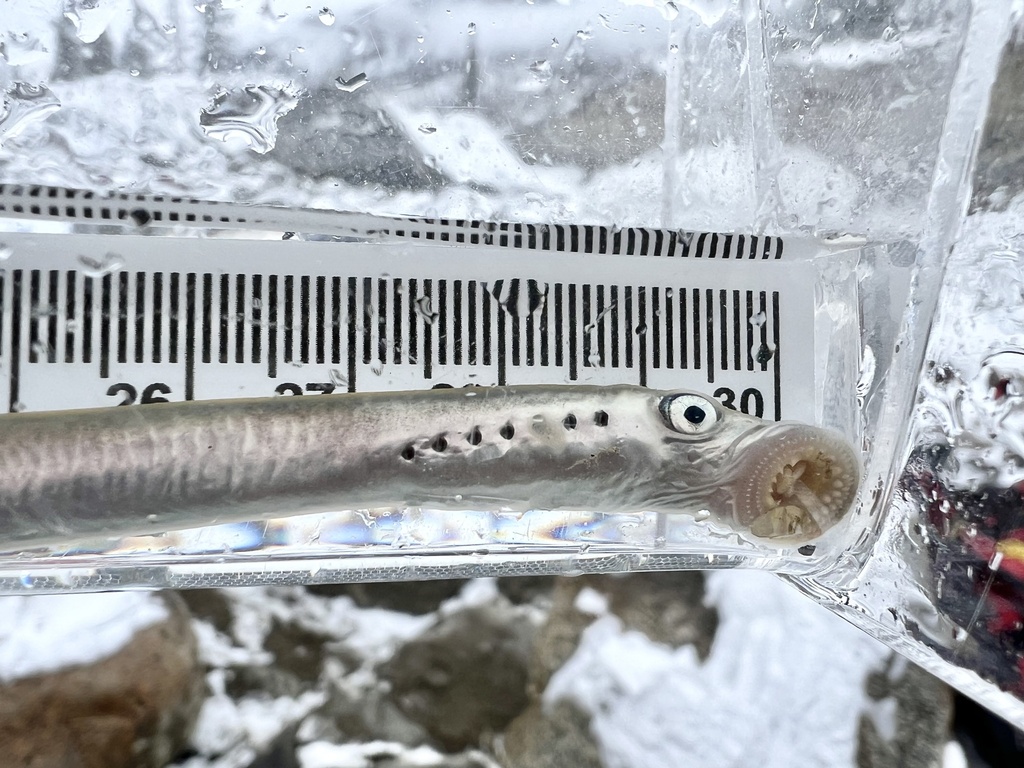
(c) Jason Alexander, some rights reserved (CC BY) · licence
Family: Petromyzontidae · Class: Petromyzontida · Order: Petromyzontiformes
Conservation status: G3G4 S3
Entosphenus lethophagus (Pit-Klamath brook lamprey) is a California animal in the Petromyzontidae family.
The Pit-Klamath brook lamprey (Entosphenus lethophagus) is a non-parasitic freshwater lamprey species endemic to the Pacific Northwest. Adults typically measure 130 to 180 mm (5.1 to 7.1 inches) in total length. The body is elongated and eel-like with smooth, scaleless skin ranging from olive-brown to dark gray dorsally, fading to yellow or cream ventrally. The circular, suction-cup mouth lacks teeth in adults, distinguishing it from parasitic lamprey species. Seven paired gill openings are present behind the head, and the species possesses two separate dorsal fins. The species occurs in the Pit River system in northeastern California and the Klamath River basin in Oregon and California. In California, populations are documented in Shasta, Lassen, and Siskiyou counties. The range includes tributaries of the Pit River such as Hat Creek, Fall River, and Burney Creek, as well as portions of the upper Klamath River watershed including the Sprague and Williamson rivers in Oregon. Pit-Klamath brook lampreys inhabit cool, clear streams and rivers with gravel and cobble substrates. Adults are found in areas with moderate to swift current and high dissolved oxygen levels. Water temperatures in occupied habitats typically remain below 20°C (68°F) during summer months. The species requires clean gravel beds for spawning and fine sediments for larval development. Elevation ranges from approximately 600 to 1,500 meters (1,970 to 4,920 feet). This species exhibits a complex life cycle typical of lampreys. Adults spawn in spring, constructing nests in gravel substrates where females deposit up to 2,000 eggs. After spawning, adults die. Larvae, called ammocoetes, burrow into fine sediments where they remain for 3 to 7 years, filter-feeding on algae, detritus, and microorganisms. During metamorphosis, the larval oral hood transforms into the adult suction disc, and the digestive tract degenerates. Newly transformed adults do not feed and typically live only 6 to 12 months before reaching sexual maturity and spawning. The Pit-Klamath brook lamprey is assigned a global rank of G3G4 (vulnerable to apparently secure) and a state rank of S3 (vulnerable) in California. While not federally listed, the species faces threats from habitat degradation, altered flow regimes due to water diversions and dam operations, sedimentation from logging and agricultural practices, and elevated water temperatures. Climate change may exacerbate thermal stress in already marginal habitats. Water quality degradation from agricultural runoff and urban development poses additional risks. Conservation efforts focus on maintaining instream flows, reducing sedimentation, and preserving cool water temperatures in spawning and rearing areas. The species serves as an indicator of ecosystem health in Pacific Northwest watersheds.
Classification
Class: Petromyzontida · Order: Petromyzontiformes · Family: Petromyzontidae
Conservation status
G3G4 S3
Frequently asked questions
How is Entosphenus lethophagus classified?
Entosphenus lethophagus belongs to class Petromyzontida, order Petromyzontiformes, family Petromyzontidae.
What family does Entosphenus lethophagus belong to?
Entosphenus lethophagus is in the Petromyzontidae family.
Is Entosphenus lethophagus protected or of conservation concern?
Entosphenus lethophagus carries the following status: G3G4 S3.
What is Entosphenus lethophagus?
The Pit-Klamath brook lamprey (Entosphenus lethophagus) is a non-parasitic freshwater lamprey species endemic to the Pacific Northwest.
Is Entosphenus lethophagus found in California?
Yes. Entosphenus lethophagus is recorded in California in The California Species Project's catalogue.
Related species
Other California species in the same genus, family, or bioregion.
Data from The California Species Project — 14,000+ California species with verified data from CNPS, CDFW, USFWS, and more.