Entosphenus tridentatus
Pacific Lamprey
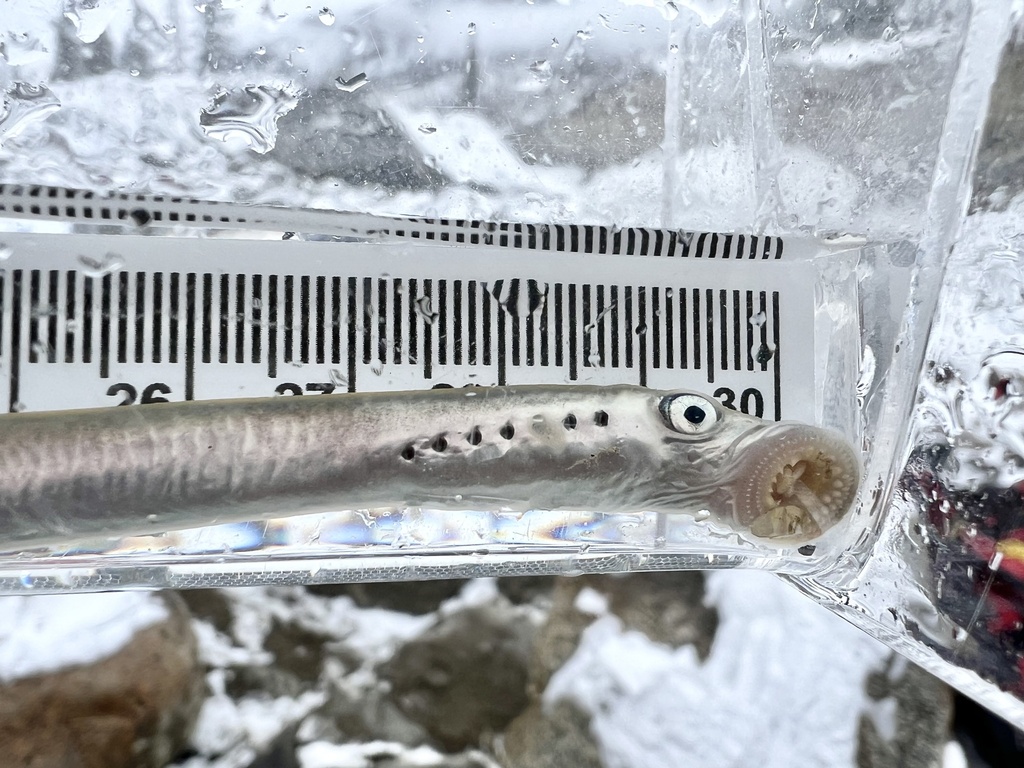
(c) Jason Alexander, some rights reserved (CC BY) · licence
Family: Petromyzontidae · Class: Petromyzontida · Order: Petromyzontiformes
Conservation status: G4 S4
Entosphenus tridentatus (Pacific Lamprey) is a California animal in the Petromyzontidae family.
The Pacific lamprey (Entosphenus tridentatus) is an anadromous jawless fish that represents one of the most ancient vertebrate lineages. Adults measure 380 to 760 mm (15 to 30 inches) in total length and weigh 113 to 680 grams (0.25 to 1.5 pounds). The elongated, eel-like body lacks paired fins and scales, with a smooth, mucus-covered skin ranging from blue-black to brown dorsally and pale yellow-white ventrally. The distinctive oral disc contains rows of rasping teeth arranged in concentric circles, with the species' namesake three-pointed teeth visible on the supraoral plate. Seven external gill openings are present on each side of the head, posterior to the eyes. Pacific lamprey historically ranged throughout the North Pacific rim from Japan to Baja California, Mexico. In California, the species occurs in coastal watersheds from the Klamath River system south to Ventura County. Major populations persist in the Sacramento-San Joaquin River system, Russian River, Eel River, and other coastal drainages. The species has experienced significant range contraction, with extirpations documented in many southern California watersheds where dams and water diversions have blocked migration routes. Adult Pacific lamprey spawn in gravel beds of freshwater streams and rivers, typically in areas with moderate to swift current and water temperatures below 18°C (64°F). Larvae, called ammocoetes, burrow into fine sediments downstream of spawning areas, filtering organic matter from the water column. These juvenile habitats require stable substrates of sand, silt, and detritus with adequate organic content. Adults tolerate marine salinities during their parasitic phase in the ocean. The Pacific lamprey exhibits a complex life cycle spanning 7 to 8 years. Ammocoetes remain in freshwater sediments for 3 to 7 years, growing to 120 to 170 mm before metamorphosing into juveniles. Post-metamorphic juveniles migrate to the ocean where they parasitize large fish including salmon, sharks, and marine mammals by attaching with their oral disc and feeding on body fluids. After 1 to 3 years in marine waters, sexually mature adults return to freshwater to spawn from late winter through early summer. Adults cease feeding upon entering freshwater and die after spawning, contributing nutrients to stream ecosystems. Pacific lamprey populations have declined substantially throughout their range due to dam construction, habitat degradation, water diversions, and pollution. The species is not federally listed but is considered a species of special concern by various agencies. In California, populations face threats from altered flow regimes, sedimentation, and passage barriers. Climate change poses additional challenges through warming water temperatures and altered precipitation patterns. Tribal nations throughout the Pacific Northwest consider Pacific lamprey culturally significant, leading to collaborative restoration efforts including dam removal, habitat restoration, and artificial propagation programs to support population recovery.
Classification
Class: Petromyzontida · Order: Petromyzontiformes · Family: Petromyzontidae
Conservation status
G4 S4
Frequently asked questions
How is Entosphenus tridentatus classified?
Entosphenus tridentatus belongs to class Petromyzontida, order Petromyzontiformes, family Petromyzontidae.
What family does Entosphenus tridentatus belong to?
Entosphenus tridentatus is in the Petromyzontidae family.
Is Entosphenus tridentatus protected or of conservation concern?
Entosphenus tridentatus carries the following status: G4 S4.
What is Entosphenus tridentatus?
The Pacific lamprey (Entosphenus tridentatus) is an anadromous jawless fish that represents one of the most ancient vertebrate lineages.
Is Entosphenus tridentatus found in California?
Yes. Entosphenus tridentatus is recorded in California in The California Species Project's catalogue.
Related species
Other California species in the same genus, family, or bioregion.
Data from The California Species Project — 14,000+ California species with verified data from CNPS, CDFW, USFWS, and more.