Entosphenus tridentatus ssp. 1
Coastal Pacific lamprey
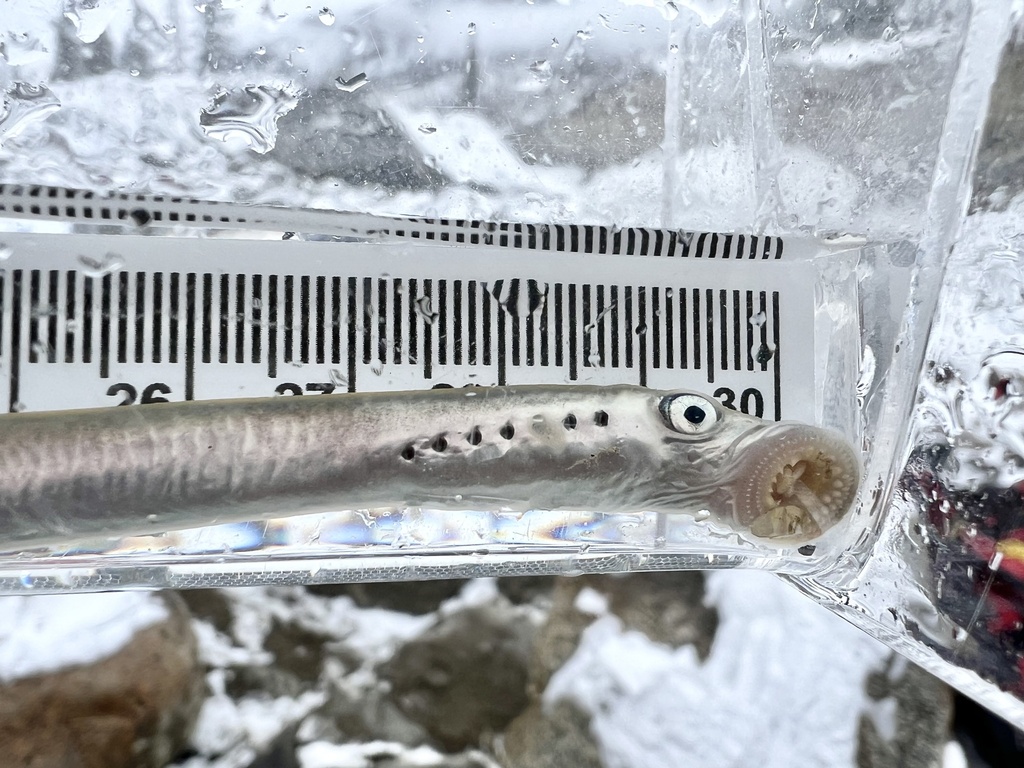
(c) Jason Alexander, some rights reserved (CC BY) · licence
Family: Petromyzontidae · Class: Petromyzontida · Order: Petromyzontiformes
Conservation status: G4T1 S1
Entosphenus tridentatus ssp. 1 (Coastal Pacific lamprey) is a California animal in the Petromyzontidae family.
The coastal Pacific lamprey (Entosphenus tridentatus ssp. 1) is a subspecies of the Pacific lamprey that represents one of the most imperiled lamprey taxa on the Pacific coast. Adults typically measure 1.5 to 2.5 feet (46 to 76 cm) in length with an eel-like, elongated body form characteristic of all lampreys (USFWS 2024). The species lacks paired fins and jaws, instead possessing a circular, suction-cup mouth lined with rows of rasping teeth. The body is cylindrical and scaleless, with seven gill openings on each side of the head. Historically, coastal Pacific lamprey likely occurred in coastal drainages from California north to Alaska, but current distribution is severely restricted. This subspecies is distinguished from other Pacific lamprey populations by genetic and morphological characteristics, though detailed taxonomic studies remain limited. The subspecies' current range and population status are poorly documented, contributing to its critically imperiled conservation ranking. Coastal Pacific lamprey utilize both freshwater and marine environments during their complex life cycle. Like other anadromous lampreys, they spawn in gravel-bottomed freshwater streams, typically in riffle habitats similar to those used by Pacific salmon (USFWS 2024). Larvae, known as ammocoetes, burrow into fine sediments in quiet backwater areas where they filter-feed on organic matter and algae for several years before metamorphosing into juveniles that migrate to the ocean. The species exhibits a parasitic marine phase lasting one to three years, during which juveniles attach to various host fish including Pacific salmon, flatfish, rockfish, and pollock using their circular mouth (USFWS 2024). Adult lampreys cease feeding upon returning to freshwater between February and June to spawn. Spawning involves nest construction in gravel substrates, with adults dying shortly after reproduction, providing nutrients to freshwater ecosystems. Coastal Pacific lamprey face severe conservation challenges reflected in their Global/State rank of G4T1 S1, indicating they are critically imperiled in California with five or fewer occurrences statewide. Primary threats include habitat loss and fragmentation, dam construction that blocks migration routes, water diversions, pollution, and sedimentation of spawning gravels. Climate change may further impact the species through altered stream flows and temperature regimes. The subspecies lacks federal protection under the Endangered Species Act, despite petitions for listing consideration. However, Pacific lamprey conservation efforts are underway through the Pacific Lamprey Conservation Initiative, a collaborative partnership between Native American tribes and natural resource agencies working across California, Oregon, Washington, Idaho, and Alaska (USFWS 2024). This initiative recognizes the cultural importance of lampreys to Pacific coast tribes and the species' ecological role in both freshwater and marine ecosystems. Given the critically low population status and ongoing threats, coastal Pacific lamprey represents one of California's most endangered aquatic species requiring immediate conservation attention.
Classification
Class: Petromyzontida · Order: Petromyzontiformes · Family: Petromyzontidae
Conservation status
G4T1 S1
Frequently asked questions
How is Entosphenus tridentatus ssp. 1 classified?
Entosphenus tridentatus ssp. 1 belongs to class Petromyzontida, order Petromyzontiformes, family Petromyzontidae.
What family does Entosphenus tridentatus ssp. 1 belong to?
Entosphenus tridentatus ssp. 1 is in the Petromyzontidae family.
Is Entosphenus tridentatus ssp. 1 protected or of conservation concern?
Entosphenus tridentatus ssp. 1 carries the following status: G4T1 S1.
What is Entosphenus tridentatus ssp. 1?
The coastal Pacific lamprey (Entosphenus tridentatus ssp.
Is Entosphenus tridentatus ssp. 1 found in California?
Yes. Entosphenus tridentatus ssp. 1 is recorded in California in The California Species Project's catalogue.
Related species
Other California species in the same genus, family, or bioregion.
Data from The California Species Project — 14,000+ California species with verified data from CNPS, CDFW, USFWS, and more.